Controlling powdery mildew this season has been a challenge for wine grape growers like Scott Abraham and his brothers. They’ve been applying sulfur every week to keep mildew at bay.
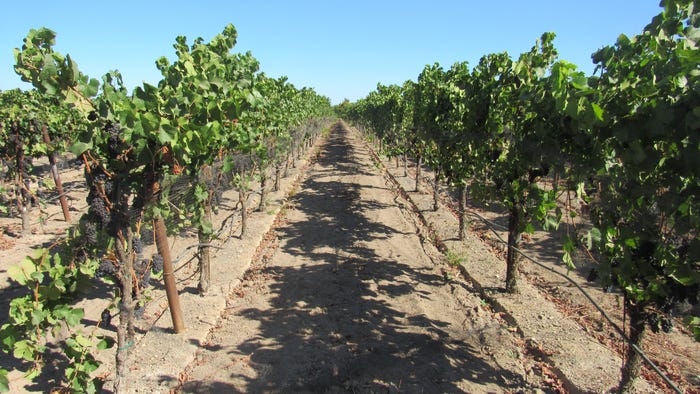
The Abraham Brothers vineyards in Merced County near Livingston, Calif., include 40 acres of French Colombard and 20 acres of Syrah grapes.
The cool, wet spring forced the Abrahams to tighten their sulfuring schedule, changing from their normal practice of treating vines every 10 days to once a week.
It has been worth the extra expense, Scott says, especially as thermometer readings began climbing in June.
“Mildew control becomes more challenging once the heat and humidity start to rise,” he says. “We’ll keep on this seven-day dusting schedule until daytime temperatures start staying at 100 degrees or above. We’re really watching for the disease and our fieldmen are checking vineyards twice a week to stay on top of things. We may even throw in an extra sulfur dusting, if needed, because we can’t afford to lose a crop.”
Scott and his brothers made their first mildew treatment in late March, spraying vines with wettable sulfur when the new shoots were 3 inches long. They followed with two more sprays, each when shoots had grown another three inches. In the first week of April, seven days after the last spray, they went back and started dusting vines once a week.
They apply sulfur at the rate of 10 pounds per acre, treating every other row versus an every-other-row regime that some growers practice. However, they treat every row following a rain storm.
They started furrow irrigating the 40-year-old French Colombard vines the last week of May, using district water. But, they didn’t turn on the well water drip system for the Syrah blocks until a mid-June hot spell. The Syrah is grafted to fast-growing Freedom rootstock.
“One of our biggest problems is getting growth to slow down,” Scott says. “The vigorous growth makes it hard to get in with our equipment to apply sulfur.”
The set looks good and the vines are developing on their normal schedule by the calendar, he says. A bunch count this month will give a better idea of tonnage.
They have been few problems with insects. “We may get some mite pressure along a roadway we share with other growers and where we get dust from vehicle traffic,” he says.
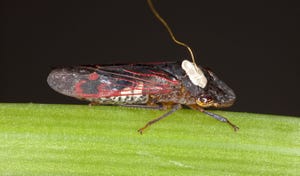
“Leafhoppers can be a problem, but they’re more of a nuisance for the tractor drivers and harvesting crews than anything. So we treat the vineyards every other year just before harvest. A single application pretty much knocks out that cycle of the insect and provides good control through the next growing season.”
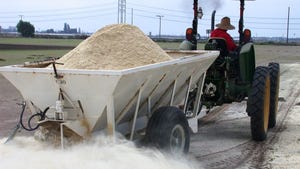
Because of its strong growth habit, the Abrahams’ Syrah requires little added nitrogen. But, for the past six years they have been applying it to their French Colombard in the form of chicken litter; each December, prior to pruning, they disk in 10 tons per. This natural material replaces the CAN17 or UN32 that they had been using.
“We wanted to move away from commercial fertilizers and improve organic matter levels, using chicken litter to help hold more water in the soil,” Scott says.
“We were already disking the French Colombard vineyard regularly to control weeds, so we use that operation to incorporate the manure. We like this program — it has really improved the vines, and it’s also helping to increase water-holding capacity of the sandy loam soils.”
The narrow row spacing doesn’t allow them to work chicken litter into the soils in their Syrah blocks. There, they apply either CAN17 or UN32 at the rate of about 30 to 40 gallons per acre, once or twice a season, depending on crop size.
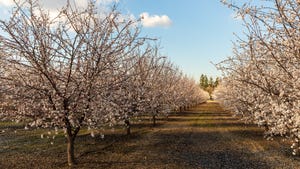
The price of chicken litter increased this past year, but fuel costs have shot up much more. To offset that, the Abrahams are reducing the number of tractor trips through vineyards, as well as their almond orchards.
“Our fields are a bit weedier than we’d normally like,” Scott says. “Instead of every two weeks, we’re mowing every 20 days. That saves on fuel as well as labor.”