What is in this article?:
- Arizona Veg IPM: insect and weeds, powdery mildew, herbicide applications
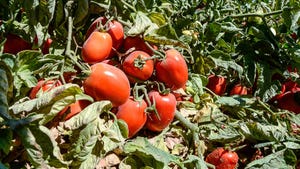
- Managing powdery mildew on melons
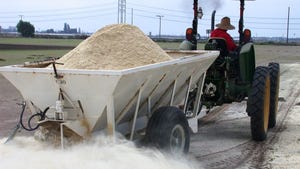
- Band applications of herbicides
- Effective weed management is critical for the profitable production of vegetable crops in the desert southwest. However, weed management is also essential for another important but often overlooked reason.
- Maximum control of powdery mildew on melons requires initiation of a fungicide application program when environmental conditions favor disease development but before the first visible detection of disease.
- Band applications of herbicides are less common than band applications of insecticides since weeds need to be controlled in the entire field; not just in or on the plant area.
More About:

Managing powdery mildew on melons
By Mike Matheron, UA Extension Plant Pathologist
Maximum control of powdery mildew on melons requires initiation of a fungicide application program when environmental conditions favor disease development but before the first visible detection of disease. Less than optimal but good levels of disease control can also be achieved by waiting to begin fungicide application until no later than the very first sign of disease in the field.
Early initiation of fungicide treatment on susceptible melon varieties is essential due to the rapid development and spread of powdery mildew from initial invisible infection sites within the crop. Application of a newly registered active ingredient usually is effective on virtually all of the individual pathogen spores or colonies developing from spores.
However, the very small number of individuals not killed or inhibited by the fungicide will become an increasingly larger proportion of the pathogen population as the use of the same active ingredient increases. This is how resistance to a particular fungicide becomes established.
The melon powdery mildew fungus Podosphaera xanthii has developed significant resistance to some fungicides in the past. An important strategy to delay development of fungicide resistance is to alternate among or mix products with different modes of action.
Previous research demonstrated that fungicide application sequences, containing a highly efficacious fungicide alternated with a product of moderate to low efficacy, provided a final level of disease control equivalent to that achieved by continuous application of the highly effective material.
Data from these trials support the notion that high levels of disease control and resistance management can be realized with fungicide alternation programs containing different modes of action of only highly effective chemistries as well as application programs incorporating products with high efficacy along with those of moderate and low effectiveness.
The most recently completed cantaloupe powdery mildew fungicide evaluation trial in 2011 reveals the relative efficacy against this disease of fungicides currently registered as well as those in development.
Click on this link to see the Comparison of fungicides for management of powdery mildew on muskmelon, 2011.
Contact Matheron: (928) 726-6856 or matheron@ag.arizona.edu.