Pests pose toughest challenge for Tulare County walnut grower

Despite some sunburn on his Tulares, walnut grower Tom Lang, Visalia, Calif., is pleased with the condition of his orchards this summer — this, following a good bloom and set in the spring.

To help protect profits by reducing pistillate flower abortion, he treated only his lowest-producing block of Serrs with a plant growth regulator.

Lang Farms, which formerly grew alfalfa, corn and cotton, now produces 1,400 acres of walnuts in various orchards throughout Tulare County. Chandler and Tulare account for most of the varieties, in addition to Serr, Ashley, Payne, Tehama and Vina. The trees range in age from 5 years to 40 years.

Lang works in partnership with his father, Gerald, who planted the farm’s first trees. Other nut crops include almonds and pecans.

As usual, Lang’s main concern this season has been controlling pests. “My biggest challenge is keeping bugs out of the orchards. I keep in close touch with my PCA, who monitors traps regularly.”

Codling moth, walnut husk fly and mites are his most pressing pest challenges. He chooses among four different insecticides for his coddling moth spray, which he usually applies three or four times during the season. The second week of August, he sprayed some of his walnuts with a codling moth treatment for the third and probably last time this season. He combined the chemical with a husk fly insecticide.

He also selects among several chemicals when spraying mites, typically once in June and again in July. Sometimes he tank mixes a miticide with his codling moth spray.

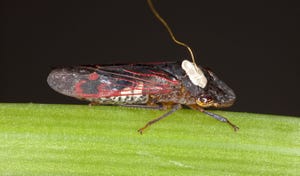
“In the last year or so, husk fly seems to be getting worse and is becoming big issue,” Lang says. “The later varieties, like Tulare and Chandler, seem to be more susceptible, but in the first week of August, we started finding the insect in our early varieties, such as Ashley, Payne and Serr. We’ll be checking traps two or three times a week, and base our spraying on the husk fly count.”

In an effort to limit production costs, Lang has begun doing more hedging and less pruning. “We’re trying to save money without cutting out too much wood,” he says.

In January, he hedges every other row of trees, which are planted in rows with 20-foot or 24-foot centers, and puts a pruning tower in the other rows to remove broken limbs and for selective cutting. He hedges each of these blocks every other year. He still uses only the pruning tower for trees planted on 30-foot row centers.

“Hedging goes a lot faster than working from a pruning tower,” Lang says. “It costs about $30 an acre to hedge every other row. With good, heavy trees, costs for a pruning tower can get up to $120 to $130 an acre.”

Discuss this Article 0

Post new comment
Sign In or register to use your Western Farm Press ID
(optional)

Continuing Education Courses
This accredited CE course focuses on choosing the correct variety alfalfa based on a number of...
New Course
The 2,000-member Weed Science Society of America’s (WSSA) Herbicide Resistance Action...

The course details six of the primary diseases affecting citrus: Huanglongbing (Citrus...

Newsletter Signup