California pecan industry the 'comeback kid'

What is in this article?:

  • The California pecan industry is the ‘comeback kid’ after its almost inevitable financial ruin 15 years ago.
  • Technological advances, improved crop management, and strong leadership rallied the pecan industry back into the black ink column.
  • “We’re back making money again growing pecans,” says California pecan grower Brian Blain of Visalia.

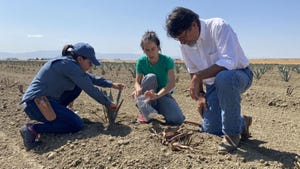
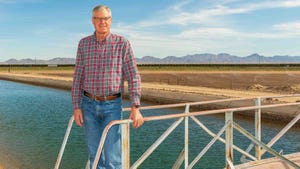
2013 Arizona Pecan Growers Association leaders - from left, Harold Payne, Allen Brandt, Mike Kilby, Jim Walworth, Roger Hooper, and Gerry Gonzalez.

In California, the pecan is the ‘other tree nut’ in a deciduous family heavily dominated by almonds, walnuts, and pistachios.

The pecan, Carya illinoinensis, is grown on about 4,000 acres in the Golden State; shadowed by the 1.1 million acres of the Big Three nuts which blanket the San Joaquin and Sacramento valleys.

The pecan industry is the ‘comeback kid’ after its almost inevitable financial ruin 15 years ago. Technological advances, improved crop management, and strong leadership rallied the pecan industry back into the black ink column.

“We’re back making money again growing pecans,” says California pecan grower Brian Blain of Visalia.

Blain owns and operates Blain Farms, the state’s largest pecan grower with about 800 acres in Kern, Tulare, and Fresno counties. Blain and his sons Brody and Barrett also operate Atlas World Food, a processing company which packs and ships about 80 percent of the statewide pecan crop. The nuts are sold inshell, cracked, and shelled.

Blain also dons a hat as a founding director of the California Pecan Growers Association.

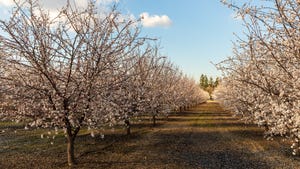
Statewide, the California pecan production belt is a narrow stretch which reaches from the Chico-Orland area in the Sacramento Valley down to Bakersfield in the southern San Joaquin Valley.

Blain shared the California pecan industry’s rise and fall - and rise again - during the 2013 Arizona Pecan Growers Association annual meeting in Tucson this fall.

The first commercial pecan trees were planted in California in the 1960s with most additional plantings in the 70’s and early 80’s. Like any newbie crop, the first growers entered the pecan industry with eyes cast on lucrative financial potential.

“The California pecan industry thought it could do no wrong,” Blain said. “We were getting high prices. Growing pecans was a way to make good money.”

Early-planted pecan trees grew extremely well in California soils and Mediterranean climate. At fourth leaf, yields totaled several hundred pounds per acre. At eighth-leaf, yields topped one ton per acre with a 62 percent in-shell kernel yield. 

Suddenly, the honeymoon was over.

“Ignorance is bliss,” Blain told the pecan audience. “The California pecan industry’s big decline began.”

Pecan yields shriveled from 2,000-pounds-plus per acre in 1990 to about 500-pounds-per-acre around 1995; a 400-plus percent yield reduction in five years.

“The yield average just kept falling and falling.”

The blame finger was pointed at two major production mistakes.

Discuss this Article 4

Anonymous (not verified)
on Nov 27, 2012

Thanks for the report on pecans in California. I wonder why the NC office of NASS quit reporting on pecans. the NC Pecan Association had some great meetings in the last two decades, and yields were good in 2012.

Anonymous (not verified)
on Nov 27, 2012

Wouldn't 2,000 lbs to 500 lbs be a 75% (not 400%) reduction?

Anonymous (not verified)
on Nov 29, 2012

2000# to 500# would indeed be a 75% reduction; if you went from 500 to 2000# you'd get a 400% increase (go figure).

jones88
on May 7, 2013

It is so good to see that the pecan industry is coming back so strong. So many farmers are in the industry and can make good money off of it. The supply and demand is definitely here. furniture stores Toronto

Post new comment
Sign In or register to use your Western Farm Press ID
(optional)

Continuing Education Courses
This accredited CE course focuses on choosing the correct variety alfalfa based on a number of...
New Course
The 2,000-member Weed Science Society of America’s (WSSA) Herbicide Resistance Action...

The course details six of the primary diseases affecting citrus: Huanglongbing (Citrus...

Newsletter Signup