UC developing Web site for drought water management in almonds

Mar 19, 2008 9:57 AM, By Bob Curtis
Senior Manager, Production Research
Almond Board of California

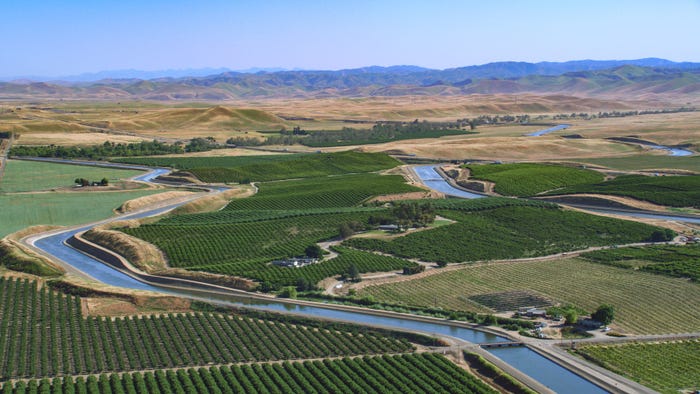
A number of critical issues are at play concerning the short- and long-term availability of water for the California almond industry. The most pressing of these is the recent Delta smelt decision that will impact about 216,000 acres of almonds served by the Central Valley Project and the State Water Project.

In response, irrigation and water experts in the UC Division of Ag and Natural Resources are developing a Web site for drought water management in almonds and other crops. UC researchers, farm advisors and Extension specialists have developed extensive information over the years on water management practices during periods of reduced water availability. The Web site will compile this information, and in particular, will focus on drought management and irrigation.

Terry Prichard, UC water management specialist, and Larry Schwankl, UC irrigation specialist, are leading this effort. Numerous agricultural crops, both perennial and annual — as well as urban horticulture — will be included; however, Prichard and Schwankl chose almonds as the first and the “template” crop because the Almond Board of California has funded a substantial body of research over the years.

By March 17, you will be able to preview the almond-related drought management information on the ABC Web site www.almondboard.com. Click on production research and look for the drought water management link. Here you will find drought and deficit irrigation management practices and strategies for almonds that make the best use of limited water supplies.

When the UC Web site is up and running, you will find a link from the ABC Web site to this valuable drought management tool. While the Web site will be aimed primarily at drought concerns, the water management information will be applicable to a wide array of situations and therefore useful under normal conditions as well.

For almonds, the Web site covers the key areas of: 1) Timing of water stress; 2) Developing a deficit irrigation strategy under varying scenarios — moderate water stress vs. more severe water stress vs. keeping the tree alive; 3) Irrigation system management; and 4) Soil- and plant-based irrigation scheduling. Here are some key pointers:

Timing of stress

•Early season – Water stress is most harmful during this period — from leaf out through shoot growth of terminal and lateral buds. Because trees do not need much water during this period, deficit irrigating can save little.

•Nut development – Nuts undergo a rapid growth phase and are sensitive to water deficits during this time. However, once the nuts have sized, trees and the crop can tolerate drought stress during the two months prior to harvest. This permits successful deficit irrigation during this period.

•Post harvest – Moderate stress during this period will have little effect on subsequent years’ nut numbers, but severe water stress during bud differentiation dramatically reduces fruit set the following spring.

Deficit irrigation strategies

It is best to use both plant-based (e.g., pressure bomb) and soil monitoring in concert. Effective monitoring along with irrigation system efficiency is crucial for deficit strategies.

•Moderate water stress strategy – If possible, do not compromise from leaf out through mid-June. However, from mid-June through harvest, 50 percent to 60 percent of full water use will result in only minimal reductions in kernel weight.

•More severe water stress strategy – Reduces use by a seasonal 50 percent with water stress in early to middle to late season. For instance, up to April through May, no irrigation should be applied until the trees reach a pressure bomb reading of -12 to -14 bars. From June 1 through hull split, pressure bomb stem water potential readings can reach a higher deficit reading of -20 to -22 bars. Expect nut weight reductions the first year and in succeeding years if the same strategy is followed, and also reduced nut numbers in years after this deficit program is followed. After four years of this strategy, trees and yields recovered within two seasons in UC studies.

•Staying alive strategy - Less is known about this strategy since it is rarely an option. However, based on past drought conditions, trees may be kept alive using about a foot of water. This strategy does not consider growth and yield — just tree survival.

Get Copyright ClearanceWant to use this article? Click here for options!
© 2008 Penton Media, Inc.


Latest Jobs

resources

events icon events

product info icon tradeshows

tradeshow icon digests

research icon photos

Continuing Education

Accredited by California DPR and California and Arizona Certified Crop Advisers:


(New Course)

Nutrient Management in Key California Crops


This online CEU course offers a detailed look at the nutrient management in key California crops. It is sponsored online by Western Plant Health Association and funded by a grant from the California Department of Food and Agriculture Fertilizer Research and Protection Program (FREP). It is accredited for one (1)-hour of credit by the California Department of Pesticide Regulation for California Pest Control Advisers (PCA), Private Applicators, Qualified Applicators and Aerial Applicators. The course is also accredited for 3 units in Nutrient Management (NM) for California and Arizona Certified Crop Advisers (CCAs).

Accredited in California, Arizona, Idaho, Oregon and Washington and for Certified Crop Advisers:


(New Course)
Organic/Sustainable Agricultural Production in the West

Organic/sustainable agriculture is expanding rapidly in the U.S. with an average annual increase of 20% during the last 15 years. This course covers a wide range of pests and organic control strategies. It is accredited for up to 4 continuing education hours for PCAs and Applicator Licensees in California, Arizona, Idaho, Oregon and Washington. It is also approved for Certified Crop Adviser credit.

ACCREDITED IN OREGON AND WASHINGTON:


(New Course)
Managing Spray Drift to Minimize Problems

This online spray drift management course has been certified by the Oregon Department of Agriculture and the Washington Department of Agriculture for 2 hours of credit for licensed Applicators and Consultants in Oregon and Washington.

ACCREDITED IN CALIFORNIA ONLY:


Almond Pest Management

Get the latest info on almond insect pest management and earn 2 hrs. CE DPR and CCA credit in California.

California Groundwater Protection Regulations

Earn 2 hrs. in California laws and regs CE and learn how to protect California groundwater supplies.


Disease Management in California Almonds

Managing diseases in California almond production is a year-long process. This course provides the latest information on controlling these diseases with management practices and fungicides. The course is approved for 2 CEUs by DPR for PCAs and all applicator categories and California CCAs.

Powdery Mildew Control in California Grapevines

Learn about the No. 1 grape disease in California; earn 2 California CE hours.

ACCREDITED IN CALIFORNIA AND ARIZONA:


The Role of Copper in Disease Control

Copper has long been a key tool in disease control in a many crops. This 2-CEU course accredited California PCAs and all DPR applicator categories and Arizona applicators details how best to use copper to maximize its potential.

Insecticide Resistance Management in Agronomic and Row Crops

A 3-hr. CE approved for California and Arizona licensees and CCAs in both states.

Agronomic Weed Resistance Management in Row Crops, Trees Nuts and Vines

Weeds Resistance Management is approved for 3 hours of CE credit for all California and Arizona licensees and Certified Crop Advisers.

Lepidopterous Pest Management/ Pesticide Safety

This course is approved for 2 hours in Arizona and California (1 hr. of laws/regs; 1 hour Other) and for CCAs.

Managing Spray Drift to Minimize Problems

2-hrs laws and regs for California licensees; 2 hours in Arizona and for CCAs.

Back to Top

Browse Print Issues

Additional Resources

subscribe to Farm Press Daily Southeast Farm Press Southwest Farm Press Delta Farm Press