Regulators view environmental successes on almond orchard tour

Mar 7, 2008 10:25 AM

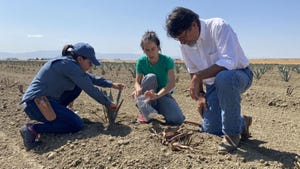
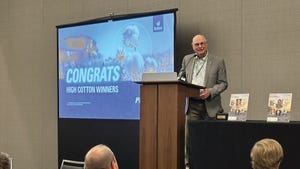
More than 30 regulators, members of the media and local dignitaries gathered in February for the Almond Board of California's fourth annual Environmental Stewardship Tour in Hickman, Calif., to hear first-hand how the industry is tackling environmental issues.

State and federal regulators praised the work of almond growers and handlers — including tour host Braden Farms — who are finding solutions to environmental challenges, including endangered species, air and water quality and reduced-risk pest management.

Pamela Creedon, executive officer with the Central Valley Water Board's Irrigated Lands Program, said the Environmental Stewardship Tour helps illustrate not only the impacts of various regulations on industry, but opportunities for partnerships in meeting the Board's water quality mandates.

"It's encouraging to see some of the things we've seen out in the field today," Creedon told tour attendees.

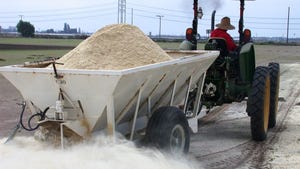
The tour highlighted new technologies and methods designed to reduce the impact of almond production on the environment. Braden Farms' new hulling and shelling plant in Hickman, Calif., for instance, produces nearly zero dust emissions thanks to state-of-the-art technology, said Braden Farms CEO Dick Braden.

That environmental minded approach extends to the company's growing operations as well. Braden Farms has added 1,000 acres of new almonds annually to its 13,000-acre orchard, and each new block is planted with an eye on reducing environmental impacts.

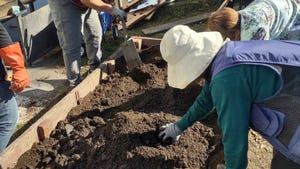
Land is laser leveled and designed with collection ponds and cover crops to reduce fertilizer and soil runoff into nearby waterways.

Micro-irrigation systems help Braden reduce water use and runoff and apply fertilizers more efficiently. And pests are managed through careful monitoring and timely sprays of softer insecticides.

Jim Wagner, pest control advisor and partner at Braden Farms, says winter orchard sanitation has helped reduce or eliminate dormant and in-season navel orangeworm sprays while maintaining very low insect damage rejection levels at the processor. Weather stations in each block also help Braden Farms time fungicide applications so they are sprayed only when necessary and for maximum benefit.

The Environmental Tour also spotlighted new harvesting technologies that are drastically cutting air quality emissions at harvest. Regulators viewed new sweepers and pick up machines that reduce dust and also save fuel and reduce emissions by eliminating passes and truck traffic during the three-step harvesting process.

Gabriele Ludwig, the Almond Board's senior manager for technical and regulatory affairs, said many of these strategies and technologies have been developed through years of research sponsored by the Almond Board of California.

The Board's Environmental Committee this year is funding $400,000 in research to address environmental issues, including the study of harvest dust generation, greenhouse gas emissions, water quality mitigation measures and site-specific soil fumigation.

"The Almond Board's Environmental Committee focuses on research projects that help almond growers do things differently or give regulators data about almond production that they can use," Ludwig said.

Committee Chairman Dave Baker said the industry will continue to seek proactive solutions to environmental challenges in almond production.

"Through research and outreach supported by the Almond Board's Environmental Committee, almond growers have been able to reduce their PM 10 emission at harvest by 50 percent in recent years," he said. "We continue to reduce runoff from farms, are on track to reduce VOCs from pesticides in the field and we now chip 80 percent to 85 percent of our brush compared to burning all of it just a few years ago.

"We enjoy the opportunity to share these successes with regulators first-hand and will continue to work on projects that move the industry toward sustainability very quickly in the future," Baker said.

Kathy Taylor, director for agriculture programs with the U.S. EPA Region 9 in San Francisco, said it was good to see first-hand industry efforts to move toward sustainable almond production.

"[The almond industry] has been doing great work for many years and we have worked with you for many years," Taylor said. "We were talking with the Almond Board about sustainability when other commodity groups wouldn't even let us say the word. And as the industry now works to put real meat around the bones of the word sustainability, we will be able to really move the partnership forward."

Get Copyright ClearanceWant to use this article? Click here for options!
© 2009 Penton Media, Inc.


Latest Jobs

resources

events icon events

product info icon tradeshows

tradeshow icon digests

research icon photos

Continuing Education

Accredited for California, Arizona and CCA hours:


(New Course)
Biopesticides -- Effective Use in Pest Management Programs

Biopesticides are increasingly being recommended as components of Integrated Pest Management (IPM) programs in the production of non-organic high-value specialty crops such as fruit, nut, vegetable, vine, ornamental and turf. This online, accredited course, sponsored by Marrone Bio Innovations, details some of the 245 registered biopesticide active ingredients used in a wide array pest management products.

Accredited in California and Arizona:


(New Course)
Agronomic Principles and Efficient Chemigation and Fertigation Using Center Pivot/Linear Sprinkler Systems

This online CE course details sound mechanical irrigation design and management practices to allow efficient chemigation and fertigation. It is accredited for Certified Crop Adviser CE units and is approved for credit hours in California and Arizona.


(New Course)
Pome, Stone Fruit Pest Management Using New Mode of Action Chemistry

New chemistry Rynaxypyr has proven effective against a wide range of economically important Lepidoptera species. Marketed under the trade name Altacor for use in grapes, pome and stone fruit, details on how to use this new chemistry are in this online Continuing Education course that is accredited in California, Pennsylvania, and New Jersey with CE applications pending in Oregon and Washington.


(New Course)
Vegetable Pest Management Using New Mode of Action

Integration of a new mode of action compound like Coragen into IPM and IRM programs to control Lepidoptera in leafy greens, fruiting vegetables, peppers and brassica or cole crops is always welcome. This online CE accredited details how best to use this new mode of action in intensive vegetable production. It is accredited in California, Arizona, Texas, Georgia, New Jersey and Pennsylvania. Application for credit is pending in Florida and Washington.

Accredited by Accredited in California and Washington:


(New Course)
Utilizing Calcium as Nutrient That Protects Against Disease Organisms

This online accredited course focus on Calcium, an important plant nutrient in fertilizer management for maximum, healthy plant development as well as disease and pest prevention. It is accredited in California, Georgia,: Pennsylvania and New Jersey. Credit pending in Florida, South Carolina, Tennessee, Virginia, West Virginia and Washington.


Accredited by California DPR and California and Arizona Certified Crop Advisers:


(New Course)

Nutrient Management in Key California Crops


This online CEU course offers a detailed look at the nutrient management in key California crops. It is sponsored online by Western Plant Health Association and funded by a grant from the California Department of Food and Agriculture Fertilizer Research and Education Program (FREP). It is accredited for one (1)-hour of credit by the California Department of Pesticide Regulation for California Pest Control Advisers (PCA), Private Applicators, Qualified Applicators and Aerial Applicators. The course is also accredited for 3 units in Nutrient Management (NM) for California and Arizona Certified Crop Advisers (CCAs).

Accredited in California, Arizona, Idaho, Oregon and Washington and for Certified Crop Advisers:


(New Course)
Organic/Sustainable Agricultural Production in the West

Organic/sustainable agriculture is expanding rapidly in the U.S. with an average annual increase of 20% during the last 15 years. This course covers a wide range of pests and organic control strategies. It is accredited for up to 4 continuing education hours for PCAs and Applicator Licensees in California, Arizona, Idaho, Oregon and Washington. It is also approved for Certified Crop Adviser credit.


ACCREDITED IN CALIFORNIA ONLY:


Almond Pest Management

Get the latest info on almond insect pest management and earn 2 hrs. CE DPR and CCA credit in California.

California Groundwater Protection Regulations

Earn 2 hrs. in California laws and regs CE and learn how to protect California groundwater supplies.


Disease Management in California Almonds

Managing diseases in California almond production is a year-long process. This course provides the latest information on controlling these diseases with management practices and fungicides. The course is approved for 2 CEUs by DPR for PCAs and all applicator categories and California CCAs.

Powdery Mildew Control in California Grapevines

Learn about the No. 1 grape disease in California; earn 2 California CE hours.

ACCREDITED IN CALIFORNIA AND ARIZONA:


The Role of Copper in Disease Control

Copper has long been a key tool in disease control in a many crops. This 2-CEU course accredited California PCAs and all DPR applicator categories and Arizona applicators details how best to use copper to maximize its potential.

Insecticide Resistance Management in Agronomic and Row Crops

A 3-hr. CE approved for California and Arizona licensees and CCAs in both states.

Agronomic Weed Resistance Management in Row Crops, Trees Nuts and Vines

Weeds Resistance Management is approved for 3 hours of CE credit for all California and Arizona licensees and Certified Crop Advisers.

Lepidopterous Pest Management/ Pesticide Safety

This course is approved for 2 hours in Arizona and California (1 hr. of laws/regs; 1 hour Other) and for CCAs.

ACCREDITED IN CALIFORNIA, ARIZONA, OREGON, AND WASHINGTON:

Managing Spray Drift to Minimize Problems

This online CEU on managing spray drift to minimize problems is accredited for 2-hours in California (Laws and Regs); Arizona, Oregon and Washington.

Back to Top

Browse Print Issues

Additional Resources

subscribe to Farm Press Daily Southeast Farm Press Southwest Farm Press Delta Farm Press