California research playing key role in rice production increase

What is in this article?:

  • Rice production worldwide must increase 30 percent to 40 percent within the next three decades to feed those additional 2 billion people.
  • California may be only a bit player in world rice production; however, the Biggs RES has long been a world leader in developing rice varieties and rice production systems.

More About:

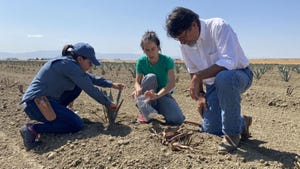
Jeff Oster, left, plant pathology project leader at RES, is dwarfed by his research plot while talking about his work to a group touring the farm.

Like the freight trains that continually thunder past the California Rice Experiment Station (RES) near Biggs, Calif., the world demand for rice rolls ever onward and will only grow more voracious.

More than half the world’s population depends on rice for basic nourishment, and world population is expected to grow from 7.1 billion today to 9 billion by 2050, according to James E. Hill, long time University of California Cooperative Extension agronomy/rice specialist and now Associate Dean for International Programs in the UC College of Agricultural and Environmental Sciences.

This will mean rice production worldwide must increase 30 percent to 40 percent within the next three decades to feed those additional 2 billion inhabitants, Hill told more than 600 people attending the RES Centennial Field Day Celebration.

Ninety-one percent of the world’s rice is grown in Asia. The U.S. produces just 1.4 percent of the world’s rice and four-fifths of that is produced in California where the acreage this season totals 544,000, mostly in the Sacramento Valley.

California may be only a bit player in world rice production; however, the Biggs RES has long been a world leader in developing rice varieties and rice production systems and that will likely only increase in the future.

Ed Knipling, USDA-ARS administrator, reinterated Hill’s comments that it will be a massive challenge to meet future world rice demand, but the research station’s world class status as a rice variety breeding hub will play a key role in meeting that challenge.

Knipling hailed the cooperative effort of USDA-ARS scientists and university and RES station scientists in releasing 44 rice varieties from the station since it was founded by producers a century ago. Since 1997, it has released 10 different market types of rice, an unequaled accomplishment.

California’s rice industry would seem up to the challenge of being a leader in gaining that 30 percent to 40 percent more rice, if past history is any indication.

Since the 1960s, California’s rice yields have tripled with improvements in nitrogen management and weed control, as well as the introduction of new semi-dwarf varieties from RES plus production advances like laser leveling.

A quintet of rice growers at the field day have benefitted from much of these improvements/advances and report that their 2012 crops look good.

Colusa County, Calif., producers Joe Kalfsbeck and C. J. LeGrande say their crops are late, but hold promise for a good yield. Kalfsbeck expects to start harvesting his crop Oct. 1 and LaGrande says it will likely be late September before his combines roll.

“We got a late start—about two weeks late — due to cool weather in the spring,” says LeGrande. “The warm weather this summer moved the crop along pretty good.”

Kalfsbeck expects an “average yield.” He and his neighbor, however, said they are disappointed with current prices.

Discuss this Article 0

Post new comment
Sign In or register to use your Western Farm Press ID
(optional)

Continuing Education Courses
This accredited CE course focuses on choosing the correct variety alfalfa based on a number of...
New Course
The 2,000-member Weed Science Society of America’s (WSSA) Herbicide Resistance Action...

The course details six of the primary diseases affecting citrus: Huanglongbing (Citrus...

Newsletter Signup