Relationship of honey bees and pesticides

What is in this article?:

  • Honey bees are an essential component of modern agriculture as their pollination efforts are necessary for production of about one-third of the crops we produce in this country. Exposure to pesticides has produced negative effects on individual bees and their colonies for nearly a century.
  • Contaminated pollen can get carried into hives. That pollen is transferred to housekeeping bees that pack portions of it into cells. The stored pollen undergoes microbial, partial digestion and becomes preserved with lactic acid for con-sumption some time during the next half year or so.

Biochemistry of bees

The biochemistry of adult bees is not terribly complex, since they are fully developed and require only maintenance nutrition. Larvae are another story. They are growing at a fantastic rate (1,000 X gain in mass in six days). They undergo six molts during their development that require an intricate balance of hormones in order to reach maturity. That makes the larvae very vulnerable to any chemicals that might interfere with the delicate balance of interacting biochemical pathways being utilized. Pesticides frequently are designed to interfere with one or more biochemical pathways of the target organism. It should come as no surprise that exposure to small amounts of any of a large number of pesticides can disrupt normal larval development. All types of pesticides contain some products that are toxic to developing honey bee brood.

It would be nice to think that we know all about the effects of pesticides on adult and immature honey bees, but that just is not the case. New pesticides, being reviewed for registration by EPA and CDPR, are required to be tested against the relatively chemically inert adult worker honey bee to determine the short-term acute toxicity levels by contact and ingestion. If the product is determined to be toxic to adult honey bees, a warning or prohibition is placed on the label. Any product toxic to adult honey bees also is supposed to be tested against honey bee brood, but definitive protocol for such testing never has been developed at the federal or state level.

Some companies conduct such studies on their own volition, but most do not. Also, many products are registered on the basis of toxicity testing of the active ingredient in a pesticide. So-called “inert ingredients” are neither listed on the label nor tested for honey bee toxicity. Thus, some formulations, with active ingredients that are supposedly innocuous to honey bees, kill bees on contact or when taken back to the hive and introduced into the colony food chain. Products that are tank mixed may produce synergistic effects many times more toxic then the individual products, alone, but the tank mixes are not tested for bee toxicity. Label statements can fail to relate the true toxicity of their products to honey bees.

The best way to protect honey bees from damage by pesticides is to keep them from being exposed. Very infrequently do pesticides enter the hive directly. However, on warm to hot evenings very large groups of honey bees can be clustered on the fronts of beehives and are very susceptible to being hit by applications from directly overhead or from pesticide drift. Better attention to local hive conditions by applicators can reduce those problems.

Most honey bees and their food are contaminated by applications through which the pollen foragers fly or by residual products on floral parts (especially pollen) or foliage. Surface contaminated bees will add pesticide to their pollen loads. Contaminated pollen can be returned to the hive. Most pesticides are lipophilic, so they blend chemically with the hydrocarbons in beeswax and the exoskeletons of honey bees. They also become blended with the lipids in the outer layer of pollen grains. Thus, beeswax and pollens exchange contaminants.

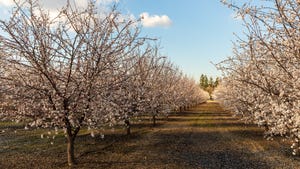
To prevent negative effects of pes-ticides of all types, do not apply them to blooming plants upon which bees are foraging. Evening or night applications of short residual materials, in areas where bees are foraging, will greatly reduce negative effects on bees. What about fungicides that are routinely applied during bloom? Again, proper timing of such applications can be significant. For example, given good flight conditions, pollen foragers will remove nearly all of the day‟s melon pollen by mid-morning and almond pollen by mid-afternoon. Fungicides applied to almonds from late afternoon until very early the next morning will contaminate pollen or pollen foragers much less than fungicides applied early-morning to mid-afternoon. Concerns about fungicide-induced failure of pupae to emerge as adult bees could be greatly reduced. The least exposure to pesticides is best for the bees.

Discuss this Article 1

Anonymous (not verified)
on Jan 6, 2011

Very concerning not just for the bees but, if as is written, the pesticide rsidues or biproducts are gettting in the brood food, could they also be getting into the honey for human consumption. The use of pesticides of all kinds should be restricted for health, not just the bees but ours as well.

Post new comment
Sign In or register to use your Western Farm Press ID

(optional)

Continuing Education Courses
This accredited CE course focuses on choosing the correct variety alfalfa based on a number of...
New Course
The 2,000-member Weed Science Society of America’s (WSSA) Herbicide Resistance Action...

The course details six of the primary diseases affecting citrus: Huanglongbing (Citrus...

Newsletter Signup