Pistachio orchards begin greening

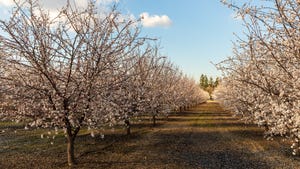
As the middle of April neared, Johnny Starling’s pistachio trees near Hanford, Calif., were in the pineapple stage.

“The buds are pushing out and forming small clusters,” the general manager of farming for Nichols Farms said. “The green tips are out about 1 to 2 inches — a little bit late, but they’ve been this late before.”

In view of the weather at the time, mostly sunny with temperatures reaching in to the low 70s, and the forecast, he saw the possibility of a pretty good bloom.

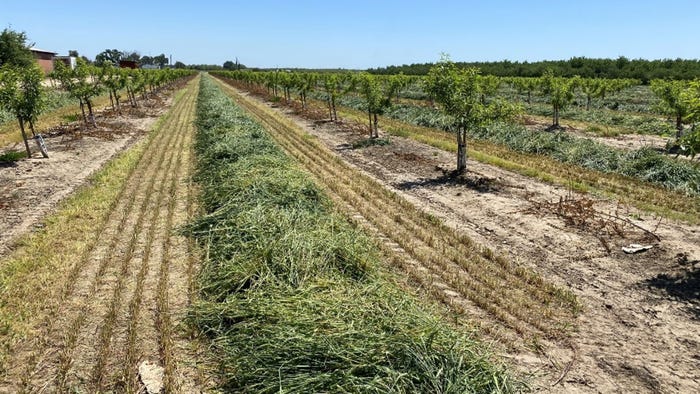
Meanwhile, following weather-related delays in winter maintenance chores, such as replanting missing trees in older orchards, his crews were catching up on spraying and mowing to control weeds in the row middles.

The Nichols Farms pistachios, the first of which were planted in 1983, now total about 2,100 acres in the Hanford-Tulare area west of Highway 99 and on the West Side of the San Joaquin Valley near Coalinga. About 1,200 acres are currently in production.

Starling expected to get a better idea of how well the male trees were synchronizing with the rest of the orchards during the third week of April, when the female clusters would be more developed and have a sort of stickiness to them.

Later in April, they will begin leaf-out sprays to feed the trees micronutrients, including copper, zinc and boron, and fungicides to control botrytis and botryosphaeria.

“We have a high incidence of botryosphaeria in our area, and if you don’t keep on top of it, you can get behind the 8-ball and suffer some long-term damage,” Starling says. “A few years ago, we had a blowup of the disease, and we’ve been very proactive in controlling it.”

The botryosphaeria sprays are based on field history, observations and results of the BUDMON test, which detects the pathogen in buds. “We’ll treat fields where the history and the tests show a high threat of the disease,” he says.

Recently, Nichols Farms finished converting the last of its flood-irrigated fields to drip systems. Those systems also play a key role in keeping the trees healthy.

“The ability to apply fertilizers and water very accurately and efficiently makes drip irrigation a phenomenal management tool,” Starling says. “We can go with long duration sets or, using remote controls, we can alternate between different parts of a field with short duration sets. For example, during July and August, we can use shorter irrigation times to lower humidity, which will reduce the incidence of botryosphaeria and alternaria.”

About seven years ago, Nichols Farms tried some new clonal root stock developed by University of California. Starling has been impressed with its ability to tolerate cold temperatures.

In the winter of 2007, temperatures dropped to 9 degrees in several spots in one of the company’s fields in the Coalinga area. “The UCB clonal rootstock handled the cold much better than other rootstocks,” he says.

Most of Nichols Farms’ trees are the Kerman variety. In 2007, the company planted 45 acres of pistachios that were budded with the Golden Hills variety. In 2008, they planted an additional 460 acres. Maturing 10 to 14 days earlier than Kerman, Golden Hills offers the chance to make more productive use of the company’s processing plant. “Once we start harvesting the early varieties, we can begin using our hulling facility two weeks earlier to increase production without adding capacity,” Starling says.”Also, based on the few fields that have been harvested, the variety seems to be producing a good quality nut.”

Continuing Education Courses
New Course
The 2,000-member Weed Science Society of America’s (WSSA) Herbicide Resistance Action...
New Course

The course details six of the primary diseases affecting citrus: Huanglongbing (Citrus...

Get the latest info on almond insect pest management. California: 2 Hours "Other"
Farmer-to-Farmer Used Equipment