California water crisis' human face

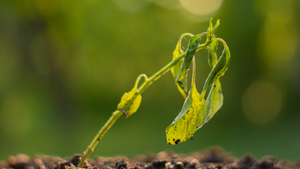
A water bond to finance solutions to California’s water crisis on the ballot would face no better chance of passing than a snowball surviving in Death Valley.

Experts say only 36 percent of Californians would approve a major water bond issue today in a state that is riddled with debt and a projected continuing budget deficit reaching into the billions.

While the fiscal malaise continues to hang over the state like a black cloud, California’s water crisis is really the No. 1 mess facing this state, according to agricultural lobbyist/attorney and Hanford, Calif., dairyman George Soares.

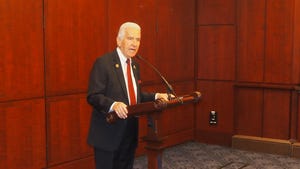
Soares, whose law firm represents a host of agricultural and commodity groups, told the annual Western Cotton Shippers Association conference at Harris Ranch on the West Side of the San Joaquin Valley that California’s water crisis is in a race against money, politics and time.

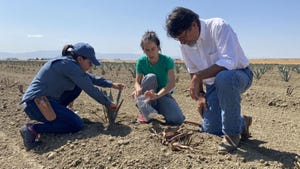
Agriculture has mounted a well-funded, well-orchestrated headline-grabbing campaign to improve those odds. California’s water crisis now has a face; a human element that for the first time focuses on people rather than farms and farmers.

Soares told the annual conference of cotton merchants that there are photographs in the state Capitol of thousands of farmworkers, farmers, business owners, town mayors and others marching head down into howling, dust choking wind on the West Side of the San Joaquin Valley last spring. They were marching for water in an area that has 40-percent unemployment because the drought and environmental laws have reduced the water supply to one of the most productive agricultural areas in the world.

Politicians and bureaucrats see those photos and read the headlines that continue to herald California’s water crisis.

Soares says agriculture is “seriously engaged” with “direct involvement” in efforts to increase the state’s water supply and delivery system that was built to service 20 million in a state with a current population of 38 million.

Everyone is “desperate to one degree or another” for current and future water supplies which bring all political elements of the state together. Heretofore, the state water crisis has been primarily an agricultural issue. Now it cuts across the spectrum and is statewide.

A regular legislative session failed to reach a compromise water package to put on the ballot. Soares said the emphasis is not for the governor to call a special session to deal with the water crisis. Soares said the “momentum” to reach an agreement will continue into the fall and next year.

He said there must be a comprehensive water bond on the ballot in 2010. Term limits will change the structure of the Legislature afterwards. Following that, “we have to start all over” with a significant batch of new legislators. “We do not have time to start over,” remarked Soares.

Agriculture has put a “human face” on the water crisis in the fields and that has given the issue considerable traction with the public and the politicians; it will take more than that to solve the issue. It will take political coalitions.

One of the strongest voices in resolving the water crisis has been the Latino political caucus. It is the strongest caucus in the Legislature with 26 members. “This caucus is sensitive to the human conditions brought on by a lack of water for agriculture,” he says. This group of legislators has put together one of the most comprehensive water solution packages yet.

“Trade unions are part of this effort. When is the last time a union stood up for us in ag? The carpenters’ union said they supported the Latino caucus’ water package.”

The water crisis is a jobs issue with many unions, according to Soares.

Amazingly, the United Farm Workers of America have not supported the water bond measures. The UFW has boycotted marches and rallies focusing on the water crisis. Soares said the UFW recently donated $1 million to defeat a water bond issue. That may seem puzzling, but Soares explained that the UFW is allied with the state workers union. These groups do not want the bond issue to pass because the debt service to finance a major bond issue might take money from state workers.

The focus of the water crisis is the Sacramento-San Joaquin Delta. It is in need of repair and it is also the hub for controversy. Many farmers and towns in the Delta do not want a canal built because they see it as a threat to the Delta’s water quality.

Soares said ag must embrace the concerns of the Delta and work to restore the Delta as well as improve water conveyed through or around it.

However, the Delta is only part of what must be a comprehensive water bond package that includes above and underground storage and water rights issues.

It will take a solid coalition to get a comprehensive package passed.

“I call it relationships … relationship to relevancy. Unfortunately, everyone in ag does not appreciate that relationships have value. Without relationships we will not have success,” he says.

He cited the appeal in 2001 of the state tax on farm equipment. Soares said this was the result of relationships created with urban legislators. It was a victory for ag that continues to pay off to the tune of $150 million in savings for agriculture.

“It has been eight years since the tractor tax victory and it is still intact, even after this year’s budget crisis,” said Soares.

The long time Hanford resident did not guarantee victory for a 2010 water bond issue. “It is too soon to tell if all segments of society will be with us,” said Soares. However, he made it clear agriculture has a dog in the fight with perhaps a better chance of winning than ever before.

It is a daunting task with a dysfunctional fiscal system that continues to allow the state to spend more than it takes in.

Soares admits to bewilderment with a process that results in political leaders being happy reducing the deficit from $26 billion to $5 billion in the last state budget. That $5 billion, projects Soares, will likely grow to $15 billion by the spring. However, the attitude remains that it’s better than $26 billion.

“The budget will continue to be a problem long term in this state,” Soares told the farmers and cotton merchants at the WCSA gathering.

email: hcline@farmpress.com

Discuss this article 0

Post new comment

Sign in or Register to use your Western Farm Press ID
(optional)
CAPTCHA
This question is for testing whether you are a human visitor and to prevent automated spam submissions.
Incorrect please try again
Enter the words above: Enter the numbers you hear:
Sign Up
Sign Up!

For the Western Farm Press Newsletter
Keep up with the latest news with our daily newsletter

Continuing Education Courses
New Course

Copper has long been a key tool in disease control in a many crops. This course details how best to use copper to maximize its disease management potential.

New Course

This covers managing Lepidopterous pests in a wide array of crops and there is a second section on pesticide safety.

New Course

California groundwater regulations and their impact on pesticide recommendations and applications are covered in this course.

New Course

Healthy plants have a greater ability to resist soil pathogens and insect damage. This course details how to utilize organic acids to improve plant health and therefore crop production.

New Course

Weeds Resistance Management covers a wide array of weed control strategies from mechanical to chemical.

New Course

Learn about the No.1 disease in grape production.

New Course

This course provides the latest information on controlling diseases in almond orchards using management practices and fungicides.

New Course

This online CEU covers the management of spray drift to minimize problems.

New Course

Get the latest info on almond insect pest management.

New Course

Organic/sustainable agriculture is expanding rapidly in the U.S. with an average annual increase of 20% during the past 15 years. This course covers a wide range of pests and organic control strategies.

New Course

This online CEU course offers a detailed look at the nutrient management in key California crops.

New Course

Integration of a new mode of action compound like Coragen into IPM and IRM programs to control Lepidoptera in leafy greens, fruiting vegetables, peppers and brassica or cole crops is always welcome.

New Course

New chemistry Rynaxypyr has proven effective against a wide range of economically important Lepidoptera species. Marketed under the trade name Altacor for use in grapes, pome and stone fruit, details on how to use this new chemistry are in this online CE course.

New Course

This online CE course details sound mechanical irrigation design and management practices to allow efficient chemigation and fertigation.

New Course

Biopesticides are increasingly being recommended as components of Integrated Pest Management (IPM) programs in the production of non-organic high-value specialty crops like fruit, nut, vegetable, vine, ornamental and turf.

New Course

Integrated weed management (IWM) programs and orchard cultural practices have been developed for specific orchard and vineyard crops. This accredited CEU provides information on economically and environmentally sound IWM practices.

New Course

American agriculture exports 20 to 30 percent of its production annually. For specific commodities, the percentage is much higher. When recommending and applying pest management products for crops, license Pest Control Advisers (PCAs) and applicators and farmers must be aware of which products applied are in compliance with Maximum Residue Levels (MRLs) established by foreign customers

New Course

This online accredited course focus on Calcium, an important plant nutrient in fertilizer management for maximum, healthy plant development as well as disease and pest prevention.

New Course

Insect resistance management is managed by using the correct IPM techniques and modes of action chemistry.