Mechanical olive harvesting advances described to growers

Oct 9, 2008 10:21 AM, By Dan Bryant
Contributing Writer

Mechanical harvesting research in California olives during the 2007 season documented greater efficiency with hedgerows over traditional trees, according to Louise Ferguson, University of California, Davis Extension specialist in pomology.

Ferguson explained the 2007 trial results and plans for the 2008 harvest research during a Central California olive day at Exeter recently.

She heads a team including food science experts Diane Barrett and Jean-Xavier Guinard of UC Davis and Jackie Burns, horticulture specialist of the University of Florida. Additional UC Extension personnel and California growers are cooperating.

The table olive industry, caught between general rising costs and expected lower gross returns, and threatened by possible labor shortages and an anticipated short crop this year, is turning to mechanical harvesting for survival.

“We are trying to develop a harvester that will produce commercially marketable processed olives,” Ferguson said. “To do that, the harvester has to have efficient enough fruit removal to beat hand harvest and has to maintain fruit quality for processing.”

It would be very helpful, she added, if a machine could work with an abscission agent sprayed on trees to decrease the force required to remove the fruit. Several abscission-causing compounds are being evaluated.

Reducing the force would increase harvester efficiency and decrease fruit damage. However, pre- and post-harvest treatments might also be needed to counteract undesirable effects such as dropping leaves or immature fruit.

“And we really need to look at pruning current trees and training future trees to make the harvesting more efficient,” she said.

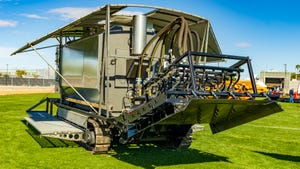
Trials in 2007 near Exeter included work with the experimental DSE 007 harvester from Dave Smith Engineering of Exeter. The original design was developed by Phil Scott of AgRight of Madera and modified by OXBO of Wisconsin before undergoing additional changes to its present form.

Design advances, including an improved picking head, additional padding to protect fruit from bruising and a GPS system for yield monitoring, were made to the machine for the 2007 trials. It is being used again this year in trials at Exeter.

Among other data, Ferguson recorded that when the machine was operated on traditionally pruned trees, efficiency, or the amount of olives collected in bins, was only 11 percent and in some trees damage was quite severe.

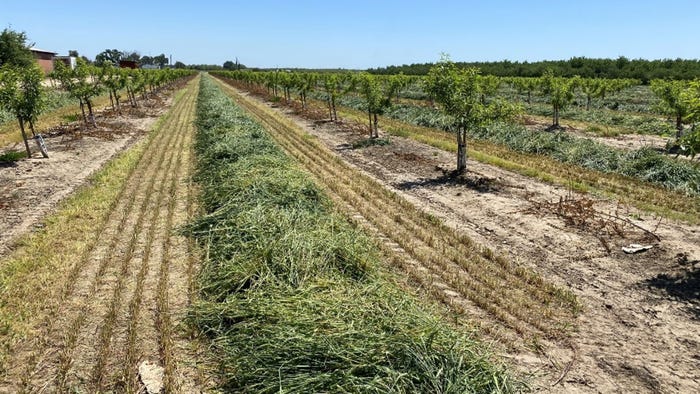
However, when the machine was operated on hedgerow pruned trees, fruit removal efficiency jumped to 73 percent while tree damage was 13 percent.

In a Colusa County trial last year comparing hand harvesting with a Spanish wrap-around trunk shaker harvester, the researchers learned the method of picking is less related than previously thought to the quality of the finished processed product.

The project is also monitoring a hedgerow orchard planted in 2001 to the Manzanillo variety in Colusa County. Four designs: conventional, free-standing espalier, espalier woven through a trellis, and espalier clipped to a trellis, are being used. The trees are about 12 feet high, 6 feet wide, and skirted about 3 feet off the ground.

Ferguson said thus far all designs have shown equal yields, and the evaluations will continue until trees mature and yield increases flatten out. The team is testing four commercially available shaker harvesters with the four hedgerow configurations.

Ferguson and Krueger are scheduled to evaluate the Maqtec Colossus picking head harvester in Argentina in February of 2009. The equipment has some improvements suggested after their trials with it early this year.

Also on the olive day program was Dan Flynn, executive director of the new Olive Center at UC Davis, where consumer taste tests have begun to compare black-ripe olives from California with imported products.

The consumer research, the first project of the Center, is intended to identify the preferred qualities of California olive products, overcome the current stagnation of the industry’s table-olive sector, and guide development of the olive oil sector.

In addition to consumer preferences, the survey is determining sensory attributes of appearance, aroma, and texture by a trained tasting panel.

Supported by growers and processors of the California Ripe Olive Coalition, the sampling used the sliced black-olive products common to the food service industry.

Preliminary results from the tasting panel sessions showed preferences for California products, while imports from Egypt, Morocco, and other sources were found to have undesirable traits, such as metallic, soapy, rancid, medicine-like, or cardboard-like flavors.

Along with additional tastings, Flynn said, the Center will use laboratory instruments for chemical analyses to quantify flavors and other attributes of top quality olives. “Hard numbers will be more compelling to USDA inspectors than results from a sensory panel.”

The Center, which started operations in January and is part of the Robert Mondavi Institute for Wine and Food Science Technology, features state-of-the-art olive oil processing equipment.

“The University of California has a long background with California olive producers,” Flynn said in outlining the collaboration dating back to 1898 between Professor Eugene Hilgard at UC Berkeley and early Marysville, Calif., olive grower Frieda Ehman, in developing canning methods for black-ripe olives.

UC Davis continues to work closely with growers and processors on research in production and economics for the olive industry. The campus has more than 2,000 olive trees, the most extensive collection of varieties in North America, which are the basis of an olive oil production program.

The Center’s mission reflects the emergence of the olive oil segment, Flynn said. Table-olive acreage in the state in the 1970s reached a peak of about 37,000 acres and has since declined to 25,000. Acreage devoted to oil production was at 3,000 a few years ago but is expected to reach about 21,000 next year and expand at about 7,000 acres annually in the future.

“So with that growth, the acreage for oil will surpass that for table olives within two years’ time,” he said. Olive acreage is now concentrated in Tulare, Tehama and Glenn counties.

Driving the expansion of the oil segment in the past 25 years has been the trend toward a flavorful alternative to other vegetable oils. Demand for olive oil has doubled in the past 10 years, and California currently produces about 400,000 gallons annually.

According to a fact sheet from the Olive Center, development of new tree varieties that can be efficiently machine-harvested has accelerated new acreage and industry forecasts are for the state’s olive oil volume to increase by 500 percent in the next five years.

A bill holding imported olive oil sold in California to prevailing international grade standards had cleared the state Legislature and was awaiting signature by Gov. Arnold Schwarzenegger, Flynn said.

Some inferior imported product labeled “extra virgin” olive oil, he added, has been sold at retail for $10 per liter, although that price is less than the cost of production for such quality in California.

Standards for extra virgin olive oil are established by the International Olive Council, a United Nations-sanctioned organization with 40 nation members. Flynn said importers welcomed the bill as a benefit to the global industry.

Get Copyright ClearanceWant to use this article? Click here for options!
© 2009 Penton Media, Inc.


Latest Jobs

resources

events icon events

product info icon tradeshows

tradeshow icon digests

research icon photos

Continuing Education

Accredited for California, Arizona and CCA hours:


(New Course)
Biopesticides -- Effective Use in Pest Management Programs

Biopesticides are increasingly being recommended as components of Integrated Pest Management (IPM) programs in the production of non-organic high-value specialty crops such as fruit, nut, vegetable, vine, ornamental and turf. This online, accredited course, sponsored by Marrone Bio Innovations, details some of the 245 registered biopesticide active ingredients used in a wide array pest management products.

Accredited in California and Arizona:


(New Course)
Agronomic Principles and Efficient Chemigation and Fertigation Using Center Pivot/Linear Sprinkler Systems

This online CE course details sound mechanical irrigation design and management practices to allow efficient chemigation and fertigation. It is accredited for Certified Crop Adviser CE units and is approved for credit hours in California and Arizona.


(New Course)
Pome, Stone Fruit Pest Management Using New Mode of Action Chemistry

New chemistry Rynaxypyr has proven effective against a wide range of economically important Lepidoptera species. Marketed under the trade name Altacor for use in grapes, pome and stone fruit, details on how to use this new chemistry are in this online Continuing Education course that is accredited in California, Pennsylvania, and New Jersey with CE applications pending in Oregon and Washington.


(New Course)
Vegetable Pest Management Using New Mode of Action

Integration of a new mode of action compound like Coragen into IPM and IRM programs to control Lepidoptera in leafy greens, fruiting vegetables, peppers and brassica or cole crops is always welcome. This online CE accredited details how best to use this new mode of action in intensive vegetable production. It is accredited in California, Arizona, Texas, Georgia, New Jersey and Pennsylvania. Application for credit is pending in Florida and Washington.

Accredited by Accredited in California and Washington:


(New Course)
Utilizing Calcium as Nutrient That Protects Against Disease Organisms

This online accredited course focus on Calcium, an important plant nutrient in fertilizer management for maximum, healthy plant development as well as disease and pest prevention. It is accredited in California, Georgia,: Pennsylvania and New Jersey. Credit pending in Florida, South Carolina, Tennessee, Virginia, West Virginia and Washington.


Accredited by California DPR and California and Arizona Certified Crop Advisers:


(New Course)

Nutrient Management in Key California Crops


This online CEU course offers a detailed look at the nutrient management in key California crops. It is sponsored online by Western Plant Health Association and funded by a grant from the California Department of Food and Agriculture Fertilizer Research and Education Program (FREP). It is accredited for one (1)-hour of credit by the California Department of Pesticide Regulation for California Pest Control Advisers (PCA), Private Applicators, Qualified Applicators and Aerial Applicators. The course is also accredited for 3 units in Nutrient Management (NM) for California and Arizona Certified Crop Advisers (CCAs).

Accredited in California, Arizona, Idaho, Oregon and Washington and for Certified Crop Advisers:


(New Course)
Organic/Sustainable Agricultural Production in the West

Organic/sustainable agriculture is expanding rapidly in the U.S. with an average annual increase of 20% during the last 15 years. This course covers a wide range of pests and organic control strategies. It is accredited for up to 4 continuing education hours for PCAs and Applicator Licensees in California, Arizona, Idaho, Oregon and Washington. It is also approved for Certified Crop Adviser credit.


ACCREDITED IN CALIFORNIA ONLY:


Almond Pest Management

Get the latest info on almond insect pest management and earn 2 hrs. CE DPR and CCA credit in California.

California Groundwater Protection Regulations

Earn 2 hrs. in California laws and regs CE and learn how to protect California groundwater supplies.


Disease Management in California Almonds

Managing diseases in California almond production is a year-long process. This course provides the latest information on controlling these diseases with management practices and fungicides. The course is approved for 2 CEUs by DPR for PCAs and all applicator categories and California CCAs.

Powdery Mildew Control in California Grapevines

Learn about the No. 1 grape disease in California; earn 2 California CE hours.

ACCREDITED IN CALIFORNIA AND ARIZONA:


The Role of Copper in Disease Control

Copper has long been a key tool in disease control in a many crops. This 2-CEU course accredited California PCAs and all DPR applicator categories and Arizona applicators details how best to use copper to maximize its potential.

Insecticide Resistance Management in Agronomic and Row Crops

A 3-hr. CE approved for California and Arizona licensees and CCAs in both states.

Agronomic Weed Resistance Management in Row Crops, Trees Nuts and Vines

Weeds Resistance Management is approved for 3 hours of CE credit for all California and Arizona licensees and Certified Crop Advisers.

Lepidopterous Pest Management/ Pesticide Safety

This course is approved for 2 hours in Arizona and California (1 hr. of laws/regs; 1 hour Other) and for CCAs.

ACCREDITED IN CALIFORNIA, ARIZONA, OREGON, AND WASHINGTON:

Managing Spray Drift to Minimize Problems

This online CEU on managing spray drift to minimize problems is accredited for 2-hours in California (Laws and Regs); Arizona, Oregon and Washington.

Back to Top

Browse Print Issues

Additional Resources

subscribe to Farm Press Daily Southeast Farm Press Southwest Farm Press Delta Farm Press