Researchers say global warming to have devastating impact on certain California crops

Dec 30, 2008 10:39 AM

Global warming will likely put enormous strain on California's water supply and energy systems and have a devastating impact on certain crops.

Stanford researchers predict this outcome based on projections from two different emission scenarios. One assumes a continuing moderate increase in greenhouse gas emissions until 2100; the other assumes emissions would increase until mid-century and then start dropping off.

Both of the scenarios indicate there will be more frequent heat waves and generally rising temperatures, the only difference being just how dramatic the increases will be.

"We will very likely see our current high temperatures much more often and also temperatures hotter than anything we've seen before under both projected levels of carbon dioxide emissions," said Michael Mastrandrea, a lecturer in the Interdisciplinary Graduate Program in Environment and Resources and a research associate at the Woods Institute for the Environment. "This is something that's going to be a huge challenge for California to deal with in the future."

Mastrandrea developed temperature projections using output from a set of global climate models scaled to reflect potential climate changes in California under both higher and lower emissions scenarios. In the next 50-100 years, average temperatures are expected to increase approximately 4-9 degrees Fahrenheit. Both the climate scenarios were developed by the Intergovernmental Panel on Climate Change, which shared the 2007 Nobel Peace Prize with Al Gore.

Though this may not seem like a significant change, it is enough to increase the intensity and frequency of extreme weather events, such as the devastating heat wave that struck California in July 2006, lasting 12 days and causing 138 deaths, and triggering rolling blackouts for more than 1.5 million consumers due to spiking energy demands. Water consumption also peaked sharply, particularly to prevent crops from overheating.

Depending on the projected carbon-dioxide-emission scenario used for modeling, heat wave occurrences could increase by a factor of 10 or more, Mastrandrea said. In addition, extreme high temperatures currently expected to be seen once every 100 years (analogous to a 100-year flood) are projected to appear more frequently than once every 10 years, or even annually, by the second half of the 21st century.

Warming temperatures, especially in winter, can put an additional strain on water resources. Mastrandrea said other researchers have projected that snow pack in the Sierra Nevada, which provides approximately one-third to one-half of California's water supply when it melts during the summer months, will decrease from current levels by 12-42 percent by 2050.

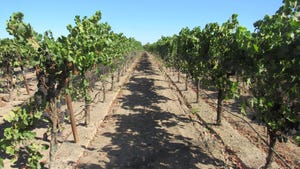
Key crops like cherries, peaches and grapes are particularly vulnerable to the projected changes in climate, said David Lobell, senior research scholar at the Program on Food Security and the Environment at Stanford University.

Lobell analyzed the top 20 high-value perennial crops grown in California, which include grapes, almonds, pistachios, walnuts, cherries, peaches, oranges and lemons, and estimated how these crops would be affected by the expected rise in temperature.

Cherry yields are expected to decrease 20 percent by the year 2050, having a dramatic impact on sales, which amount to about $100 million annually. Production of table grapes, such as the green, red and blue-black varieties stocked and sold in grocery stores that account for $400 million in annual sales, face a 5 percent decrease.

However, the effects of warming on some of California's other crops are unclear.

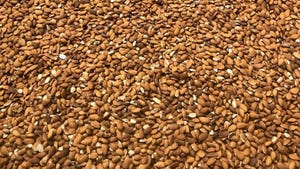
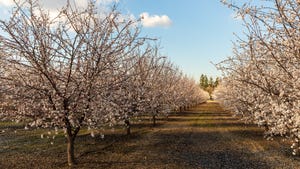
In the case of almonds - California produces 80 percent of the world's supply and receives a majority of the growing $2 billion annual sales - winter temperatures above 45 degrees Fahrenheit disrupt the natural growth cycle resulting in lower yields. However hotter spring and summer temperatures, which are ideal for almond growth, may counterbalance this effect, Lobell said. A final verdict also remains to be reached regarding wine and raisin grape yields, which account for roughly $1.8 billion and $500 million in annual sales, respectively.

"The implication of these findings is that we now have some ability to focus on making adaptations to growing those crops we think will be hit the hardest," Lobell said.

"Adaptations might include growing new varieties or switching to new crops, or simply deciding where to site new orchards that haven't been established yet."

The California Energy Commission provided funding for both researchers.

Get Copyright ClearanceWant to use this article? Click here for options!
© 2009 Penton Media, Inc.


Latest Jobs

resources

events icon events

product info icon tradeshows

tradeshow icon digests

research icon photos

Continuing Education

Accredited for California, Arizona and CCA hours:


(New Course)
Biopesticides -- Effective Use in Pest Management Programs

Biopesticides are increasingly being recommended as components of Integrated Pest Management (IPM) programs in the production of non-organic high-value specialty crops such as fruit, nut, vegetable, vine, ornamental and turf. This online, accredited course, sponsored by Marrone Bio Innovations, details some of the 245 registered biopesticide active ingredients used in a wide array pest management products.

Accredited in California and Arizona:


(New Course)
Agronomic Principles and Efficient Chemigation and Fertigation Using Center Pivot/Linear Sprinkler Systems

This online CE course details sound mechanical irrigation design and management practices to allow efficient chemigation and fertigation. It is accredited for Certified Crop Adviser CE units and is approved for credit hours in California and Arizona.


(New Course)
Pome, Stone Fruit Pest Management Using New Mode of Action Chemistry

New chemistry Rynaxypyr has proven effective against a wide range of economically important Lepidoptera species. Marketed under the trade name Altacor for use in grapes, pome and stone fruit, details on how to use this new chemistry are in this online Continuing Education course that is accredited in California, Pennsylvania, and New Jersey with CE applications pending in Oregon and Washington.


(New Course)
Vegetable Pest Management Using New Mode of Action

Integration of a new mode of action compound like Coragen into IPM and IRM programs to control Lepidoptera in leafy greens, fruiting vegetables, peppers and brassica or cole crops is always welcome. This online CE accredited details how best to use this new mode of action in intensive vegetable production. It is accredited in California, Arizona, Texas, Georgia, New Jersey and Pennsylvania. Application for credit is pending in Florida and Washington.

Accredited by Accredited in California and Washington:


(New Course)
Utilizing Calcium as Nutrient That Protects Against Disease Organisms

This online accredited course focus on Calcium, an important plant nutrient in fertilizer management for maximum, healthy plant development as well as disease and pest prevention. It is accredited in California, Georgia,: Pennsylvania and New Jersey. Credit pending in Florida, South Carolina, Tennessee, Virginia, West Virginia and Washington.


Accredited by California DPR and California and Arizona Certified Crop Advisers:


(New Course)

Nutrient Management in Key California Crops


This online CEU course offers a detailed look at the nutrient management in key California crops. It is sponsored online by Western Plant Health Association and funded by a grant from the California Department of Food and Agriculture Fertilizer Research and Education Program (FREP). It is accredited for one (1)-hour of credit by the California Department of Pesticide Regulation for California Pest Control Advisers (PCA), Private Applicators, Qualified Applicators and Aerial Applicators. The course is also accredited for 3 units in Nutrient Management (NM) for California and Arizona Certified Crop Advisers (CCAs).

Accredited in California, Arizona, Idaho, Oregon and Washington and for Certified Crop Advisers:


(New Course)
Organic/Sustainable Agricultural Production in the West

Organic/sustainable agriculture is expanding rapidly in the U.S. with an average annual increase of 20% during the last 15 years. This course covers a wide range of pests and organic control strategies. It is accredited for up to 4 continuing education hours for PCAs and Applicator Licensees in California, Arizona, Idaho, Oregon and Washington. It is also approved for Certified Crop Adviser credit.


ACCREDITED IN CALIFORNIA ONLY:


Almond Pest Management

Get the latest info on almond insect pest management and earn 2 hrs. CE DPR and CCA credit in California.

California Groundwater Protection Regulations

Earn 2 hrs. in California laws and regs CE and learn how to protect California groundwater supplies.


Disease Management in California Almonds

Managing diseases in California almond production is a year-long process. This course provides the latest information on controlling these diseases with management practices and fungicides. The course is approved for 2 CEUs by DPR for PCAs and all applicator categories and California CCAs.

Powdery Mildew Control in California Grapevines

Learn about the No. 1 grape disease in California; earn 2 California CE hours.

ACCREDITED IN CALIFORNIA AND ARIZONA:


The Role of Copper in Disease Control

Copper has long been a key tool in disease control in a many crops. This 2-CEU course accredited California PCAs and all DPR applicator categories and Arizona applicators details how best to use copper to maximize its potential.

Insecticide Resistance Management in Agronomic and Row Crops

A 3-hr. CE approved for California and Arizona licensees and CCAs in both states.

Agronomic Weed Resistance Management in Row Crops, Trees Nuts and Vines

Weeds Resistance Management is approved for 3 hours of CE credit for all California and Arizona licensees and Certified Crop Advisers.

Lepidopterous Pest Management/ Pesticide Safety

This course is approved for 2 hours in Arizona and California (1 hr. of laws/regs; 1 hour Other) and for CCAs.

ACCREDITED IN CALIFORNIA, ARIZONA, OREGON, AND WASHINGTON:

Managing Spray Drift to Minimize Problems

This online CEU on managing spray drift to minimize problems is accredited for 2-hours in California (Laws and Regs); Arizona, Oregon and Washington.

Back to Top

Browse Print Issues

Additional Resources

subscribe to Farm Press Daily Southeast Farm Press Southwest Farm Press Delta Farm Press