Although many growers in California’s Salinas Valley monitor nitrates in plant tissue, soil, and water, fewer of those who monitor incorporate the data collected into their fertilizer scheduling.

That was one finding from a voluntary survey of growers by the Monterey County Water Resources Agency (MCWRA) during 2001 in an effort to profile nitrate management practices in the county, which for years has been concerned about nitrate content in wells.

The State Water Resources Control Board requested the study and funded it for $75,000 in two grants for a four-year project leading up to the final report. Other boards and industry groups collaborated broadly to represent all areas of the county.

Kathy Thomasberg, program manager for the MCWR in Salinas, said although only 107, or 35 percent, of the growers in the county responded, the 99,000 acres they represent is 49 percent of the county’s 202,000 irrigated acres.

That, she added, was sufficient to establish a baseline for future focus on where best management practices (BMPs) for nitrogen use are most needed in the county.

She outlined the results recently in Tulare at a conference of the Fertilizer Research and Education Program, a partnership between the California Department of Food and Agriculture and several other governmental agencies and plant health industry groups.

Groundwater reliance

The study area, the Salinas Valley from Monterey Bay to San Ardo, has about 3,000 agricultural wells and 314 well operators. The area, Thomasberg said, "depends 100 percent on groundwater, and that sets us aside from any other area in California."

The nitrate issue, and later the study, emerged because domestic wells have been shut down due to high nitrate content in the water. In 1986, 113 of the county’s 1,207 small public water systems were in violation of safe drinking water standards.

In 1998, 31 percent of the agricultural production wells studied were found to contain nitrates exceeding the standards.

Thomasberg said the MCWR is searching for a double solution: what to do about existing nitrate and how to prevent more of it.

"For what’s already there, we are promoting best management practices to incorporate those nitrate values in irrigation water, soil, and plant tissue into growers’ fertilizer schedules."

Nitrate prevention, she continued, is more complicated because of differing soils and climates and first needed a nitrate management survey to see what growers are presently doing. The survey generated a baseline to gauge future action for improvement in areas that most need promotion of best management practices.

Growers in the upper Salinas Valley reported the most nitrate monitoring and the most incorporating of data into fertilizer scheduling.

Offered guidance

"We were looking for a qualitative measurement, and the survey also served a purpose in leading us to ask why others are not using the data. It gave us some idea about where we need to focus our outreach in the future," she said. University of California specialists assisted with interpretation of survey results.

The survey, among farms as small as five acres to as large as more than 8,000 acres, also revealed organic soil amendments were applied to over half the 99,000 acres farmed by responding growers. For nearly 90 percent of the acreage, respondents said they calculated the amount of nitrogen needed per acre of crop, coordinated fertilizer application and irrigation scheduling, and applied their crop nitrogen fertilizer budget in multiple applications.

Thomasberg said her agency promotes use of multiple applications as an important part of nitrogen management.

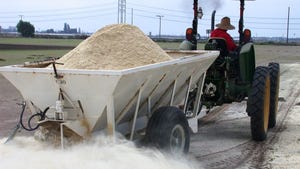
"Fertilizer was stored on the ranch for over 70 percent of the irrigated acres represented, and, of that number, just under 90 percent applied their own fertilizer."

Among other findings related to BMPs, 65 percent of the respondents used outside consultants to guide their fertility programs, 65 percent used mobile irrigation lab services, 45 percent grew non-legume, fallow, cover crops, and 37 percent diverted and confined water for reuse.

Management gains

According to Thomasberg, 88 percent of the 107 respondents said they had improved their nitrate management practices over a 10-year period. Sixty-seven percent, she added, said they had implemented four or more best management practices.

However, she could not account for the difference between the number of growers who monitor for nitrates and those among them who use the data in fertilizer scheduling.

The confidential survey had a brief, four-page format and queried growers about the amount of fertilizer they applied, their fertilizer storage and handling, application methods, and other practices. It also invited comments from growers.

Since the survey was voluntary, she said the agency offered free nitrate quick tests with the questionnaire and a free flashlight when the completed questionnaire was submitted. Some 900 phone calls were made to follow up the questionnaires.

Thomasberg said her agency distributed the questionnaires in May 2001 but later learned they should have been sent out earlier, in February, when growers had more time to respond.

She credited the much of the success of the survey to "public and private partnerships" that are making progress toward finding local, voluntary solutions to water quality issues and to hopefully avoid regulation of nitrate management. Local farm groups helped with publicity on the purpose of the survey before it was taken.

resources

events icon events

product info icon tradeshows

tradeshow icon digests

research icon photos

Continuing Education

Accredited for California, Arizona and CCA hours:


(New Course)
Biopesticides -- Effective Use in Pest Management Programs

Biopesticides are increasingly being recommended as components of Integrated Pest Management (IPM) programs in the production of non-organic high-value specialty crops such as fruit, nut, vegetable, vine, ornamental and turf. This online, accredited course, sponsored by Marrone Bio Innovations, details some of the 245 registered biopesticide active ingredients used in a wide array pest management products.

Accredited in California and Arizona:


(New Course)
Agronomic Principles and Efficient Chemigation and Fertigation Using Center Pivot/Linear Sprinkler Systems

This online CE course details sound mechanical irrigation design and management practices to allow efficient chemigation and fertigation. It is accredited for Certified Crop Adviser CE units and is approved for credit hours in California and Arizona.


(New Course)
Pome, Stone Fruit Pest Management Using New Mode of Action Chemistry

New chemistry Rynaxypyr has proven effective against a wide range of economically important Lepidoptera species. Marketed under the trade name Altacor for use in grapes, pome and stone fruit, details on how to use this new chemistry are in this online Continuing Education course that is accredited in California, Pennsylvania, and New Jersey with CE applications pending in Oregon and Washington.


(New Course)
Vegetable Pest Management Using New Mode of Action

Integration of a new mode of action compound like Coragen into IPM and IRM programs to control Lepidoptera in leafy greens, fruiting vegetables, peppers and brassica or cole crops is always welcome. This online CE accredited details how best to use this new mode of action in intensive vegetable production. It is accredited in California, Arizona, Texas, Georgia, New Jersey and Pennsylvania. Application for credit is pending in Florida and Washington.

Accredited by Accredited in California and Washington:


(New Course)
Utilizing Calcium as Nutrient That Protects Against Disease Organisms

This online accredited course focus on Calcium, an important plant nutrient in fertilizer management for maximum, healthy plant development as well as disease and pest prevention. It is accredited in California, Georgia,: Pennsylvania and New Jersey. Credit pending in Florida, South Carolina, Tennessee, Virginia, West Virginia and Washington.


Accredited by California DPR and California and Arizona Certified Crop Advisers:


(New Course)

Nutrient Management in Key California Crops


This online CEU course offers a detailed look at the nutrient management in key California crops. It is sponsored online by Western Plant Health Association and funded by a grant from the California Department of Food and Agriculture Fertilizer Research and Education Program (FREP). It is accredited for one (1)-hour of credit by the California Department of Pesticide Regulation for California Pest Control Advisers (PCA), Private Applicators, Qualified Applicators and Aerial Applicators. The course is also accredited for 3 units in Nutrient Management (NM) for California and Arizona Certified Crop Advisers (CCAs).

Accredited in California, Arizona, Idaho, Oregon and Washington and for Certified Crop Advisers:


(New Course)
Organic/Sustainable Agricultural Production in the West

Organic/sustainable agriculture is expanding rapidly in the U.S. with an average annual increase of 20% during the last 15 years. This course covers a wide range of pests and organic control strategies. It is accredited for up to 4 continuing education hours for PCAs and Applicator Licensees in California, Arizona, Idaho, Oregon and Washington. It is also approved for Certified Crop Adviser credit.


ACCREDITED IN CALIFORNIA ONLY:


Almond Pest Management

Get the latest info on almond insect pest management and earn 2 hrs. CE DPR and CCA credit in California.

California Groundwater Protection Regulations

Earn 2 hrs. in California laws and regs CE and learn how to protect California groundwater supplies.


Disease Management in California Almonds

Managing diseases in California almond production is a year-long process. This course provides the latest information on controlling these diseases with management practices and fungicides. The course is approved for 2 CEUs by DPR for PCAs and all applicator categories and California CCAs.

Powdery Mildew Control in California Grapevines

Learn about the No. 1 grape disease in California; earn 2 California CE hours.

ACCREDITED IN CALIFORNIA AND ARIZONA:


The Role of Copper in Disease Control

Copper has long been a key tool in disease control in a many crops. This 2-CEU course accredited California PCAs and all DPR applicator categories and Arizona applicators details how best to use copper to maximize its potential.

Insecticide Resistance Management in Agronomic and Row Crops

A 3-hr. CE approved for California and Arizona licensees and CCAs in both states.

Agronomic Weed Resistance Management in Row Crops, Trees Nuts and Vines

Weeds Resistance Management is approved for 3 hours of CE credit for all California and Arizona licensees and Certified Crop Advisers.

Lepidopterous Pest Management/ Pesticide Safety

This course is approved for 2 hours in Arizona and California (1 hr. of laws/regs; 1 hour Other) and for CCAs.

ACCREDITED IN CALIFORNIA, ARIZONA, OREGON, AND WASHINGTON:

Managing Spray Drift to Minimize Problems

This online CEU on managing spray drift to minimize problems is accredited for 2-hours in California (Laws and Regs); Arizona, Oregon and Washington.

Back to Top

Browse Print Issues

Additional Resources

subscribe to Farm Press Daily Southeast Farm Press Southwest Farm Press Delta Farm Press