Honey bee research is long-term solution to almond industry’s growing pollination needs

Jan 16, 2008 11:39 AM, By Cary Blake
Farm Press Editorial Staff
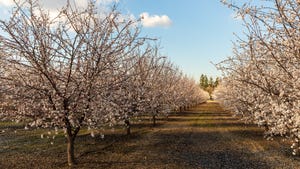
California’s almond bearing acreage is expected to mushroom about 22 percent in the next five years, from 615,000 bearing acres in the 2006-2007 crop year to 750,000 bearing acres in 2011. Yet what’s a stinging concern in the side of almond growers is whether adequate and healthy honey bee numbers will be available for crucial pollination every spring.

Research is a fundamental answer to honey bee issues, including the so-called colony collapse (CCD) disorder that killed millions of bees over the last few years. There is no single answer to the massive bee die-off that helped push colony rental prices up to the $135 per hive range during the 2006-2007 almond season.

“For almond growers, the price of colonies of bees has tripled in the last five years. It has become quite a significant cost of our operations,” said Dan Cummings, owner and general manager of Cummings-Violich, Inc., Chico, Calif., which manages 7,000 acres of almonds and walnuts. Cummings is also co-owner of Olivarez Honey Bees, an apiary business.

“If you look back about five years ago, my pollination expense to produce a pound of almonds was about 8 percent. Today it’s more than 20 percent. That’s what’s on the almond grower’s mind, and potentially it could get worse.” Cummings is chairman of the Almond Board of California’s (ABC) bee task force.

About 60 percent of the U.S. honey bee supply buzzes around California almond orchards each spring for pollination. With almond bearing acreage projections of 750,000 bearing acres in 2011, the demand for pollination could require 1.7 million colonies, or 70 percent of the nation’s current honey bee supply.

Cummings spoke during a panel discussion at the Almond Industry Conference in Modesto, Calif. recently, along with several renowned bee researchers.

Honey bee research

Nutrition is an integral cog in the spinning wheel to maintain honey bee health. Research conducted at the U.S. Department of Agriculture — Agricultural Research Service’s Carl Hayden Bee Research Center, Tucson, Ariz. yielded a new bee supplement product in 2007 called MegaBee. The product, available in liquid or patty form, was developed under an agreement with S.A.F.E. Research & Development, LLC.

“The research would have never gotten off the ground without funding from the Almond Board and the California Beekeepers in the early stages,” according to Hayden Bee Lab research leader Gloria DeGrandi-Hoffman.

“The funding allowed Gordon Wardell (S.A.F.E. president) to leverage those dollars with USDA small business innovative research grants that furthered the research. Our laboratory invested heavily in the project because beekeepers told us they needed a liquid protein diet and a patty diet that would build colonies for pollination, specifically for almonds.”

Other Hayden Bee Lab research is focused on the physiological effects of feeding high fructose corn syrup (HFCS) to bees. The product may be harmless to bees but no one is absolutely sure, DeGrandi-Hoffman said. HFCS from different manufacturers and distributors is under the microscope.

Researchers are checking HFCS for any impact caused by temperature during HFCS shipping, as well as the actual shipping containers. The Hayden facility’s Blaise Leblanc is pursuing the chemistry angle while Diana Sammataro is exploring bee behavior and the effects on bee physiology.

The lab is lacking actual HCFS product delivered to beekeepers. Beekeepers are asked to send HCFS samples to the lab to check for possible contaminants. For more information, contact Sammataro at (520) 670-6380, ext. 121 or diana.sammataro@ars.usda.gov.

Other research is garnered toward two new methods of varroa mite control, 2-Heptanone and Beta Plant Acids.

Meanwhile, a $5 million USDA-ARS grant will be shared amongst USDA-ARS’ four U.S. bee labs in Beltsville, Md.; Weslaco, Texas; Baton Rouge, La.; and Tucson. The funding is to deliver ARS-developed technologies, like the MegaBee diet, to beekeepers and growers. New varroa controls will also be tested.

“The Tucson lab has been charged with the Western U.S. and how to keep bees healthy for pollination, how to get them ready to go into almonds, and to come out of almonds in healthy, vigorous shape for the pollination of other crops,” DeGrandi-Hoffman said. A large part of the area-wide project is to specifically tailored for the almond industry, making sure the industry has strong, healthy colonies to fit pollination needs.

In addition, the Tucson lab is developing a five-year plan, 2009 to 2014, for further bee health research. The three major objectives include:

–Determining the effects of nutrition from pollen and HFCS on honey bee health and longevity;

–Determining the chemical components in pollen and HFCS that impact bee health and longevity; and

–Evaluating the effects of supplemental feeding on the varroa tolerance, queen production, and foraging and cross-pollination rates of honey bee colonies.

DeGrandi-Hoffman and Eric Mussen, Extension apiculturist, University of California, Davis, represent academia and research on the ABC’s bee task force.

Respected bee breeder and geneticist Susan Cobey also addressed honey bee research issues. She joined UC Davis as a staff research associate in May 2007. Cobey’s responsibilities include managing and rebuilding the Harry J. Laidlaw Jr. Honey Bee Research Center at Davis.

Cobey, a world-renowned bee insemination expert, plans to concentrate her efforts on rebuilding and improving honey bee stocks.

“The industry hasn’t made much progress in stock improvement as honey bees mate in flight which makes mating difficult to control,” Cobey said. “Honey bees are also very sensitive to inbreeding resulting in a general loss of vigor.” Therefore, multiple mating behavior is critical to colony health.

Cobey also tied limited foundation stocks to a U.S. stock importation ban in 1922. Prior to the ban, the U.S. had nine sub-species of the 26 available in the world. Just two sub-species are recognizable in the U.S. today — the Italian and the Carniolan.

The diversity of the honey bee gene pool has also suffered due to colony losses linked to parasitic mites — tracheal and varroa — and from so-called CCD.

“Research shows that a more genetically diverse worker force in a colony increases brood viability, disease resistance, improves foraging behavior, and increases survivability and production, while enhancing queen physiology and quality,” Cobey said.

Queens mate with up to 60 drones, while six to 12 is about average. The queen stores only about 10 percent of the semen collected. Interestingly, each drone contributes a small amount of semen providing a uniform mixture of all the mated drones. The greater drone diversity allows the queen to produce a more solid, productive brood. Greater diversity increases bee fitness and the ability to deal with pests and diseases.

“This increases bees’ general ability to exploit resources including nest finding and production levels,” Cobey said. “Well mated queens produce a higher level of pheromone blend and are more attractive to worker bees.”

The California State Beekeepers Association funded Cobey’s proposal to examine European stocks to enhance genetic diversities in U.S. bees. The hope is to import semen instead of live bees to avoid parasitic mites and diseases. Cobey has several collaborators working on this theme.

Beekeeper perspective

A tough job is getting a handle on the supply and health of bees available to California almond growers for pollination each spring.

“The best lesson you can learn about bees — as soon as you thought you knew everything about them, forget it because you’re just starting to learn,” said Orin Johnson, a Hughson, Calif. beekeeper and 2006 president of the California State Beekeepers Association Inc.

Bees generally start coming into California for the winter in early November, Johnson said.

Johnson had talked with numerous beekeepers that were upbeat and thought bees were in good physical shape. He referenced one person who unloaded 15,000-plus hives over several weeks in the Stanilaus County area. By the time the individual left, some hives didn’t look as good.

“Our (beekeepers) most crucial period of the year is from Nov. 1 to Feb. 1. If bees are not in good shape this time of year, this is not the time for bees to get healthy. They generally will get worse before they get better,” Johnson said.

Johnson had talked with bee brokers who didn’t paint a good forecast. Johnson was unsure how that would equate with supplies on Feb. 1.

“For those in the almond industry, I urge you to stay in touch with your beekeeper,” Johnson said. “It doesn’t hurt to call now instead of waiting until the middle of January. See how we’re doing, get a feel for what’s going on, keep in touch, and make the beekeeper your best friend.”

At the recent California State Beekeeper’s Association, the non-profit group donated nearly $70,000 to fund seven pollination-related research projects.

email: cblake@farmpress.com

Get Copyright ClearanceWant to use this article? Click here for options!
© 2009 Penton Media, Inc.


Latest Jobs

resources

events icon events

product info icon tradeshows

tradeshow icon digests

research icon photos

Continuing Education

Accredited for California, Arizona and CCA hours:


(New Course)
Biopesticides -- Effective Use in Pest Management Programs

Biopesticides are increasingly being recommended as components of Integrated Pest Management (IPM) programs in the production of non-organic high-value specialty crops such as fruit, nut, vegetable, vine, ornamental and turf. This online, accredited course, sponsored by Marrone Bio Innovations, details some of the 245 registered biopesticide active ingredients used in a wide array pest management products.

Accredited in California and Arizona:


(New Course)
Agronomic Principles and Efficient Chemigation and Fertigation Using Center Pivot/Linear Sprinkler Systems

This online CE course details sound mechanical irrigation design and management practices to allow efficient chemigation and fertigation. It is accredited for Certified Crop Adviser CE units and is approved for credit hours in California and Arizona.


(New Course)
Pome, Stone Fruit Pest Management Using New Mode of Action Chemistry

New chemistry Rynaxypyr has proven effective against a wide range of economically important Lepidoptera species. Marketed under the trade name Altacor for use in grapes, pome and stone fruit, details on how to use this new chemistry are in this online Continuing Education course that is accredited in California, Pennsylvania, and New Jersey with CE applications pending in Oregon and Washington.


(New Course)
Vegetable Pest Management Using New Mode of Action

Integration of a new mode of action compound like Coragen into IPM and IRM programs to control Lepidoptera in leafy greens, fruiting vegetables, peppers and brassica or cole crops is always welcome. This online CE accredited details how best to use this new mode of action in intensive vegetable production. It is accredited in California, Arizona, Texas, Georgia, New Jersey and Pennsylvania. Application for credit is pending in Florida and Washington.

Accredited by Accredited in California and Washington:


(New Course)
Utilizing Calcium as Nutrient That Protects Against Disease Organisms

This online accredited course focus on Calcium, an important plant nutrient in fertilizer management for maximum, healthy plant development as well as disease and pest prevention. It is accredited in California, Georgia,: Pennsylvania and New Jersey. Credit pending in Florida, South Carolina, Tennessee, Virginia, West Virginia and Washington.


Accredited by California DPR and California and Arizona Certified Crop Advisers:


(New Course)

Nutrient Management in Key California Crops


This online CEU course offers a detailed look at the nutrient management in key California crops. It is sponsored online by Western Plant Health Association and funded by a grant from the California Department of Food and Agriculture Fertilizer Research and Education Program (FREP). It is accredited for one (1)-hour of credit by the California Department of Pesticide Regulation for California Pest Control Advisers (PCA), Private Applicators, Qualified Applicators and Aerial Applicators. The course is also accredited for 3 units in Nutrient Management (NM) for California and Arizona Certified Crop Advisers (CCAs).

Accredited in California, Arizona, Idaho, Oregon and Washington and for Certified Crop Advisers:


(New Course)
Organic/Sustainable Agricultural Production in the West

Organic/sustainable agriculture is expanding rapidly in the U.S. with an average annual increase of 20% during the last 15 years. This course covers a wide range of pests and organic control strategies. It is accredited for up to 4 continuing education hours for PCAs and Applicator Licensees in California, Arizona, Idaho, Oregon and Washington. It is also approved for Certified Crop Adviser credit.


ACCREDITED IN CALIFORNIA ONLY:


Almond Pest Management

Get the latest info on almond insect pest management and earn 2 hrs. CE DPR and CCA credit in California.

California Groundwater Protection Regulations

Earn 2 hrs. in California laws and regs CE and learn how to protect California groundwater supplies.


Disease Management in California Almonds

Managing diseases in California almond production is a year-long process. This course provides the latest information on controlling these diseases with management practices and fungicides. The course is approved for 2 CEUs by DPR for PCAs and all applicator categories and California CCAs.

Powdery Mildew Control in California Grapevines

Learn about the No. 1 grape disease in California; earn 2 California CE hours.

ACCREDITED IN CALIFORNIA AND ARIZONA:


The Role of Copper in Disease Control

Copper has long been a key tool in disease control in a many crops. This 2-CEU course accredited California PCAs and all DPR applicator categories and Arizona applicators details how best to use copper to maximize its potential.

Insecticide Resistance Management in Agronomic and Row Crops

A 3-hr. CE approved for California and Arizona licensees and CCAs in both states.

Agronomic Weed Resistance Management in Row Crops, Trees Nuts and Vines

Weeds Resistance Management is approved for 3 hours of CE credit for all California and Arizona licensees and Certified Crop Advisers.

Lepidopterous Pest Management/ Pesticide Safety

This course is approved for 2 hours in Arizona and California (1 hr. of laws/regs; 1 hour Other) and for CCAs.

ACCREDITED IN CALIFORNIA, ARIZONA, OREGON, AND WASHINGTON:

Managing Spray Drift to Minimize Problems

This online CEU on managing spray drift to minimize problems is accredited for 2-hours in California (Laws and Regs); Arizona, Oregon and Washington.

Back to Top

Browse Print Issues

Additional Resources

subscribe to Farm Press Daily Southeast Farm Press Southwest Farm Press Delta Farm Press