Benefits, challenges of Roundup Ready alfalfa examined

Sep 29, 2004 9:37 AM, By Harry Cline

Commercial varieties of Roundup Ready alfalfa are expected to be available to California forage producers next year.

A team of University of California Cooperative Extension farm advisors have been evaluating this new technology for the past four years and two of those specialists, Fresno County farm advisor and weed specialists Kurt Hembree and Ron Vargas, his counterpart in Madera County, are convinced alfalfa tolerant to glyphosate will be a valuable new tool for forage growers.

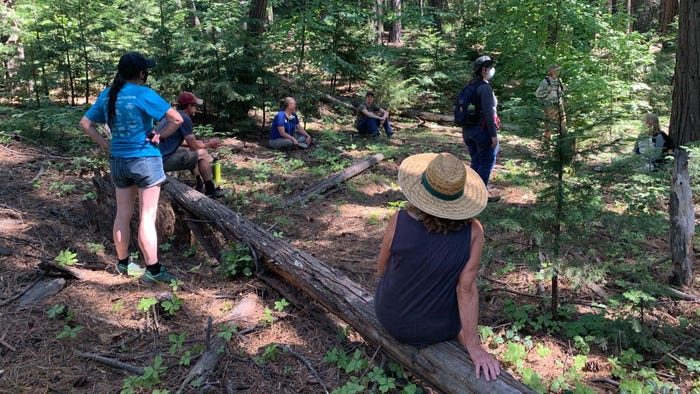
The two farm advisors told a standing-room-only alfalfa field day at the UC Kearney Ag Center in Parlier that the only question remaining is the economic benefit—what will Monsanto and Forage Genetics International charge for this new technology. They have not tipped their hand to Vargas and Hembree.

Hembree and Vargas said there are stewardship issues with this new technology. However, those concerns can be managed for growers to apply glyphosate over the top of alfalfa to kill weeds without damaging the crop. It will be third major crop in the West with this technology. Corn and cotton varieties are the other two.

"Roundup Ready alfalfa will not be a panacea, but it will be a real good tool for alfalfa growers" in establishing alfalfa and producing quality hay for the life of a stand, said Hembree.

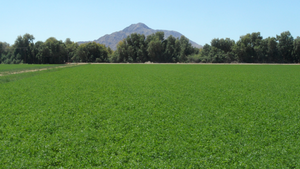
Hembree said it will be easier to establish a weed-free stand of alfalfa with the technology and it should remain weed free for its life span of three to five years in the central San Joaquin Valley.

Better quality

Hay quality should improve with fewer weeds and animal welfare should improve with the control of poisonous and other undesirable weeds, he added.

However, Roundup will not control all weeds. Cheeseweed, nettles, fleabane, filaree, henbit and marestail are not effectively controlled Roundup, said Hembree.

Tank mixes will be necessary to cover all weeds. Hembree said form his tests in Fresno County, he expects a tank mix of Roundup and Pursuit to be the standard for alfalfa weed control.

That is not all bad. Vargas and Hembree continually raise red flat of weed resistance with constant Roundup treatment. They both say the technology will offer longevity only if growers rotate weed control chemistry and tank mixing.

"Roundup should not be used every year for the life of the stand. Consider rotating with other chemistry and tank mixing to prevent resistance," said Hembree, who reminded grower and pest control advisers at the field day that there are 5,000 acres of ryegrass in California identified as resistant to glyphosate. In the Midwest, there are at least 500,000 acres of Roundup-resistant marestail.

"We are seeing reports from the U.S. cotton Belt of Roundup resistance in lambsquarter," said Vargas, who was called to an almond orchard in Madera County where the berms were "solid lambsquarter" after two glyphosate applications. Other growers have reported to Vargas that they are beginning to have difficulty controlling lambsquarter with Roundup.

‘Weed shifts’

Using Roundup will also result in "weed shifts." Weeds not controlled by Roundup will become more dominant and that can change a grower’s weed control strategy.

While there has been considerable discussion about emerging resistance to Roundup since the introduction of herbicide-resistant crops, Roundup has been identified as a herbicides with a low risk of resistance buildup.

Herbicide resistance is not exclusive to Roundup, Vargas noted. There are reports from California’s Imperial Valley of weed resistance to the newer grass herbicides as well as resistance to ALS inhibitor herbicides elsewhere.

"Rotate herbicides with different modes of action. If you rotate Roundup and Touchdown, you are not rotating herbicides," said Vargas

And, use recommended rates. A University of Nebraska study revealed a rapid buildup in herbicide resistance when growers cut rates to sub-lethal doses.

"Monitor for resistance. Make note of clumps of weeds," said Vargas.

"And know what weeds you are trying to control," said Hembree. This will allow for best herbicide selection to control the weeds.

Hembree said the Forage Genetics varieties released in 2005 are expected to be in dormancy classes 3 and 8. "We have been working with some of the new varieties at the West Side Research and Extension Center at Five Points and they look pretty darn good," he added.

Expect a 5 percent loss at stand establishment with herbicide-resistant variety because seed lots will not be 100 percent pure, said Hembree.

The Fresno County farm advisor said one pound active ingredient is just as effective as two pounds, but application timing is critical. The three-to-four trifoliate stage is ideal. Applying Roundup at the first trifoliate is too early because a second weed flush is likely. Treat at the six-to-nine trifoliate stage and the crop canopy will prevent Roundup contact with the weeds.

Add flexibility

Roundup Ready alfalfa will offer more flexibility to growers in weed control and possibly stand establishment. Typically, alfalfa stands are established in the fall. With this new technology, Hembree said it may be possible to establish alfalfa in the spring if a grower finds himself kept out of the field in the fall. That is usually precluded now by the threat of weeds taking over the stand before it is well-established.

Gene flow does not seem to be an issue with isolation of 900 feet between conventional and Roundup Ready alfalfas for forage production. The isolation between seed fields needs to be at least 1,500 feet.

Feral alfalfa, however, poses a challenge. This can develop into a problem along roadsides where feral alfalfa is common. County road crews now use Roundup to control this alfalfa, but with herbicide resistant alfalfa, this could be a new challenge in keeping roadsides clean, said Vargas.

Feral Roundup Ready alfalfa could be problem if is part of a rotation with Roundup Ready cotton and corn. Vargas’ recommendation is to avoid rotating glyphosate crops.

"You do not want to lose this technology," said Vargas.

Glyphosate is used to take out conventional alfalfa stands. Vargas said 2, 4-D and Dicamba will take out herbicide-resistant stands in the fall, but that may be a touchy issue since there are times when phenoxy herbicides are banned in the valley and others areas.

Marketing Roundup-resistant alfalfa is not expected to be a major issue since the majority of California’s hay is sold domestically. However, Vargas pointed out that Japan is a prominent destination of hay exported from the U.S. Japan has been reluctant to accept genetically modified crops.

Four years of research by the UC team has well-identified the problems associated with Roundup Ready alfalfa. Hembree and Vargas are convinced the benefits far outweigh the risks.

e-mail:hcline@primediabusiness.com

Get Copyright ClearanceWant to use this article? Click here for options!
© 2009 Penton Media, Inc.


Latest Jobs

resources

events icon events

product info icon tradeshows

tradeshow icon digests

research icon photos

Continuing Education

Accredited for California, Arizona and CCA hours:


(New Course)
Biopesticides -- Effective Use in Pest Management Programs

Biopesticides are increasingly being recommended as components of Integrated Pest Management (IPM) programs in the production of non-organic high-value specialty crops such as fruit, nut, vegetable, vine, ornamental and turf. This online, accredited course, sponsored by Marrone Bio Innovations, details some of the 245 registered biopesticide active ingredients used in a wide array pest management products.

Accredited in California and Arizona:


(New Course)
Agronomic Principles and Efficient Chemigation and Fertigation Using Center Pivot/Linear Sprinkler Systems

This online CE course details sound mechanical irrigation design and management practices to allow efficient chemigation and fertigation. It is accredited for Certified Crop Adviser CE units and is approved for credit hours in California and Arizona.


(New Course)
Pome, Stone Fruit Pest Management Using New Mode of Action Chemistry

New chemistry Rynaxypyr has proven effective against a wide range of economically important Lepidoptera species. Marketed under the trade name Altacor for use in grapes, pome and stone fruit, details on how to use this new chemistry are in this online Continuing Education course that is accredited in California, Pennsylvania, and New Jersey with CE applications pending in Oregon and Washington.


(New Course)
Vegetable Pest Management Using New Mode of Action

Integration of a new mode of action compound like Coragen into IPM and IRM programs to control Lepidoptera in leafy greens, fruiting vegetables, peppers and brassica or cole crops is always welcome. This online CE accredited details how best to use this new mode of action in intensive vegetable production. It is accredited in California, Arizona, Texas, Georgia, New Jersey and Pennsylvania. Application for credit is pending in Florida and Washington.

Accredited by Accredited in California and Washington:


(New Course)
Utilizing Calcium as Nutrient That Protects Against Disease Organisms

This online accredited course focus on Calcium, an important plant nutrient in fertilizer management for maximum, healthy plant development as well as disease and pest prevention. It is accredited in California, Georgia,: Pennsylvania and New Jersey. Credit pending in Florida, South Carolina, Tennessee, Virginia, West Virginia and Washington.


Accredited by California DPR and California and Arizona Certified Crop Advisers:


(New Course)

Nutrient Management in Key California Crops


This online CEU course offers a detailed look at the nutrient management in key California crops. It is sponsored online by Western Plant Health Association and funded by a grant from the California Department of Food and Agriculture Fertilizer Research and Education Program (FREP). It is accredited for one (1)-hour of credit by the California Department of Pesticide Regulation for California Pest Control Advisers (PCA), Private Applicators, Qualified Applicators and Aerial Applicators. The course is also accredited for 3 units in Nutrient Management (NM) for California and Arizona Certified Crop Advisers (CCAs).

Accredited in California, Arizona, Idaho, Oregon and Washington and for Certified Crop Advisers:


(New Course)
Organic/Sustainable Agricultural Production in the West

Organic/sustainable agriculture is expanding rapidly in the U.S. with an average annual increase of 20% during the last 15 years. This course covers a wide range of pests and organic control strategies. It is accredited for up to 4 continuing education hours for PCAs and Applicator Licensees in California, Arizona, Idaho, Oregon and Washington. It is also approved for Certified Crop Adviser credit.


ACCREDITED IN CALIFORNIA ONLY:


Almond Pest Management

Get the latest info on almond insect pest management and earn 2 hrs. CE DPR and CCA credit in California.

California Groundwater Protection Regulations

Earn 2 hrs. in California laws and regs CE and learn how to protect California groundwater supplies.


Disease Management in California Almonds

Managing diseases in California almond production is a year-long process. This course provides the latest information on controlling these diseases with management practices and fungicides. The course is approved for 2 CEUs by DPR for PCAs and all applicator categories and California CCAs.

Powdery Mildew Control in California Grapevines

Learn about the No. 1 grape disease in California; earn 2 California CE hours.

ACCREDITED IN CALIFORNIA AND ARIZONA:


The Role of Copper in Disease Control

Copper has long been a key tool in disease control in a many crops. This 2-CEU course accredited California PCAs and all DPR applicator categories and Arizona applicators details how best to use copper to maximize its potential.

Insecticide Resistance Management in Agronomic and Row Crops

A 3-hr. CE approved for California and Arizona licensees and CCAs in both states.

Agronomic Weed Resistance Management in Row Crops, Trees Nuts and Vines

Weeds Resistance Management is approved for 3 hours of CE credit for all California and Arizona licensees and Certified Crop Advisers.

Lepidopterous Pest Management/ Pesticide Safety

This course is approved for 2 hours in Arizona and California (1 hr. of laws/regs; 1 hour Other) and for CCAs.

ACCREDITED IN CALIFORNIA, ARIZONA, OREGON, AND WASHINGTON:

Managing Spray Drift to Minimize Problems

This online CEU on managing spray drift to minimize problems is accredited for 2-hours in California (Laws and Regs); Arizona, Oregon and Washington.

Back to Top

Browse Print Issues

Additional Resources

subscribe to Farm Press Daily Southeast Farm Press Southwest Farm Press Delta Farm Press