How close is California grape industry to another wine glut

Mar 30, 2006 9:16 AM, By Harry Cline, Farm Press Editorial Staff


It would not take much to dunk California wine grape growers in another sea of surplus wine this season.

Growers are one crop away from another big surplus and falling grape prices in the wake of the largest grape crush in history last season when 4.3 million tons of grapes were crushed, 3.7 million for wine and 550,000 tons for concentrate.

All it would take for the industry to go blub, blub, blub once again is for wine sales to falter, and the ’06 crop to come in with an average yield higher than the historical 10-year average yield of 6.7 tons per acre.

Even if the ’06 average hits the decade calculated average of 6.7 tons it would make the season now at bud break the third largest California wine grape crush in history. Three of the last 10 years had average yields of more than 7 tons per acre.

In evaluating the impact of the huge ’05 crush and its implications on the nearby and long-term future, Allied Grape Growers, the state’s largest marketing cooperative, says the likelihood of another huge crop is “very small” but definitely a possibility.

According to Allied president Nat DiBuduo, through bud dissection and subjective measures of the crop just now breaking dormancy the indicators “point to the likelihood that 2006 will be on the short side for both wine grapes and seedless varieties.” He certain hopes it will.

However, before last summer no one expected ’05 to be a tank buster. When wineries realized how big it was, the spot market not only fell, it disappeared. Even when it was in the tanks, most producers were clueless to how big it had been. DiBuduo’s estimate at the January Unified Wine and Grape Symposium of 3.4 million tons of wine grapes crushed in ’05 was the largest publicized, and it was underestimated by 300,000 tons. This alone is enough to add 319 million gallons to winery inventory.

All varieties gain

Every significant wine grape variety in the state recorded an increase in tonnage last year. Some of the key ones were huge; Merlot up 45 percent over ’04; Chardonnay at 740,000 tons (17 percent of the crush) the largest varietal in the state was up 41 percent over ’04. Cabernet Sauvignon (12.5 percent of the total crush) was up 50 percent. Admittedly ’04 was the smallest average yields per acre (5.9 tons per acre) in the past decade, but still the tonnage increase from ’04 to ’05 was staggering.

While the average prices for all grapes crushed was up 11 percent from $473 per ton in ’04 to $524 last season, the average wine grape price was up only 2 percent to $580 per ton and raisin varieties (467,000 crushed tons) were down 18 percent to just $164 per ton.

As big as it was, the ’05 crop “didn’t necessarily add to an existing surplus” because DiBuduo said most wineries were “in balance.

“As long as 2006 doesn’t provide us with an above average crop and wine shipments remain strong and growing, the 2005 crop will simply be absorbed by the market in time,” said the Allied CEO.

However, DiBuduo admitted buyers and growers alike will be watching this season’s crop development “very closely.”

Wineries were obviously watching very closely last season, and the wine grape market died during the season when wineries realized the crop was huge. It ended up with 1 million tons more wine grapes crushed in ’05 than ’04.

For years, acreage as well as crop size has been what everyone watched to get a handle on crop size. However, acreage is not expected to change significantly in the near future and for now is a non-factor in guesstimating crop size. For the immediate future, the yields will be the critical element in determining whether growers make a profit or not.

Long-term problem?

A large ’06 crop could really find the industry swimming in inventory. However, the prospect of treading water beyond that is also possible. California could be in for a long series of 3-million-ton crops without any change in acreage, said Allied in a report to the industry.

The 10-year average wine grape yield is 6.7 tons providing a good crop estimating factor since the bearing acreage is not expected to change much over the next three to five years. There are about 480,000 bearing acres of wine grapes in the state.

“The bottom line is that … an average yield this season would produce the third largest crush in California history,” pointed out DiBuduo.

“We are near the largest amount of bearing wine grape vineyards we’ve ever had,” even with more than 100,000 acres pushed and burned over the past five years. About half that acreage was wine grapes. The remainder was table and raisin varieties. Much of what was pushed out was old and the loss of tonnage from those pullouts has been minimized by newer, high producing vineyards now reaching production.

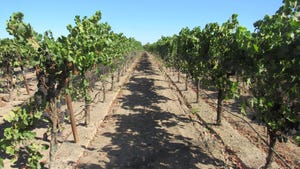
DiBuduo said one of the key reasons California wine grape crushes could be 3 million tons or more per year for the foreseeable future is that many of the acres planted in 2001-2004 are now “primed for maximum production. They consist of young, healthy vines with closer spacing and enhanced irrigation, nutrition and trellis designs.

“We have a new base of bearing acres going forward, and the potential for larger than historical crops is definitely there,” explained DiBuduo.

Sales challenge

At the current growth rate of wine sales, the wine grape market looks like it will be a year-to-year marketing challenge depending on yield.

“Our goal is not to frighten anyone that we will be swimming in inventory in the future, but we need to be careful about being overly-optimistic about market trends and looming shortages.

“Why don’t we enjoy a balanced market for awhile and only plant when sensible contracts to do so are provided by buyers,” he suggested strongly.

However, that is not likely to be the case since “most buyers do not offer contracts until it is too late and they are already short.”

e-mail:hcline@farmpress.com*

Get Copyright ClearanceWant to use this article? Click here for options!
© 2008 Penton Media, Inc.


Latest Jobs

resources

events icon events

product info icon tradeshows

tradeshow icon digests

research icon photos

Continuing Education

Accredited in California, Arizona, Idaho, Oregon and Washington and for Certified Crop Advisers:


(New Course)
Organic/Sustainable Agricultural Production in the West

Organic/sustainable agriculture is expanding rapidly in the U.S. with an average annual increase of 20% during the last 15 years. This course covers a wide range of pests and organic control strategies. It is accredited for up to 4 continuing education hours for PCAs and Applicator Licensees in California, Arizona, Idaho, Oregon and Washington. It is also approved for Certified Crop Adviser credit.

ACCREDITED IN OREGON AND WASHINGTON:


(New Course)
Managing Spray Drift to Minimize Problems

This online spray drift management course has been certified by the Oregon Department of Agriculture and the Washington Department of Agriculture for 2 hours of credit for licensed Applicators and Consultants in Oregon and Washington.

ACCREDITED IN CALIFORNIA ONLY:


Almond Pest Management

Get the latest info on almond insect pest management and earn 2 hrs. CE DPR and CCA credit in California.

California Groundwater Protection Regulations

Earn 2 hrs. in California laws and regs CE and learn how to protect California groundwater supplies.


Disease Management in California Almonds

Managing diseases in California almond production is a year-long process. This course provides the latest information on controlling these diseases with management practices and fungicides. The course is approved for 2 CEUs by DPR for PCAs and all applicator categories and California CCAs.

Powdery Mildew Control in California Grapevines

Learn about the No. 1 grape disease in California; earn 2 California CE hours.

ACCREDITED IN CALIFORNIA AND ARIZONA:


The Role of Copper in Disease Control

Copper has long been a key tool in disease control in a many crops. This 2-CEU course accredited California PCAs and all DPR applicator categories and Arizona applicators details how best to use copper to maximize its potential.

Insecticide Resistance Management in Agronomic and Row Crops

A 3-hr. CE approved for California and Arizona licensees and CCAs in both states.

Agronomic Weed Resistance Management in Row Crops, Trees Nuts and Vines

Weeds Resistance Management is approved for 3 hours of CE credit for all California and Arizona licensees and Certified Crop Advisers.

Lepidopterous Pest Management/ Pesticide Safety

This course is approved for 2 hours in Arizona and California (1 hr. of laws/regs; 1 hour Other) and for CCAs.

Managing Spray Drift to Minimize Problems

2-hrs laws and regs for California licensees; 2 hours in Arizona and for CCAs.

Back to Top

Browse Print Issues

Additional Resources

subscribe to Farm Press Daily Southeast Farm Press Southwest Farm Press Delta Farm Press