Record supplies will depress U.S. exports over 2004

Feb 28, 2005 9:24 AM, By Hembree Brandon

ARLINGTON, Va. — U.S. agricultural exports are forecast to hit $59 billion in fiscal 2005, down from the $62.3 billion level of 2004, but up $3 billion from USDA’s Nov. 2004 projection.

The decline from 2004 is due to record global grain, soybean, and cotton supplies, according to Nora Brooks and Carol Whitton, Economic Research Service coordinators, and Ernest Carter, Food and Agriculture Service coordinator. Their projections were presented at USDA’s Agricultural Outlook Forum 2005 here.

"The gains in export value since the November forecast reflect further depreciation of the U.S. dollar compared to currencies of major export competitors and rising global demand, buoyed by strong economic growth," their report noted.

Higher prices also will boost the expected export value of soybeans and cotton.

Supported by strong global demands and a weaker dollar, the value of U.S. horticultural products, dairy products, and pork are all forecast to hit record highs.

Agricultural imports are forecast to also set a record in 2005, at $58 billion. This faster pace in growth, which started in 2003, is mainly due to broad-based gains in the prices of imports as the value of the U.S. dollar has declined.

Horticultural products account for 50 percent to 60 percent of the annual gain, but rising imports of live cattle, beef, and snack foods "are also significant," the report said.

Global economic growth remains strong, but is expected to slow somewhat in 2005, and oil prices appear likely to stay at historically high nominal levels "for some time to come."

Higher industrial commodity prices and interest rates also pose a risk to continued robust global growth, the economists said.

China factor

World growth prospects for 2005 will be highly dependent on China, they noted. "China’s economic growth is critical to world economic growth. China’s roaring economy prompted a surge in demand in late 2003 and 2004 that resulted in increasing prices of raw materials, such as crude oil, and intermediate goods, such as steel and cement."

Although the Chinese government has rationed credit in an attempt to curtail inflation, major forecasters see that country’s total imports as comparable to those of the U.S. in 2004 and 2005.

"This import growth picture makes prospects for world growth very good for 2005."

China’s gross domestic product (GDP) is expected to exceed 8 percent in 2005, compared to 9 percent in 2003 and 2004.

Economic growth in developing countries is projected to exceed 5 percent this year, with Asia continuing as the fastest-growing region, and India a close second, followed by South Korea. The five major economies in Latin America – Argentina, Brazil, Mexico, Venezuela, and Chile – are all experiencing strong growth.

The U.S. dollar has been declining against the currencies of major countries since Feb. 2002, which results in higher prices for imports.

USDA’s forecast for grain and feed exports is unchanged from its November report, at $15.1 billion. Rice export volume has been increased by 100,000 tons, based on larger sales to Southeast Asia and the Middle East and more competitive prices. Compared to 2004, rice export volume is virtually unchanged, but value is down about $200 million because of sharply lower prices due to a record U.S. crop and record supplies.

Oilseeds, products

The forecast for oilseeds and products has been raised by 1.6 million tons, with a value of $9.9 billion. A sharp increase in shipments is expected for minor vegetable oils and processed oilseed products.

Soybean export volume is forecast at 27.5 million tons, but an increase in average unit price to $223 per ton will boost value to $6.1 billion. Most of the stronger pace of U.S. soybean shipments is attributed to China. A larger portion of U.S. soybeans is expected to be sold during the first half of the marketing year before most South American soybeans reach market in the spring.

The forecast for U.S. cotton exports for fiscal 2005 has been increased 100,000 tons from November; higher volume and somewhat stronger unit value will boost the value by $300 million to a total $3.4 billion.

"Despite a further upward revision in record global production, demand remains very strong and is expected to keep world prices somewhat higher than anticipated in November," the economists said. "China’s imports of cotton from all countries is expected to remain near record levels. U.S. exportable supplies are larger than anticipated due to an upward revision in the record U.S. crop in 2004."

Livestock, poultry, and dairy products exports for fiscal 2005 are projected at $11.5 billion, up $700 million from the November forecast, with red meats and dairy products accounting for most of the gain. Pork exports are expected to reach a record 800,000 tons.

The forecast for U.S. horticultural products has been raised by $700 million from the November estimate, for a record $14.5 billion, mainly reflecting higher prices due to increased foreign demand and a weaker dollar.

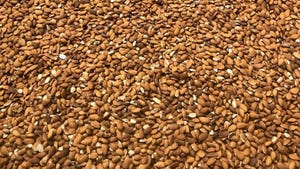
Export forecasts for tree nuts, fresh and processed fruits, and fresh and processed vegetables have each been raised $200 million from the November estimates. Record walnut and pistachio crops are expected and the almond crop will be near-record, the analysts said. Successive almond crop failures in Spain and low global pistachio stocks will also support higher prices.

e-mail:hbrandon@primediabusiness.com

Get Copyright ClearanceWant to use this article? Click here for options!
© 2008 Penton Media, Inc.


Latest Jobs

resources

events icon events

product info icon tradeshows

tradeshow icon digests

research icon photos

Continuing Education

Accredited by California DPR and California and Arizona Certified Crop Advisers:


(New Course)

Nutrient Management in Key California Crops


This online CEU course offers a detailed look at the nutrient management in key California crops. It is sponsored online by Western Plant Health Association and funded by a grant from the California Department of Food and Agriculture Fertilizer Research and Protection Program (FREP). It is accredited for one (1)-hour of credit by the California Department of Pesticide Regulation for California Pest Control Advisers (PCA), Private Applicators, Qualified Applicators and Aerial Applicators. The course is also accredited for 3 units in Nutrient Management (NM) for California and Arizona Certified Crop Advisers (CCAs).

Accredited in California, Arizona, Idaho, Oregon and Washington and for Certified Crop Advisers:


(New Course)
Organic/Sustainable Agricultural Production in the West

Organic/sustainable agriculture is expanding rapidly in the U.S. with an average annual increase of 20% during the last 15 years. This course covers a wide range of pests and organic control strategies. It is accredited for up to 4 continuing education hours for PCAs and Applicator Licensees in California, Arizona, Idaho, Oregon and Washington. It is also approved for Certified Crop Adviser credit.

ACCREDITED IN OREGON AND WASHINGTON:


(New Course)
Managing Spray Drift to Minimize Problems

This online spray drift management course has been certified by the Oregon Department of Agriculture and the Washington Department of Agriculture for 2 hours of credit for licensed Applicators and Consultants in Oregon and Washington.

ACCREDITED IN CALIFORNIA ONLY:


Almond Pest Management

Get the latest info on almond insect pest management and earn 2 hrs. CE DPR and CCA credit in California.

California Groundwater Protection Regulations

Earn 2 hrs. in California laws and regs CE and learn how to protect California groundwater supplies.


Disease Management in California Almonds

Managing diseases in California almond production is a year-long process. This course provides the latest information on controlling these diseases with management practices and fungicides. The course is approved for 2 CEUs by DPR for PCAs and all applicator categories and California CCAs.

Powdery Mildew Control in California Grapevines

Learn about the No. 1 grape disease in California; earn 2 California CE hours.

ACCREDITED IN CALIFORNIA AND ARIZONA:


The Role of Copper in Disease Control

Copper has long been a key tool in disease control in a many crops. This 2-CEU course accredited California PCAs and all DPR applicator categories and Arizona applicators details how best to use copper to maximize its potential.

Insecticide Resistance Management in Agronomic and Row Crops

A 3-hr. CE approved for California and Arizona licensees and CCAs in both states.

Agronomic Weed Resistance Management in Row Crops, Trees Nuts and Vines

Weeds Resistance Management is approved for 3 hours of CE credit for all California and Arizona licensees and Certified Crop Advisers.

Lepidopterous Pest Management/ Pesticide Safety

This course is approved for 2 hours in Arizona and California (1 hr. of laws/regs; 1 hour Other) and for CCAs.

Managing Spray Drift to Minimize Problems

2-hrs laws and regs for California licensees; 2 hours in Arizona and for CCAs.

Back to Top

Browse Print Issues

Additional Resources

subscribe to Farm Press Daily Southeast Farm Press Southwest Farm Press Delta Farm Press