Lime sulfur seen as aid for black measles of grapes

Dec 19, 2005 9:12 AM, By Dan Bryant

Lime sulfur sprays can manage the trio of pathogens that cause black measles, also known as young vine decline, in California vineyards, says a University of California plant pathologist.

According to Doug Gubler, the combination of fungi, which also goes by the names esca, Spanish measles, and Petri disease, is throughout the state, as well as everywhere else grapes are grown.

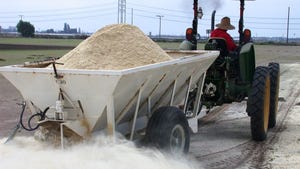
Pending results of continuing trials during the winter, Gubler said his studies indicate that treatments of lime sulfur at 10 to 15 gallons per acre will kill the spores of the disease complex.

An alternative treatment is packing infected vine cavities with any tar-like substance to seal off the fungi and stop release of their spores.

Black measles symptoms, usually seen in July and August, include discolored leaves and cane dieback and later spotted, spoiled fruit. Infections can lead to a 50 percent loss of new shoots and also support entry into vines by other destructive, wood rot fungi. Infected tools used during pruning and grafting may also spread the pathogens.

The disease complex, by one name or another, has been described since antiquity and has evolved with vines. Plant pathologists have known for decades of the several fungi involved, although they could not introduce infections and cause symptoms and therefore discounted them as pathogens.

Grow rapidly

Only in the last several years has Gubler learned more about the pathogens’ biology, particularly that they grow rapidly in the presence of proteins in the sap of water-stressed vines. He was able to isolate them and then re-infect young, water-stressed vines with them.

At a recent plant disease seminar in Salinas, he identified the three major pathogens in California as Phaeomoniella chlamydospora, Phaeoacremonium inflatipes, and Phaeoacremonium aleophilium.

The first and second pathogens release spores from February to June, and the third from February to late July. All three reside in cavities on the vine, and fresh pruning wounds are highly susceptible to each for up to four months.

Gubler’s use of spore-trapping techniques and microscopic videos demonstrated that, once activated by rainfall or sprinkler irrigation, tiny structures of the pathogens can cast out spores at a distance of up to four inches. Water splashing and wind then carry the spores farther to invade new infection sites.

Typically, black measles infects vines 10 years or older, but it has been identified on the fruit and foliage of vines aged 2 to 4 years. Symptoms are often not visible until a year after infection, and severe symptoms have been linked to high summer temperatures.

Gubler has reported that the incidence of black measles in young vines was associated with the introduction of phylloxera-resistant rootstocks in California. AXR#1 rootstock and own-rooted vines are more resistant to the fungi, and that explains why symptoms of the disease were not widely seen previously.

Although in his initial observations Gubler said nurseries were thought to be the cause of the spread of measles on contaminated wood, he later learned that the three pathogens are present in every vineyard in California.

Strawberry diseases

Turning to another crop of high interest for his Salinas audience of growers and PCAs, Gubler said available fungicides for the three major foliar diseases of strawberry - powdery mildew, anthracnose, and Botrytis fruit rot - can do a good job.

However, he reminded the group to use thorough coverage for optimum control and to rotate materials or use them in tank mixes. “And you have to remember that all of these foliar pathogens can change very rapidly when you use the same material repeatedly under high disease pressure.”

Powdery mildew, he said, is an increasing problem in California’s strawberry production areas. This is partly because some newer varieties are more susceptible to it and partly because the fungus, Sphaerotheca macularis, is developing resistance to DMI fungicides.

Symptoms of the disease include small, white powdery colonies on undersides of foliage. Advanced infections cause leaves to roll up and develop purple reddish blotches. Infected fruit show a seedy appearance and support additional colonies.

Gubler said Quintec, Flint, Valent V-10118, Pristine, and Cabrio are among a group of fungicides with different chemistry that “did a pretty significant job” in controlling the disease in his 2004 trials.

Avoid resistance

He said the best policy would be to not use any material more than twice a year to avoid the disease acquiring resistance.

He continues his research to develop a powdery mildew risk index for strawberries similar to that for grapes. Grape growers have used the system of collecting weather data to gain better disease control with fewer sprays. The key to it is scouting fields and monitoring for the range of temperatures that bring on infection. In the case of strawberries, he said it could mean two or three fewer sprays each year.

Anthracnose on strawberry starts with stem lesions and then shows as wilting and collapse of plants and fruit decay. It appeared in the late 1980s and early 1990s and then receded.

However, Gubler said, it returned about four years ago, striking many strawberry fields just after planting.

Several weeds, such as chickweed, fiddleneck, and vetch, are hosts, although the pathogen can persist in the soil without a host for as long as nine months.

Product rotation

The fungicides Switch and Pristine have done well in his trials for anthracnose control, but Gubler said the strawberry industry needs other products, some now in the experimental phase, for proper rotation to keep a step ahead of the disease.

Botrytis fruit rot, also known as gray mold, invades strawberry plants either by infecting the flowers when free water and cool temperatures occur or later by attacking the mature fruit in the presence of free moisture.

“The priority for application of fungicides for Botrytis is full bloom,” he said. “As fungicides go, we have some pretty good materials for this disease, and if we use them correctly, we could have them for some time.”

His trials indicate good control of Botrytis with Elevate, Switch, and Thiram, along with Scala, BAS51604F and other experimental products used in rotation, either singly or in tank mixes.

Get Copyright ClearanceWant to use this article? Click here for options!
© 2009 Penton Media, Inc.


Latest Jobs

resources

events icon events

product info icon tradeshows

tradeshow icon digests

research icon photos

Continuing Education

Accredited for California, Arizona and CCA hours:


(New Course)
Biopesticides -- Effective Use in Pest Management Programs

Biopesticides are increasingly being recommended as components of Integrated Pest Management (IPM) programs in the production of non-organic high-value specialty crops such as fruit, nut, vegetable, vine, ornamental and turf. This online, accredited course, sponsored by Marrone Bio Innovations, details some of the 245 registered biopesticide active ingredients used in a wide array pest management products.

Accredited in California and Arizona:


(New Course)
Agronomic Principles and Efficient Chemigation and Fertigation Using Center Pivot/Linear Sprinkler Systems

This online CE course details sound mechanical irrigation design and management practices to allow efficient chemigation and fertigation. It is accredited for Certified Crop Adviser CE units and is approved for credit hours in California and Arizona.


(New Course)
Pome, Stone Fruit Pest Management Using New Mode of Action Chemistry

New chemistry Rynaxypyr has proven effective against a wide range of economically important Lepidoptera species. Marketed under the trade name Altacor for use in grapes, pome and stone fruit, details on how to use this new chemistry are in this online Continuing Education course that is accredited in California, Pennsylvania, and New Jersey with CE applications pending in Oregon and Washington.


(New Course)
Vegetable Pest Management Using New Mode of Action

Integration of a new mode of action compound like Coragen into IPM and IRM programs to control Lepidoptera in leafy greens, fruiting vegetables, peppers and brassica or cole crops is always welcome. This online CE accredited details how best to use this new mode of action in intensive vegetable production. It is accredited in California, Arizona, Texas, Georgia, New Jersey and Pennsylvania. Application for credit is pending in Florida and Washington.

Accredited by Accredited in California and Washington:


(New Course)
Utilizing Calcium as Nutrient That Protects Against Disease Organisms

This online accredited course focus on Calcium, an important plant nutrient in fertilizer management for maximum, healthy plant development as well as disease and pest prevention. It is accredited in California, Georgia,: Pennsylvania and New Jersey. Credit pending in Florida, South Carolina, Tennessee, Virginia, West Virginia and Washington.


Accredited by California DPR and California and Arizona Certified Crop Advisers:


(New Course)

Nutrient Management in Key California Crops


This online CEU course offers a detailed look at the nutrient management in key California crops. It is sponsored online by Western Plant Health Association and funded by a grant from the California Department of Food and Agriculture Fertilizer Research and Education Program (FREP). It is accredited for one (1)-hour of credit by the California Department of Pesticide Regulation for California Pest Control Advisers (PCA), Private Applicators, Qualified Applicators and Aerial Applicators. The course is also accredited for 3 units in Nutrient Management (NM) for California and Arizona Certified Crop Advisers (CCAs).

Accredited in California, Arizona, Idaho, Oregon and Washington and for Certified Crop Advisers:


(New Course)
Organic/Sustainable Agricultural Production in the West

Organic/sustainable agriculture is expanding rapidly in the U.S. with an average annual increase of 20% during the last 15 years. This course covers a wide range of pests and organic control strategies. It is accredited for up to 4 continuing education hours for PCAs and Applicator Licensees in California, Arizona, Idaho, Oregon and Washington. It is also approved for Certified Crop Adviser credit.


ACCREDITED IN CALIFORNIA ONLY:


Almond Pest Management

Get the latest info on almond insect pest management and earn 2 hrs. CE DPR and CCA credit in California.

California Groundwater Protection Regulations

Earn 2 hrs. in California laws and regs CE and learn how to protect California groundwater supplies.


Disease Management in California Almonds

Managing diseases in California almond production is a year-long process. This course provides the latest information on controlling these diseases with management practices and fungicides. The course is approved for 2 CEUs by DPR for PCAs and all applicator categories and California CCAs.

Powdery Mildew Control in California Grapevines

Learn about the No. 1 grape disease in California; earn 2 California CE hours.

ACCREDITED IN CALIFORNIA AND ARIZONA:


The Role of Copper in Disease Control

Copper has long been a key tool in disease control in a many crops. This 2-CEU course accredited California PCAs and all DPR applicator categories and Arizona applicators details how best to use copper to maximize its potential.

Insecticide Resistance Management in Agronomic and Row Crops

A 3-hr. CE approved for California and Arizona licensees and CCAs in both states.

Agronomic Weed Resistance Management in Row Crops, Trees Nuts and Vines

Weeds Resistance Management is approved for 3 hours of CE credit for all California and Arizona licensees and Certified Crop Advisers.

Lepidopterous Pest Management/ Pesticide Safety

This course is approved for 2 hours in Arizona and California (1 hr. of laws/regs; 1 hour Other) and for CCAs.

ACCREDITED IN CALIFORNIA, ARIZONA, OREGON, AND WASHINGTON:

Managing Spray Drift to Minimize Problems

This online CEU on managing spray drift to minimize problems is accredited for 2-hours in California (Laws and Regs); Arizona, Oregon and Washington.

Back to Top

Browse Print Issues

Additional Resources

subscribe to Farm Press Daily Southeast Farm Press Southwest Farm Press Delta Farm Press