Bush nominates North Dakotan to be secretary of agriculture

Nov 2, 2007 10:04 AM, By Forrest Laws and Cary Blake
Farm Press Editorial Staff

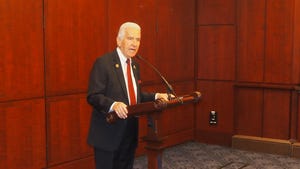
President Bush has nominated former North Dakota Gov. Edward T. Schafer to be secretary of agriculture, once again reaching outside mainstream agriculture to select a relative unknown to be the administration’s chief agricultural spokesman.

Schafer would replace Mike Johanns, who resigned as agriculture secretary in September to run for the Senate seat being vacated by Chuck Hagel of Nebraska. Johanns was serving as Nebraska’s governor when the president nominated him to be secretary in 2005.

“Ed Schafer is the right choice to fill this post,” The president said in a White House Web cast. “He was a leader on agricultural issues during his eight years as the governor of North Dakota. He worked to open new markets for North Dakota farmers and ranchers by expanding trade with China.”

The president said Schafer also oversaw the development of the state’s agricultural biofuels industry, helped families recover from natural disasters – including drought, fires and floods – and pioneered innovative programs to increase economic opportunity in rural communities.

Spokesmen for the North Dakota Farm Bureau said they thought Schafer’s nomination would be good for farmers and ranchers across the country.

“The governor understands agriculture,” said Sandy Clark, public policy director for the North Dakota Farm Bureau. “Gov. Schafer is a businessman, and he will understand the business of agriculture in this country and agriculture in the global market.”

Clark said Schafer has been involved in lobbying for farm bills and trade agreements at the national level. If confirmed, he said, the governor will bring a keen sense of the importance of agriculture to states such as North Dakota.

“Gov. Schafer comes from a smaller farming state compared to Illinois, California, and Texas,” said Clark. “It’s to our advantage he comes from a less populated state because agriculture is the number one economic engine in North Dakota – always has been and always will be.

“Don’t underestimate the importance of North Dakota agriculture on the national level. We’re the nation’s No. 1 producer of durum and spring wheat, oats, barley, beans, peas, and more. On the national level, North Dakota ranks about ninth in farm exports.”

During his term as governor, a lot of work was done in the value-added agriculture sector in the state, said Brian Kramer, who also works for the North Dakota Farm Bureau. The Dakota Growers Pasta plant in Carrington, N.D., and other value-added companies were started during his tenure.

“I was a bit surprised – not that he lacked the credentials but I didn’t know he was on the radar screen with the president for this position,” said Kramer. “Gov. Schafer definitely has the capabilities. As governor, he was always approachable, very outgoing, and tries to weigh both sides to come to a compromise situation.”

Kramer said Gov. Schafer organized a North Dakota Wetlands Taskforce designed to bring sportsmen’s groups, wildlife interests and agriculture together to deal with wetlands issues in the prairie pothole region.

“It was difficult to come to a consensus on the issue but we understood where each other was coming from,” said Kramer, who served on the task force. “This points out his ability to bring people together and try to compromise. I think he’ll use this effectively as the next secretary of agriculture.”

North Dakota Sen. Kent Conrad, a frequent critic of the Bush administration’s farm policy, said he welcomed Schafer’s nomination to the top post at USDA as a fellow North Dakotan.

“I hope he will support this farm bill,” said Conrad, referring to the legislation reported out by the Senate Committee on Agriculture, Nutrition and Forestry, Oct. 25. “I look forward to speaking with him about his views on the Food and Energy Security Act currently under consideration.”

In Washington, Farm Bureau President Bob Stallman said his members hope Schafer will be a strong leader for USDA, particularly during the time the Agriculture Department is likely to be implementing a new farm bill.

“Mr. Schafer’s background in small business issues should give him an understanding of the economic challenges our farmers and ranchers face,” said Stallman, a farmer from Texas. “As a former governor of North Dakota, Schafer knows the issues important to rural America.”

According to a White House briefing paper, Schafer is the grandson of Danish immigrants who farmed throughout their lives. His father founded a household cleaning and personal care products company, where Schafer began working in the mailroom at age 14.

Schafer earned a bachelor’s degree in business administration from the University of North Dakota and an MBA from the University of Denver. Returning after his graduation, Gov. Schafer eventually became president of the company, a position in which he served from 1978 to 1985.

He served as governor of North Dakota from 1992 to 2000. He launched a successful pilot project to revive rural communities by using technology to deliver education, healthcare, and economic development. The Centers of Excellence in Rural America project was jointly run by North Dakota and Wyoming to help create a network of small rural towns deploying affordable, high-speed telecommunications services.

The governor led an agricultural trade mission from North Dakota to China in 2000 to help open new markets for North Dakota farm products. Earlier in 2000, he also represented the United States with then-Agriculture Secretary Dan Glickman on a Presidential Delegation to China to promote Permanent Normal Trading Relations.

Gov. Schafer has served as the co-lead on agriculture for the National Governors Association and was chair of the National Governors Association Economic Development Committee in 1999.

He was co-founder and co-chair of the Governors Biotechnology Partnership, established in 2000 to increase public understanding and support for the benefits of agricultural biotechnology.

email: flaws@farmpress.com

Get Copyright ClearanceWant to use this article? Click here for options!
© 2008 Penton Media, Inc.


Latest Jobs

resources

events icon events

product info icon tradeshows

tradeshow icon digests

research icon photos

Continuing Education

Accredited by California DPR and California and Arizona Certified Crop Advisers:


(New Course)

Nutrient Management in Key California Crops


This online CEU course offers a detailed look at the nutrient management in key California crops. It is sponsored online by Western Plant Health Association and funded by a grant from the California Department of Food and Agriculture Fertilizer Research and Protection Program (FREP). It is accredited for one (1)-hour of credit by the California Department of Pesticide Regulation for California Pest Control Advisers (PCA), Private Applicators, Qualified Applicators and Aerial Applicators. The course is also accredited for 3 units in Nutrient Management (NM) for California and Arizona Certified Crop Advisers (CCAs).

Accredited in California, Arizona, Idaho, Oregon and Washington and for Certified Crop Advisers:


(New Course)
Organic/Sustainable Agricultural Production in the West

Organic/sustainable agriculture is expanding rapidly in the U.S. with an average annual increase of 20% during the last 15 years. This course covers a wide range of pests and organic control strategies. It is accredited for up to 4 continuing education hours for PCAs and Applicator Licensees in California, Arizona, Idaho, Oregon and Washington. It is also approved for Certified Crop Adviser credit.

ACCREDITED IN OREGON AND WASHINGTON:


(New Course)
Managing Spray Drift to Minimize Problems

This online spray drift management course has been certified by the Oregon Department of Agriculture and the Washington Department of Agriculture for 2 hours of credit for licensed Applicators and Consultants in Oregon and Washington.

ACCREDITED IN CALIFORNIA ONLY:


Almond Pest Management

Get the latest info on almond insect pest management and earn 2 hrs. CE DPR and CCA credit in California.

California Groundwater Protection Regulations

Earn 2 hrs. in California laws and regs CE and learn how to protect California groundwater supplies.


Disease Management in California Almonds

Managing diseases in California almond production is a year-long process. This course provides the latest information on controlling these diseases with management practices and fungicides. The course is approved for 2 CEUs by DPR for PCAs and all applicator categories and California CCAs.

Powdery Mildew Control in California Grapevines

Learn about the No. 1 grape disease in California; earn 2 California CE hours.

ACCREDITED IN CALIFORNIA AND ARIZONA:


The Role of Copper in Disease Control

Copper has long been a key tool in disease control in a many crops. This 2-CEU course accredited California PCAs and all DPR applicator categories and Arizona applicators details how best to use copper to maximize its potential.

Insecticide Resistance Management in Agronomic and Row Crops

A 3-hr. CE approved for California and Arizona licensees and CCAs in both states.

Agronomic Weed Resistance Management in Row Crops, Trees Nuts and Vines

Weeds Resistance Management is approved for 3 hours of CE credit for all California and Arizona licensees and Certified Crop Advisers.

Lepidopterous Pest Management/ Pesticide Safety

This course is approved for 2 hours in Arizona and California (1 hr. of laws/regs; 1 hour Other) and for CCAs.

Managing Spray Drift to Minimize Problems

2-hrs laws and regs for California licensees; 2 hours in Arizona and for CCAs.

Back to Top

Browse Print Issues

Additional Resources

subscribe to Farm Press Daily Southeast Farm Press Southwest Farm Press Delta Farm Press