Arizona wine industry worthy of respect

Nov 1, 2006 10:31 AM, By Cary Blake
Farm Press Editorial Staff

Sitting restlessly in his office in downtown Tempe, Ariz., Rod Keeling is ready to toast goodbye to a job he has enjoyed as director of the Downtown Tempe Community. Spanning a career that included flying as a commercial pilot and as the main street program coordinator for the Arizona Department of Commerce, he will soon realize his life-long passion: full-time vintner.

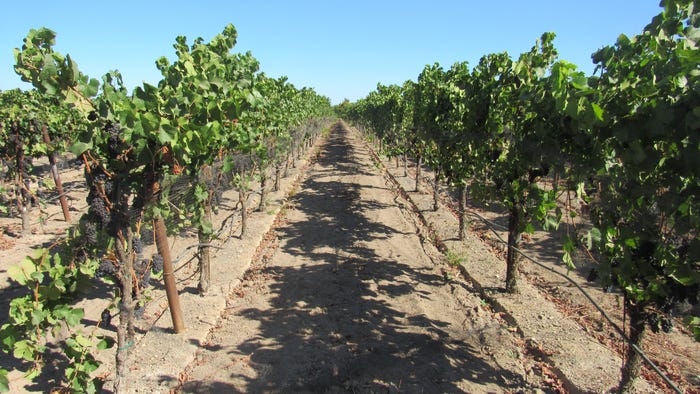
His agricultural roots were first planted as a child on the family cotton operation near Casa Grande, Ariz. In 2000, Keeling and his wife, Jan Schaefer, purchased 18 acres on Rock Creek at the foot of the Chiricahua Mountains near Pearce in southeastern Arizona. The couple has built and nurtured the Cochise County vineyard, and are excited about their first wine release just in time for Christmas: 45 cases of 2005 Two Reds Grenache, a spicy Rhone blend with 14 percent Syrah, available strictly through a “friend’s list”; and 350 cases of 2005 Three Sisters Syrah, a big, earthy, fruit-forward, full bodied Rhone for sale to the public.

While Arizona is often touted as the low desert with months of 100-degree scorching summer days, growing wine grapes is often deemed impossible. But high desert elevations of 3,700 to 5,300 feet with daytime highs of 85-90 degrees and evening lows of 65-70 degrees make the mountain region climate in northern and southern Arizona suitable for growing wine grapes.

Pioneer days

Gordon Dutt is considered the father of Arizona’s wine industry. He earned his doctorate from the University of California at Davis. As a soil science professor at the University of Arizona, he worked hand in hand with the U.S. Department of Agriculture to identify suitable specialty crops that could be grown in the four corner states – Arizona, New Mexico, Utah and Colorado. Wine grapes made the Arizona list.

Dutt and A. Blake Brophy established Arizona’s first experimental vineyard on the Ignacio de Babocomari Ranch in southern Arizona in 1973. While Arizona’s intense sun was expected to bleach the grapes for red wine and produce wines with poor color and low acidity, the results were quite the opposite. Red wines with brilliant color and acidity were the rule. Dutt’s analytical work concluded that Arizona soil in potential grape-growing areas was nearly identical to the ground in Burgundy, France.

In 1978, Dutt developed Arizona’s first commercial winery, his Sonoita Vineyards in Elgin, and opened the winery in 1983. His first Cabernet vintage was produced in 1984. His wine was served at President George Bush Sr.’s inauguration.

Progress

Today, Arizona’s infantile wine industry includes 22 wineries and 30 vineyards on 400 acres, adding an estimated economic value of $18-20 million to the state’s economy. Keeling noted acreage and gallons have doubled over the last five years, and could double again by 2008. As president of the 50-member Arizona Wine Growers Association, Keeling said the organization’s goal is to achieve a $60 million industry by 2008.

Today, Arizona’s ground zero for vineyards and wineries (four locations) is the towns of Elgin and Sonoita, located about 30 miles north of the Mexico border in Santa Cruz County. The youthful industry pales in comparison to its well-respected neighbor, California, that boasts a $1.6 billion wine grape industry, according to the California Department of Agriculture’s 2004 Statistical Review.

Arizona is not seeking to copy California’ wine successes. Instead, it is mirroring Oregon’s wine industry, which has worked hard discovering the varieties best for Oregon. While Oregon’s niche may be considered Pinot Noir, Keeling said Arizona’s future shining star could be Grenache.

Applause

From its early days, Arizona’s infant wine industry has experienced trials and tribulations. In the first years, “People tried to enter the wine business but few understood the wine business,” said Keeling. “A lot of wine money has gone to wine heaven in Arizona over the years.”

True enough, Arizona is no California, but the Grand Canyon State’s tried and true wine entrepreneurs feel they are due respect – and even a toast.

e-mail: cblake@farmpress.com

Get Copyright ClearanceWant to use this article? Click here for options!
© 2009 Penton Media, Inc.


Latest Jobs

resources

events icon events

product info icon tradeshows

tradeshow icon digests

research icon photos

Continuing Education

Accredited for California, Arizona and CCA hours:


(New Course)
Biopesticides -- Effective Use in Pest Management Programs

Biopesticides are increasingly being recommended as components of Integrated Pest Management (IPM) programs in the production of non-organic high-value specialty crops such as fruit, nut, vegetable, vine, ornamental and turf. This online, accredited course, sponsored by Marrone Bio Innovations, details some of the 245 registered biopesticide active ingredients used in a wide array pest management products.

Accredited in California and Arizona:


(New Course)
Agronomic Principles and Efficient Chemigation and Fertigation Using Center Pivot/Linear Sprinkler Systems

This online CE course details sound mechanical irrigation design and management practices to allow efficient chemigation and fertigation. It is accredited for Certified Crop Adviser CE units and is approved for credit hours in California and Arizona.


(New Course)
Pome, Stone Fruit Pest Management Using New Mode of Action Chemistry

New chemistry Rynaxypyr has proven effective against a wide range of economically important Lepidoptera species. Marketed under the trade name Altacor for use in grapes, pome and stone fruit, details on how to use this new chemistry are in this online Continuing Education course that is accredited in California, Pennsylvania, and New Jersey with CE applications pending in Oregon and Washington.


(New Course)
Vegetable Pest Management Using New Mode of Action

Integration of a new mode of action compound like Coragen into IPM and IRM programs to control Lepidoptera in leafy greens, fruiting vegetables, peppers and brassica or cole crops is always welcome. This online CE accredited details how best to use this new mode of action in intensive vegetable production. It is accredited in California, Arizona, Texas, Georgia, New Jersey and Pennsylvania. Application for credit is pending in Florida and Washington.

Accredited by Accredited in California and Washington:


(New Course)
Utilizing Calcium as Nutrient That Protects Against Disease Organisms

This online accredited course focus on Calcium, an important plant nutrient in fertilizer management for maximum, healthy plant development as well as disease and pest prevention. It is accredited in California, Georgia,: Pennsylvania and New Jersey. Credit pending in Florida, South Carolina, Tennessee, Virginia, West Virginia and Washington.


Accredited by California DPR and California and Arizona Certified Crop Advisers:


(New Course)

Nutrient Management in Key California Crops


This online CEU course offers a detailed look at the nutrient management in key California crops. It is sponsored online by Western Plant Health Association and funded by a grant from the California Department of Food and Agriculture Fertilizer Research and Education Program (FREP). It is accredited for one (1)-hour of credit by the California Department of Pesticide Regulation for California Pest Control Advisers (PCA), Private Applicators, Qualified Applicators and Aerial Applicators. The course is also accredited for 3 units in Nutrient Management (NM) for California and Arizona Certified Crop Advisers (CCAs).

Accredited in California, Arizona, Idaho, Oregon and Washington and for Certified Crop Advisers:


(New Course)
Organic/Sustainable Agricultural Production in the West

Organic/sustainable agriculture is expanding rapidly in the U.S. with an average annual increase of 20% during the last 15 years. This course covers a wide range of pests and organic control strategies. It is accredited for up to 4 continuing education hours for PCAs and Applicator Licensees in California, Arizona, Idaho, Oregon and Washington. It is also approved for Certified Crop Adviser credit.


ACCREDITED IN CALIFORNIA ONLY:


Almond Pest Management

Get the latest info on almond insect pest management and earn 2 hrs. CE DPR and CCA credit in California.

California Groundwater Protection Regulations

Earn 2 hrs. in California laws and regs CE and learn how to protect California groundwater supplies.


Disease Management in California Almonds

Managing diseases in California almond production is a year-long process. This course provides the latest information on controlling these diseases with management practices and fungicides. The course is approved for 2 CEUs by DPR for PCAs and all applicator categories and California CCAs.

Powdery Mildew Control in California Grapevines

Learn about the No. 1 grape disease in California; earn 2 California CE hours.

ACCREDITED IN CALIFORNIA AND ARIZONA:


The Role of Copper in Disease Control

Copper has long been a key tool in disease control in a many crops. This 2-CEU course accredited California PCAs and all DPR applicator categories and Arizona applicators details how best to use copper to maximize its potential.

Insecticide Resistance Management in Agronomic and Row Crops

A 3-hr. CE approved for California and Arizona licensees and CCAs in both states.

Agronomic Weed Resistance Management in Row Crops, Trees Nuts and Vines

Weeds Resistance Management is approved for 3 hours of CE credit for all California and Arizona licensees and Certified Crop Advisers.

Lepidopterous Pest Management/ Pesticide Safety

This course is approved for 2 hours in Arizona and California (1 hr. of laws/regs; 1 hour Other) and for CCAs.

ACCREDITED IN CALIFORNIA, ARIZONA, OREGON, AND WASHINGTON:

Managing Spray Drift to Minimize Problems

This online CEU on managing spray drift to minimize problems is accredited for 2-hours in California (Laws and Regs); Arizona, Oregon and Washington.

Back to Top

Browse Print Issues

Additional Resources

subscribe to Farm Press Daily Southeast Farm Press Southwest Farm Press Delta Farm Press