Knowledge is power in vineyard irrigation management

Oct 12, 2006 10:00 AM, By Marni Katz

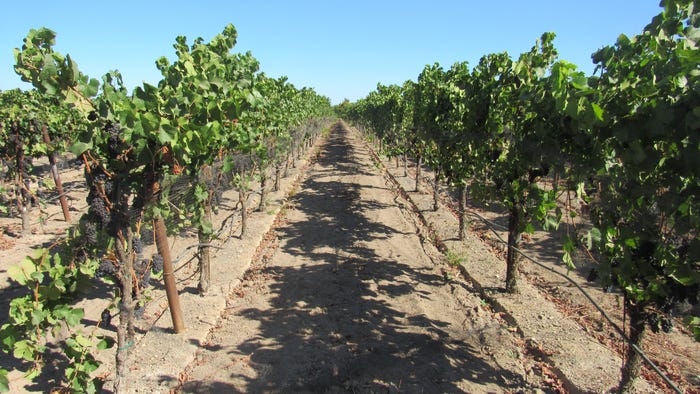
California grape grower Kevin Cantrelle says irrigation management is the foundation of success to every production practice in his wine grape vineyards.

“If you don’t irrigate it right nothing else is going to work out for you,” Cantrelle says.

Cantrelle manages 6,000 acres of wine grapes in California’s Central Valley and Central Coast for San Francisco-based The Wine Group, the nation’s third largest winery and home to labels including Franzia, Corbett Canyon and Glen Ellen.

Every year Cantrelle comes up with a “growing plan” for each vineyard with production and quality goals established according to the winery needs. At the heart of each growing plan is the irrigation program.

“It all starts with water,” he says.

Matthew Fidelibus University of California Cooperative Extension Viticulture Specialist at the Kearney Research and Extension Center, Parlier, Calif., says irrigation management is a powerful tool for influencing not only yield and fruit quality, but vine maturity, sunburn, pest pressures and nutrient status in the vineyard.

The key, he says, is to match the overall management strategy with the individual goals in the vineyard, which will be different depending on whether vines produce for raisin, table or wine grapes and the fruit quality and other demands of the buyer.

For Cantrelle, production is still the key to profitable farming his San Joaquin Valley wine grape acreage.

“For my company and what we do production is the driving factor, and we want to produce quality grapes as affordably as possible,” he says. “When you’re producing a quality wine at a low price point, you have to keep your inputs low. We compete with ‘Two Buck Chuck’ and labels in that arena, so it only allows us to produce our grapes at a certain price per ton before we can no longer maintain that price point.”

Cantrelle says that through real-time monitoring of soil and vine moisture status in his vineyard he has been able to improve yields significantly through more informed irrigation decisions. Also, he is increasing yields without a significant bump in production costs and with less time spent in each vineyard.

Cantrelle credits a new system called Agricultural Resource Management from PureSense Environmental Inc. with giving him the real time, season-long data and analysis he needs to follow soil moisture status, canopy climate conditions and irrigation system operation throughout the season to make more informed and immediate irrigation decisions.

Soil moisture stations with probes are buried from 1 to 5 feet below the surface. They, along with temperature and humidity sensors on the station, send site-specific data every 15 minutes that Cantrelle can access anytime from his office computer. He can also receive alerts about changes needing immediate attention on his cell phone.

This system joins a growing list of automated and manually accessed weather and data gathering systems growers are using to more closely monitor weather and water needs in specific vineyards.

After setting moisture status targets based on data analyzed from current and previous years, Cantrelle will supplement his drip irrigation sets with flood water before the deep profile is depleted and vines are stressed. Pressure on/off switches lets him compare moisture status to when his system has actually run.

“Now we can see after we irrigate when the peak moisture is and what is the draw down to calculate when our next irrigation will be. And the PureSense communication system allows me to integrate several things into the information I get. It’s plug and play,” he says.

After experimenting with the system last season, The Wine Group this year installed PureSense stations in all 12 of its vineyards throughout California. Probes are placed within each variety block and across different soil types. Plans next year call for at least a dozen more stations.

“As you get into it more and more you start realizing the necessity of having this type of technology,” Cantrelle says. “Knowing what’s going on inside your ground is invaluable. I don’t see how you can farm without knowing what’s going on in the soil.”

The Wine Group first installed the system on 600 acres of Zinfandel, Syrah and Rubired grapes at Northwood Vineyards in Madera, Calif. As with other sites, Cantrelle says the system has helped significantly boost his production while meeting the winery’s sugar and other quality requirements.

While many growers are reporting yields this year off as much as 30 percent from last season’s bumper crop, Cantrelle says his production is off only about 10 percent from last year and his Zinfandel block yielded 2 tons more per acre than the vineyard five-year average.

“I attribute that to the fact that we know 100 percent of the time what’s going on with our soil moisture from 2 to 5 feet down,” Cantrelle says.

Cantrelle says he has not only improved yields, but also helped reduce pressures from mites that might infiltrate stressed vines. At Northwood, this is the first year Cantrelle has not sprayed for mites in his eight years managing the vineyard.

Get Copyright ClearanceWant to use this article? Click here for options!
© 2009 Penton Media, Inc.


Latest Jobs

resources

events icon events

product info icon tradeshows

tradeshow icon digests

research icon photos

Continuing Education

Accredited for California, Arizona and CCA hours:


(New Course)
Biopesticides -- Effective Use in Pest Management Programs

Biopesticides are increasingly being recommended as components of Integrated Pest Management (IPM) programs in the production of non-organic high-value specialty crops such as fruit, nut, vegetable, vine, ornamental and turf. This online, accredited course, sponsored by Marrone Bio Innovations, details some of the 245 registered biopesticide active ingredients used in a wide array pest management products.

Accredited in California and Arizona:


(New Course)
Agronomic Principles and Efficient Chemigation and Fertigation Using Center Pivot/Linear Sprinkler Systems

This online CE course details sound mechanical irrigation design and management practices to allow efficient chemigation and fertigation. It is accredited for Certified Crop Adviser CE units and is approved for credit hours in California and Arizona.


(New Course)
Pome, Stone Fruit Pest Management Using New Mode of Action Chemistry

New chemistry Rynaxypyr has proven effective against a wide range of economically important Lepidoptera species. Marketed under the trade name Altacor for use in grapes, pome and stone fruit, details on how to use this new chemistry are in this online Continuing Education course that is accredited in California, Pennsylvania, and New Jersey with CE applications pending in Oregon and Washington.


(New Course)
Vegetable Pest Management Using New Mode of Action

Integration of a new mode of action compound like Coragen into IPM and IRM programs to control Lepidoptera in leafy greens, fruiting vegetables, peppers and brassica or cole crops is always welcome. This online CE accredited details how best to use this new mode of action in intensive vegetable production. It is accredited in California, Arizona, Texas, Georgia, New Jersey and Pennsylvania. Application for credit is pending in Florida and Washington.

Accredited by Accredited in California and Washington:


(New Course)
Utilizing Calcium as Nutrient That Protects Against Disease Organisms

This online accredited course focus on Calcium, an important plant nutrient in fertilizer management for maximum, healthy plant development as well as disease and pest prevention. It is accredited in California, Georgia,: Pennsylvania and New Jersey. Credit pending in Florida, South Carolina, Tennessee, Virginia, West Virginia and Washington.


Accredited by California DPR and California and Arizona Certified Crop Advisers:


(New Course)

Nutrient Management in Key California Crops


This online CEU course offers a detailed look at the nutrient management in key California crops. It is sponsored online by Western Plant Health Association and funded by a grant from the California Department of Food and Agriculture Fertilizer Research and Education Program (FREP). It is accredited for one (1)-hour of credit by the California Department of Pesticide Regulation for California Pest Control Advisers (PCA), Private Applicators, Qualified Applicators and Aerial Applicators. The course is also accredited for 3 units in Nutrient Management (NM) for California and Arizona Certified Crop Advisers (CCAs).

Accredited in California, Arizona, Idaho, Oregon and Washington and for Certified Crop Advisers:


(New Course)
Organic/Sustainable Agricultural Production in the West

Organic/sustainable agriculture is expanding rapidly in the U.S. with an average annual increase of 20% during the last 15 years. This course covers a wide range of pests and organic control strategies. It is accredited for up to 4 continuing education hours for PCAs and Applicator Licensees in California, Arizona, Idaho, Oregon and Washington. It is also approved for Certified Crop Adviser credit.


ACCREDITED IN CALIFORNIA ONLY:


Almond Pest Management

Get the latest info on almond insect pest management and earn 2 hrs. CE DPR and CCA credit in California.

California Groundwater Protection Regulations

Earn 2 hrs. in California laws and regs CE and learn how to protect California groundwater supplies.


Disease Management in California Almonds

Managing diseases in California almond production is a year-long process. This course provides the latest information on controlling these diseases with management practices and fungicides. The course is approved for 2 CEUs by DPR for PCAs and all applicator categories and California CCAs.

Powdery Mildew Control in California Grapevines

Learn about the No. 1 grape disease in California; earn 2 California CE hours.

ACCREDITED IN CALIFORNIA AND ARIZONA:


The Role of Copper in Disease Control

Copper has long been a key tool in disease control in a many crops. This 2-CEU course accredited California PCAs and all DPR applicator categories and Arizona applicators details how best to use copper to maximize its potential.

Insecticide Resistance Management in Agronomic and Row Crops

A 3-hr. CE approved for California and Arizona licensees and CCAs in both states.

Agronomic Weed Resistance Management in Row Crops, Trees Nuts and Vines

Weeds Resistance Management is approved for 3 hours of CE credit for all California and Arizona licensees and Certified Crop Advisers.

Lepidopterous Pest Management/ Pesticide Safety

This course is approved for 2 hours in Arizona and California (1 hr. of laws/regs; 1 hour Other) and for CCAs.

ACCREDITED IN CALIFORNIA, ARIZONA, OREGON, AND WASHINGTON:

Managing Spray Drift to Minimize Problems

This online CEU on managing spray drift to minimize problems is accredited for 2-hours in California (Laws and Regs); Arizona, Oregon and Washington.

Back to Top

Browse Print Issues

Additional Resources

subscribe to Farm Press Daily Southeast Farm Press Southwest Farm Press Delta Farm Press