Conservation tillage catches on with growers as costs continue rising

Oct 27, 2008 10:58 AM, By Brenda Carol
Contributing Writer

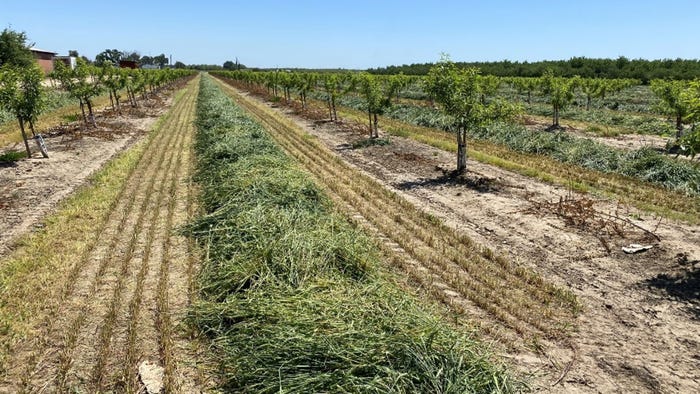
Conservation tillage is catching on in California for one basic reason – it reduces passes across fields. In today’s economy, anything that lowers costs is as welcome as the Publishers Clearing House man on your front porch.

Topper van Loben Sels, who farms 3,000 acres in the North San Joaquin Delta near Walnut Grove, Calif., started small on the road to conservation tillage, but now practices it farm-wide on his corn to benefit all his row crops.

“You can’t just jump into conservation tillage,” says Loben Sels, who grows wine grapes, pears, corn, wheat, tomatoes, safflower, alfalfa, and a few small seed crop plots. “You have to figure out how and why it works. No-till didn’t work for us because it was too labor intensive.

“By moving to conservation tillage, we got to the point where we could manage all of our fields more uniformly across the board without having to call every shot every day on every field. Conservation tillage has definitely simplified the management process.”

It has also reduced dust, diesel cost and weeds, according to Loben Sels. “We couldn’t have done this without the Roundup Ready varieties,” he says. “We’ve eliminated eight passes through the field because of it. It cleaned up the Johnsongrass which used to be a horrible problem for us. Conservation tillage helped us get a handle on our costs when costs are spiraling out of control.”

Technology is one thing. Selecting varieties is another, and for 42 years he has run his own on-farm variety trials.

“Everything changes,” he says. “And it changes rapidly. We like to average about 500 acres of corn annually. Varieties perform differently on different soils in different microclimates. If you’re going to be serious about the corn business, you need to have trials on your own ground.”

Some of the corn is continuous while other acreage is rotated.

“Generally, the difference is in drainage and soil types,” he says. “In continuous corn, we’re moving away from the sediment soils into the organic soils that have a little higher water table. In some years we’re planting corn a little bit later there than we would like to plant a tomato crop for example. But those soils lend themselves very well to corn.”

Loben Sels started out experimenting with 19 acres of no-till several years ago — saw the potential, and ultimately converted all of his acreage to conservation-tillage. “We used to make about 10 passes through the field,” he says. “Now, we’re getting by with two.”

Loben Sels applies sidedress fertilizer in the minimum till corn after it is established. “We’ve done a lot of experimentation with nutrients,” he says. “We’re using UN-32 now after a starter fertilizer that goes down at planting. We soil sample fields until we get a feeling for the profile and get an understanding of what it’s going to take to maintain that field. If we see a problem area after that, we’ll go to that area and take additional samples to see what we need to change.”

Corn is a critical part of the northern San Joaquin Valley rotation.

“A lot of crops are contracted, but you need rotational crops for other options such as tomatoes,” he says. “Corn puts a lot of organic matter back into the soil. We’ve got the right equipment and storage facilities. Our water is relatively inexpensive and we’re efficient with it. My applied water here is probably about 50 percent of what a grower might use around an area like Bakersfield. We get very good winter rains, so we start out at field capacity. Corn roots here can get into the water table, whereas growers down south don’t have that luxury.”

Where tomatoes were once used to clean up weeds in a field, Loben Sels now uses glyphosate on Roundup Ready corn varieties. “Now we’ve got something we can use to clean up Johnsongrass,” he says. “We can actually use a cornfield to clean up a field for other crops.”

Loben Sels has made subtle changes converting to con-till and cautions there are significant challenges.

“Because you haven’t prepped that seedbed like a conventional seedbed, you have to be aware that a lot of other factors come into play,” he says. “One thing is that the ground is rough with reduced tillage. We put a tiny bit more seed out there a little closer together to maintain the 30,000 to 32,000 plant population we wanted at harvest.

“When we switched to Roundup Ready and con-till, we didn’t have to put down any preplant herbicides,” he says.

As fertilizer prices have tripled and diesel is now well over $4 a gallon, it takes a sharp pencil to make corn work economically. “If we weren’t doing con-tillage, we wouldn’t be growing corn now,” Loben Sels says. “The costs of inputs have gone up exponentially, so being able to cut our costs with the Roundup Ready technology has helped immensely.

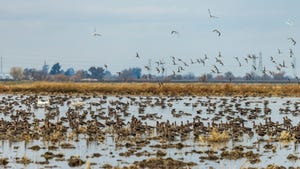
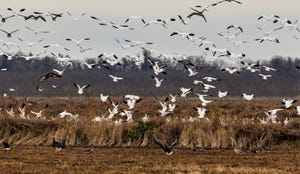
“Conservation tillage is also a very worker-friendly regime and great for wildlife. The stubble is there all winter for sandhill crane, geese and ducks.”

Loben Sels is an avid supporter of the North Delta Conservancy.

“We have three local projects. One is a wood duck project, where we’re maintaining 325 wood duck boxes in the riparian habitat. We’ve probably had about 12,000 hatchlings, and the hens are starting to return to the same boxes.”

The North Delta Conservancy is also responsible for overseeing a mallard egg rescue program. “If we’re out harvesting an alfalfa field and a hen busts out, the operator will stop, take the hen, the bedding and the eggs, and put them in a paper bag,” he says. “Then they go to our incubation facility.

“As soon as those ducks are what they call ‘floppers’, (they can’t quite fly, but they can run on water) they’re banded and released back into their natural habitat. They mix right back into the Pacific flyway.”

The conservancy also helps re-establishing wetlands, Loben Sels says. “We go to a marginal piece of property and ask the landowner if they would like to improve it. A lot of times the landowner would like to work with us rather than the government, so that’s another win-win situation.”

Get Copyright ClearanceWant to use this article? Click here for options!
© 2009 Penton Media, Inc.


Latest Jobs

resources

events icon events

product info icon tradeshows

tradeshow icon digests

research icon photos

Continuing Education

Accredited for California, Arizona and CCA hours:


(New Course)
Biopesticides -- Effective Use in Pest Management Programs

Biopesticides are increasingly being recommended as components of Integrated Pest Management (IPM) programs in the production of non-organic high-value specialty crops such as fruit, nut, vegetable, vine, ornamental and turf. This online, accredited course, sponsored by Marrone Bio Innovations, details some of the 245 registered biopesticide active ingredients used in a wide array pest management products.

Accredited in California and Arizona:


(New Course)
Agronomic Principles and Efficient Chemigation and Fertigation Using Center Pivot/Linear Sprinkler Systems

This online CE course details sound mechanical irrigation design and management practices to allow efficient chemigation and fertigation. It is accredited for Certified Crop Adviser CE units and is approved for credit hours in California and Arizona.


(New Course)
Pome, Stone Fruit Pest Management Using New Mode of Action Chemistry

New chemistry Rynaxypyr has proven effective against a wide range of economically important Lepidoptera species. Marketed under the trade name Altacor for use in grapes, pome and stone fruit, details on how to use this new chemistry are in this online Continuing Education course that is accredited in California, Pennsylvania, and New Jersey with CE applications pending in Oregon and Washington.


(New Course)
Vegetable Pest Management Using New Mode of Action

Integration of a new mode of action compound like Coragen into IPM and IRM programs to control Lepidoptera in leafy greens, fruiting vegetables, peppers and brassica or cole crops is always welcome. This online CE accredited details how best to use this new mode of action in intensive vegetable production. It is accredited in California, Arizona, Texas, Georgia, New Jersey and Pennsylvania. Application for credit is pending in Florida and Washington.

Accredited by Accredited in California and Washington:


(New Course)
Utilizing Calcium as Nutrient That Protects Against Disease Organisms

This online accredited course focus on Calcium, an important plant nutrient in fertilizer management for maximum, healthy plant development as well as disease and pest prevention. It is accredited in California, Georgia,: Pennsylvania and New Jersey. Credit pending in Florida, South Carolina, Tennessee, Virginia, West Virginia and Washington.


Accredited by California DPR and California and Arizona Certified Crop Advisers:


(New Course)

Nutrient Management in Key California Crops


This online CEU course offers a detailed look at the nutrient management in key California crops. It is sponsored online by Western Plant Health Association and funded by a grant from the California Department of Food and Agriculture Fertilizer Research and Education Program (FREP). It is accredited for one (1)-hour of credit by the California Department of Pesticide Regulation for California Pest Control Advisers (PCA), Private Applicators, Qualified Applicators and Aerial Applicators. The course is also accredited for 3 units in Nutrient Management (NM) for California and Arizona Certified Crop Advisers (CCAs).

Accredited in California, Arizona, Idaho, Oregon and Washington and for Certified Crop Advisers:


(New Course)
Organic/Sustainable Agricultural Production in the West

Organic/sustainable agriculture is expanding rapidly in the U.S. with an average annual increase of 20% during the last 15 years. This course covers a wide range of pests and organic control strategies. It is accredited for up to 4 continuing education hours for PCAs and Applicator Licensees in California, Arizona, Idaho, Oregon and Washington. It is also approved for Certified Crop Adviser credit.


ACCREDITED IN CALIFORNIA ONLY:


Almond Pest Management

Get the latest info on almond insect pest management and earn 2 hrs. CE DPR and CCA credit in California.

California Groundwater Protection Regulations

Earn 2 hrs. in California laws and regs CE and learn how to protect California groundwater supplies.


Disease Management in California Almonds

Managing diseases in California almond production is a year-long process. This course provides the latest information on controlling these diseases with management practices and fungicides. The course is approved for 2 CEUs by DPR for PCAs and all applicator categories and California CCAs.

Powdery Mildew Control in California Grapevines

Learn about the No. 1 grape disease in California; earn 2 California CE hours.

ACCREDITED IN CALIFORNIA AND ARIZONA:


The Role of Copper in Disease Control

Copper has long been a key tool in disease control in a many crops. This 2-CEU course accredited California PCAs and all DPR applicator categories and Arizona applicators details how best to use copper to maximize its potential.

Insecticide Resistance Management in Agronomic and Row Crops

A 3-hr. CE approved for California and Arizona licensees and CCAs in both states.

Agronomic Weed Resistance Management in Row Crops, Trees Nuts and Vines

Weeds Resistance Management is approved for 3 hours of CE credit for all California and Arizona licensees and Certified Crop Advisers.

Lepidopterous Pest Management/ Pesticide Safety

This course is approved for 2 hours in Arizona and California (1 hr. of laws/regs; 1 hour Other) and for CCAs.

ACCREDITED IN CALIFORNIA, ARIZONA, OREGON, AND WASHINGTON:

Managing Spray Drift to Minimize Problems

This online CEU on managing spray drift to minimize problems is accredited for 2-hours in California (Laws and Regs); Arizona, Oregon and Washington.

Back to Top

Browse Print Issues

Additional Resources

subscribe to Farm Press Daily Southeast Farm Press Southwest Farm Press Delta Farm Press