Growers switch herbicides for groundwater regulations

Oct 3, 2005 9:34 AM, By Linda Romander

Pesticide use reports for 2004 available late this year will tell the complete story, but in the meantime, a quick survey of ag chem dealers and pest control advisers (PCAs) in California counties dotted with newly designated groundwater protection zones indicates growers are largely switching products rather than hassle with the new regulations.

The requirement to either discontinue use of certain herbicides or adopt practices that prevent additional ground water contamination is part of the Ground Water Protection Program (GWPP). Begun in May 2004, the GWPP is designed to protect groundwater on about 2.4 million acres of California farmland identified by the California Department of Pesticide Regulation (DPR) as most vulnerable to pesticide contamination from leaching and runoff.

The state-designated 6800(a) list of herbicides includes atrazine, simazine, bromacil, diuron, prometon, bentazon and norflurazon, which have been found in well water. In order to continue using herbicides with these active ingredients, growers must apply for a permit and agree to follow a management practice designated by DPR to prevent groundwater contamination.

“There has been a big switch from using bromacil, diuron and simazine in citrus here in Tulare County, which has numerous GWPAs,” says Ed Murray, general manager of Orange Belt Supply Co., Lindsay, Calif. “The mitigating measures required for using a product on the list are not workable for our growers. This is why they are turning to other products,” he says. “A tremendous amount of citrus acreage has been switched over to Surflan (oryzalin), which gives equal, if not better, control and is not on the 6800(a) list. “We were initially concerned whether Surflan would hold up, but it has been doing a good job with residual control,” he adds. “Surflan has been used in the past, but it was more expensive. The price has come down now, and applications are being made at rates running from 2 quarts in the fall plus 2 quarts in the spring, to 3+1 or 3+2, depending on the PCA. These applications are lasting into the summer with a few escapes, which growers pick up by spot treating with contacts.

Compares well

“We find that Surflan compares well with diuron and simazine. With both treatments there are escapes, and you will have to come back a time or two with glyphosate,” the dealer says. “Some growers are going to multiple applications with contact herbicides in place of residuals, but this can be a problem in the winter when they can’t get in to spray.”

To Murray, the Ground Water Protection Program is important to protect the environment. “It’s not worth messing with the environment and the regulations,” he says. “Rules are rules. Let’s abide by them. If we don’t, in the long run products will be lost,” he advises.

Britz Fertilizers in Traver, Calif., serves stone fruit and grape growers in Fresno and Tulare counties. “The majority of our growers farm in Ground Water Protection,” reports branch manager John Montelongo. “I would say 80 percent of them are using other products rather than filing for permits to use the restricted products,” he estimates.

Britz’s growers are switching to Surflan, Devrinol (napropamide) and contact herbicides, the manager says. “Surflan has an advantage with its longer-lasting residual control, which is more cost-effective than using only contacts,” he says. “Devrinol works well if we can get water to it right after application, either with rain or irrigation. If we don’t get a rain and have to irrigate, that becomes costly to the grower.”

Devrinol has a handling advantage in that it comes as a dry flowable (DF) formulation, but this fall Surflan also will be available as a DF. “A couple of our growers have tried the new Surflan DF formulation and are pleased with it,” Montelongo says. “Container disposal is a big issue here; it is costly and inconvenient to rinse and dispose of plastic containers. And the new packaging is convenient — a case of 12-pound bags is equivalent to a 5-gallon container, and both the plastic bags and the cardboard case can be burned or disposed of at a landfill.”

Flowability, dispersion

Beyond the disposal issue, tests with Surflan DF have shown it to have good flowability and dispersion, resulting in easier pouring and measuring. The dry product blooms well in water and stays in solution. Spills are easily swept up, and don’t leave stains as liquid formulations tend to.

PCA Randy Radtke, Gar Tootelian, Reedley, Calif., reports that citrus, grapes and tree fruit growers have been most affected by the new groundwater protection rules. Radtke says that 80 percent of the acreage he writes recommendations for in Fresno and Tulare counties are in a groundwater protection area.

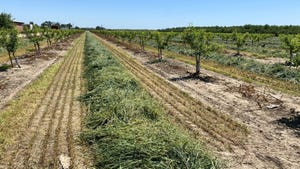
Citrus Mutual in Exeter, Calif., won approval for a mitigating practice for continued use of simazine and diuron by its members, according to Radtke. They are allowed to apply these 6800(a) herbicides up to the dripline of the trees, which is closer to 50 percent of the surface area instead of the 33 percent that is allowed under the groundwater protection regulations. The restricted products must be applied at a time when leaching or runoff is least likely. In the middles, growers use allowed herbicides such as Surflan, or a contact material.

On grapes and stone fruit, growers are switching to Surflan as an alternative to Solicam (norflurazon), the PCA says. “I use Surflan in grapes, almonds and walnuts. My growers switched to Surflan because they don’t want the hassle of applying for a permit. Growers are not happy to change their programs; it’s still a debate in many growers’ minds whether the GWPA is politics or science, but they understand it is important to abide by the regulations and look at alternatives as long as the economics are reasonable,” he says.

According to Radtke, the most popular program and the best combination of products he’s found for grapes and almonds in GWPAs is Surflan plus Chateau, a new herbicide that was just registered last year. “One gallon of Surflan plus 12 ounces of Chateau gives long-lasting residual control with far fewer escapes because the two products complement each other so well,” he says. “Chateau is strong on broadleaves — even better than simazine, and Surflan is strong on grasses.”

Crop applications

“In grapes, this combination is applied down the berm, and in almonds it is applied either solid or down the row with the centers mowed. We saw almost a full season of control this past year, even with the heavy spring rains,” Radtke reports. “This is a more expensive program, but there are far fewer follow-up contact spray applications needed. And it will be less costly for growers to use Chateau the second year as the labeled-rate will be lower.”

Replacing residuals with contacts has not been a popular program, the PCA says. “Growers who have switched to 100 percent contacts have found that there are too many escapes due to glyphosate resistance.”

Awareness of the groundwater protection program and compliance in his area is nearly 100 percent, according to Radtke. Nevertheless, the DPR continues its efforts to educate growers and PCAs about the new program.

“New programs take time to learn and will evolve as new information becomes available,” says DPR’s Mark Pepple, “so DPR outreach will likely be ongoing. Feedback at meetings has helped us develop the regulations in the first place and will provide valuable information for future activities,” he says.

Although no new GWPAs have been identified or added to the list this year, it is likely to happen in the future. “We have identified additional sensitive areas based on soil characteristics, and we are testing possible management measures for them,” Pepple says. “Once effective management measures are developed, or if pesticides are detected in these new areas, they will be identified as GWPAs.”

Pepple adds that staying ahead of the problem makes both environmental and economic sense. “How pesticides that can reach groundwater are managed today can affect groundwater quality in the years to come,” he says. “A strong continuing ‘investment’ in following the regulations will likely allow the continued use of effective, affordable pesticides in the future.”

The DPR groundwater Web site (www.cdpr.ca.gov/docs/gwp/index.htm) is a good place for growers to stay informed. It has been redesigned to focus on the new regulations, including lists and maps of GWPAs by county, identification of regulated pesticides, and lists and illustrations of the management practices that apply in leaching and runoff GWPAs.

Another good source of information is the Western Farm Press Web site (www.westernfarmpress.com) where there is a continuing education unit on the new groundwater regulations where PCAs and private, qualified and aerial applicators can earn one hour of DPR credit by taking an online course. The course is approved for one hour of laws and regulations by DPR. To date almost 500 licensees have taken the course sponsored online by Bayer CropScience.
Information on the program may also be obtained from local county ag commissioner staff, by contacting DPR staff directly at 916-324-4086, mpepple@cdpr.ca.gov or by consulting with knowledgeable PCAs in the area.

Get Copyright ClearanceWant to use this article? Click here for options!
© 2009 Penton Media, Inc.


Latest Jobs

resources

events icon events

product info icon tradeshows

tradeshow icon digests

research icon photos

Continuing Education

Accredited for California, Arizona and CCA hours:


(New Course)
Biopesticides -- Effective Use in Pest Management Programs

Biopesticides are increasingly being recommended as components of Integrated Pest Management (IPM) programs in the production of non-organic high-value specialty crops such as fruit, nut, vegetable, vine, ornamental and turf. This online, accredited course, sponsored by Marrone Bio Innovations, details some of the 245 registered biopesticide active ingredients used in a wide array pest management products.

Accredited in California and Arizona:


(New Course)
Agronomic Principles and Efficient Chemigation and Fertigation Using Center Pivot/Linear Sprinkler Systems

This online CE course details sound mechanical irrigation design and management practices to allow efficient chemigation and fertigation. It is accredited for Certified Crop Adviser CE units and is approved for credit hours in California and Arizona.


(New Course)
Pome, Stone Fruit Pest Management Using New Mode of Action Chemistry

New chemistry Rynaxypyr has proven effective against a wide range of economically important Lepidoptera species. Marketed under the trade name Altacor for use in grapes, pome and stone fruit, details on how to use this new chemistry are in this online Continuing Education course that is accredited in California, Pennsylvania, and New Jersey with CE applications pending in Oregon and Washington.


(New Course)
Vegetable Pest Management Using New Mode of Action

Integration of a new mode of action compound like Coragen into IPM and IRM programs to control Lepidoptera in leafy greens, fruiting vegetables, peppers and brassica or cole crops is always welcome. This online CE accredited details how best to use this new mode of action in intensive vegetable production. It is accredited in California, Arizona, Texas, Georgia, New Jersey and Pennsylvania. Application for credit is pending in Florida and Washington.

Accredited by Accredited in California and Washington:


(New Course)
Utilizing Calcium as Nutrient That Protects Against Disease Organisms

This online accredited course focus on Calcium, an important plant nutrient in fertilizer management for maximum, healthy plant development as well as disease and pest prevention. It is accredited in California, Georgia,: Pennsylvania and New Jersey. Credit pending in Florida, South Carolina, Tennessee, Virginia, West Virginia and Washington.


Accredited by California DPR and California and Arizona Certified Crop Advisers:


(New Course)

Nutrient Management in Key California Crops


This online CEU course offers a detailed look at the nutrient management in key California crops. It is sponsored online by Western Plant Health Association and funded by a grant from the California Department of Food and Agriculture Fertilizer Research and Education Program (FREP). It is accredited for one (1)-hour of credit by the California Department of Pesticide Regulation for California Pest Control Advisers (PCA), Private Applicators, Qualified Applicators and Aerial Applicators. The course is also accredited for 3 units in Nutrient Management (NM) for California and Arizona Certified Crop Advisers (CCAs).

Accredited in California, Arizona, Idaho, Oregon and Washington and for Certified Crop Advisers:


(New Course)
Organic/Sustainable Agricultural Production in the West

Organic/sustainable agriculture is expanding rapidly in the U.S. with an average annual increase of 20% during the last 15 years. This course covers a wide range of pests and organic control strategies. It is accredited for up to 4 continuing education hours for PCAs and Applicator Licensees in California, Arizona, Idaho, Oregon and Washington. It is also approved for Certified Crop Adviser credit.


ACCREDITED IN CALIFORNIA ONLY:


Almond Pest Management

Get the latest info on almond insect pest management and earn 2 hrs. CE DPR and CCA credit in California.

California Groundwater Protection Regulations

Earn 2 hrs. in California laws and regs CE and learn how to protect California groundwater supplies.


Disease Management in California Almonds

Managing diseases in California almond production is a year-long process. This course provides the latest information on controlling these diseases with management practices and fungicides. The course is approved for 2 CEUs by DPR for PCAs and all applicator categories and California CCAs.

Powdery Mildew Control in California Grapevines

Learn about the No. 1 grape disease in California; earn 2 California CE hours.

ACCREDITED IN CALIFORNIA AND ARIZONA:


The Role of Copper in Disease Control

Copper has long been a key tool in disease control in a many crops. This 2-CEU course accredited California PCAs and all DPR applicator categories and Arizona applicators details how best to use copper to maximize its potential.

Insecticide Resistance Management in Agronomic and Row Crops

A 3-hr. CE approved for California and Arizona licensees and CCAs in both states.

Agronomic Weed Resistance Management in Row Crops, Trees Nuts and Vines

Weeds Resistance Management is approved for 3 hours of CE credit for all California and Arizona licensees and Certified Crop Advisers.

Lepidopterous Pest Management/ Pesticide Safety

This course is approved for 2 hours in Arizona and California (1 hr. of laws/regs; 1 hour Other) and for CCAs.

ACCREDITED IN CALIFORNIA, ARIZONA, OREGON, AND WASHINGTON:

Managing Spray Drift to Minimize Problems

This online CEU on managing spray drift to minimize problems is accredited for 2-hours in California (Laws and Regs); Arizona, Oregon and Washington.

Back to Top

Browse Print Issues

Additional Resources

subscribe to Farm Press Daily Southeast Farm Press Southwest Farm Press Delta Farm Press