California growers appear ready for “official” drought

Jun 23, 2008 10:19 AM, By Greg Northcutt
Contributing Writer

California Gov. Arnold Schwarzenegger’s June 4 declaration of a statewide drought – the first in 17 years – makes official what the state’s farmers have been grappling with daily for too long – a dire water shortage that has already led to a first-ever water rationing this summer for some farmers in the San Joaquin Valley.

All this follows two straight years of below-average rainfall, very low snowmelt runoff, and the largest court-ordered water transfer restrictions in state history. That’s caused farmers in some areas to leave fields fallow, disk up crops in others, park their equipment, and forgo hiring workers as they hunker down, trying to stretch scant water supplies and survive to the next season.

“At the very least, the governor’s drought declaration has awakened much of the state to realize that the water situation is worse than many people thought it was,” says Mike Wade, executive director of the California Farm Water Coalition. “It should help bring the state together to understand that something has to be done to fix the broken water supply system.”

That system has been battered by a combination of factors. The Department of Water Resources final 2008 snow survey showed snow pack water content at only 67 percent of normal and the runoff forecast at just 55 percent of normal. What’s more, rainfall from March through May was the lowest for this three-month period in 86 years of record keeping.

Also, investment in developing new water supplies over the years has not kept pace with the state’s past and expected population growth, Wade notes.

A controversial federal district court decision last August designed to help save the endangered Delta smelt has added to the water woes. That ruling restricted water deliveries from the northern to the southern two-thirds of the state from December 2007, to the end of May this year. That prevented transfer of 650,000 acre-feet of water from the Delta to parts of the Bay area, the San Joaquin Valley and Southern California.

“Water supply reductions and living with water-short budgets are nothing new for much of California’s agriculture,” says Wade. “But, the situation now is as bad as or worse than we’ve ever seen.”

Among agricultural areas suffering from limited water supplies are those in Northern California and the eastern San Joaquin Valley that rely on Sierra Nevada runoff. However, farmers in the western San Joaquin Valley, who rely on water from the Sacramento-San Joaquin River Delta for their irrigation needs, have been hit hardest. They include a little over 700 growers in the Westlands Water District, the largest federal water district in the country.

In February, in an unprecedented move, the amount of water allocated to them was slashed from their normal 65 percent of contract with the Bureau of Reclamation to just 45 percent because of the worsening water shortage. On June 2, this figure was cut yet again, this time to just 40. That led to another unprecedented event.

For the first time in its nearly 60-year history, the district began rationing water supplies in May. Normally, farmers can use the annual water allotment as they see fit throughout the growing year. This summer, however, they’ll receive just under one-half-acre-feet of water for each acre they own for all of June, July and August. That’s about half their normal amount for this period. Whatever water remains will be available to growers from September to the end of the water year next February.

“We knew this water year would be light, so growers were very conservative about what they planted and fallowed about 200,000 acres at the beginning of the season” says Sarah Woolf, spokesperson for the district. “However, no one thought we’d get into this type of rationing situation.”

With their water supply allocations also cut from 45 percent to 40 percent, at least two other San Joaquin Valley water districts – Pacheco and Panoche – are making plans to implement rationing, if necessary, for June, July and August. Water would be pro-rated equally among members based on the districts’ contracted supply, reports Dennis Falschi, general manager of both districts. “The shortage will have a huge financial impact on growers, the industry and the county in general.”

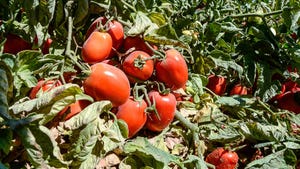
The situation has forced farmers in these districts to take a variety of defensive actions. They include forgoing annual crops, like lettuce, peppers and tomatoes to free up more water for permanent crops like almonds, grapes and pistachios. Pumping more groundwater is another option for those who have wells. However, high boron and saline levels of this water can pose a threat to crops.

Some growers are buying water wherever they can. Water sales have ranged from $500 to already $900 per acre foot and the weather is still mild.

The water shortage is also impacting farmworkers. “There’s already been a significant cutback in the labor force in our district because of the lower water supplies at the beginning of the season, over 500 year-round jobs” says Woolf. “The latest water restrictions caused even more workers to be laid off the first week of June.”

“This is an unfolding dilemma and a lot of growers are still trying to sort out what to do,” says Dan Errotabere, a former Westlands Water District chairman whose family farms near Riverdale, Calif. The Errotaberes farm almonds, tomatoes, cotton and garlic near Riverdale, Calif. “We need to try to survive the best way we can.”

This year, he fallowed 320 acres and decided not to plant lettuce, as usual, based on the earlier 45 percent allocation. Also, Errotabere completed his last wheat irrigation before rationing began. Meanwhile, his cantaloupes, tomatoes, onions and garlic will have to depend mostly on well water this year to save as much canal water as he can for his almonds. “Because of the salt levels, the well water isn’t the best choice for the land,” he says. “But, we’re in a desperate time.”

“It breaks my heart that farmers have invested thousands of dollars in permanent crops and then the water supply gets jerked out from under them,” says grower Mike Stearns, Firebaugh, Calif. “There will be some major financial losses on the West Side.”

Stearns, who is also chairman of the San Luis Delta Water Users Association, grows wine grapes, processing tomatoes and seedless watermelons in the Westlands and Panoche water districts. Over the last few years he’s cut water consumption significantly by switching from conventional furrow and sprinkler irrigation to buried drip systems for his row crops and above ground drip for his wine grapes.

This year’s water shortage has forced him to fallow about 25 percent of his land in the Panoche district to conserve water for his young wine grapes. Stearns reduced his cotton acreage 85 percent from last year and planted none of his usual garlic or processing onions. To help compensate, he planted some of his typical tomato and cotton acres to safflower this year. “I was able to pre-irrigate the safflower using water carried over from 2007,” he reports. “That’s all the water the crop got.

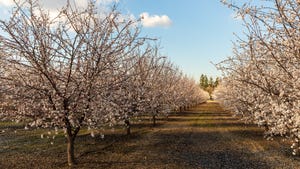
Despite deficit irrigation this year and probably a minor decline in yield, most members of the Central California Almond Growers Association should not be affected too badly, says Mike Kelley, president and CEO of the association. For one thing, only about 10 percent of them are in the Westlands Water District. Most of the rest are in older water districts where water reductions won’t be as severe because of older water rights.

“With such a tremendous investment in their acreages, the last thing they want is to be shorted on water,” he says. “So, prior to this season, our growers did a substantial amount of planning for a worst-case scenario. Because most of them have wells, they should be all right. At this point, we believe our members will weather the water situation. The only caveat is that this is a moving target that seems to change on a weekly and daily basis. If the drought continues, it could be a very bad situation everywhere.”

“Because we fallowed so much ground and planted safflower as an alternate crop, we’ll make it through summer,” adds Stearns “But, unless we have an above-normal winter, next year looks very bleak.”

Get Copyright ClearanceWant to use this article? Click here for options!
© 2008 Penton Media, Inc.


Latest Jobs

resources

events icon events

product info icon tradeshows

tradeshow icon digests

research icon photos

Continuing Education

Accredited by California DPR and California and Arizona Certified Crop Advisers:


(New Course)

Nutrient Management in Key California Crops


This online CEU course offers a detailed look at the nutrient management in key California crops. It is sponsored online by Western Plant Health Association and funded by a grant from the California Department of Food and Agriculture Fertilizer Research and Protection Program (FREP). It is accredited for one (1)-hour of credit by the California Department of Pesticide Regulation for California Pest Control Advisers (PCA), Private Applicators, Qualified Applicators and Aerial Applicators. The course is also accredited for 3 units in Nutrient Management (NM) for California and Arizona Certified Crop Advisers (CCAs).

Accredited in California, Arizona, Idaho, Oregon and Washington and for Certified Crop Advisers:


(New Course)
Organic/Sustainable Agricultural Production in the West

Organic/sustainable agriculture is expanding rapidly in the U.S. with an average annual increase of 20% during the last 15 years. This course covers a wide range of pests and organic control strategies. It is accredited for up to 4 continuing education hours for PCAs and Applicator Licensees in California, Arizona, Idaho, Oregon and Washington. It is also approved for Certified Crop Adviser credit.

ACCREDITED IN OREGON AND WASHINGTON:


(New Course)
Managing Spray Drift to Minimize Problems

This online spray drift management course has been certified by the Oregon Department of Agriculture and the Washington Department of Agriculture for 2 hours of credit for licensed Applicators and Consultants in Oregon and Washington.

ACCREDITED IN CALIFORNIA ONLY:


Almond Pest Management

Get the latest info on almond insect pest management and earn 2 hrs. CE DPR and CCA credit in California.

California Groundwater Protection Regulations

Earn 2 hrs. in California laws and regs CE and learn how to protect California groundwater supplies.


Disease Management in California Almonds

Managing diseases in California almond production is a year-long process. This course provides the latest information on controlling these diseases with management practices and fungicides. The course is approved for 2 CEUs by DPR for PCAs and all applicator categories and California CCAs.

Powdery Mildew Control in California Grapevines

Learn about the No. 1 grape disease in California; earn 2 California CE hours.

ACCREDITED IN CALIFORNIA AND ARIZONA:


The Role of Copper in Disease Control

Copper has long been a key tool in disease control in a many crops. This 2-CEU course accredited California PCAs and all DPR applicator categories and Arizona applicators details how best to use copper to maximize its potential.

Insecticide Resistance Management in Agronomic and Row Crops

A 3-hr. CE approved for California and Arizona licensees and CCAs in both states.

Agronomic Weed Resistance Management in Row Crops, Trees Nuts and Vines

Weeds Resistance Management is approved for 3 hours of CE credit for all California and Arizona licensees and Certified Crop Advisers.

Lepidopterous Pest Management/ Pesticide Safety

This course is approved for 2 hours in Arizona and California (1 hr. of laws/regs; 1 hour Other) and for CCAs.

Managing Spray Drift to Minimize Problems

2-hrs laws and regs for California licensees; 2 hours in Arizona and for CCAs.

Back to Top

Browse Print Issues

Additional Resources

subscribe to Farm Press Daily Southeast Farm Press Southwest Farm Press Delta Farm Press