Tepary beans ready for prime time agriculture?

What is in this article?:

  • Tepary beans are tolerant of drought and heat, mature quickly, are comparatively resistant to pests, and could produce more than one crop per year.
  • Teparies are able to thrive in saline soils that result from irrigation.
  • Teparies are higher in protein and fiber than common beans and have a lower glycemic index.

More or less in the middle of New Mexico State University's new Student Centered Field Laboratory, nestled among the vegetable garden space, the cover crop research section and several rows of native corn varieties, is a plot of viney, pod-bearing plants that most New Mexicans would be hard-pressed to identify.

They are tepary beans, and they are a perennial research subject of Richard Pratt, head of NMSU's Department of Plant and Environmental Sciences in the College of Agricultural, Consumer and Environmental Sciences. He feels that Southern New Mexico might be a good place to raise this crop that is well-suited to desert conditions. 

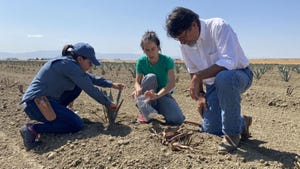
He was out in the field in late November, comparing the various individual plants with each other and determining which ones had harvest-ready beans in the pods. He had uprooted several of the plants and was holding one of them, turning the 18-inch ball of dried stems and pods in his hands.

"I specifically pulled these out because they seemed to be maturing a little ahead of the other teparies," he said.

He has five different tepary varieties at the field lab, and one aspect of the project is to assess how they grow in the Mesilla Valley. The one he was inspecting comes from Chiapas, Mexico.

"There may be a little bit of genetic variation, so what we're doing is pulling out the plants that appear to be the best. This has a nice load of dry, ready-to-go beans inside."

He removed a few from their pods and held them in the palm of his hand, noting their well-defined mottling pattern that he said indicates tepary bean maturity.

According to Pratt, the tepary is typically a smaller bean than its "common bean" cousins, such as pinto and black bean. "But that may be part of the whole drought- and heat-resistance packages, not trying to do too much, if you will. Expending its energy carefully and not going overboard."

Tepary was a traditional crop for the indigenous inhabitants of the Sonoran Desert of what is now northern Mexico and southern Arizona. In fact, the Tohono O'odham people of southern Arizona were previously known as the Papago, apparently a mispronunciation by the Spanish of the native term for "tepary eaters."

It was actually in Arizona that Pratt became interested in teparies. He earned both a bachelor's and a master's degree at the University of Arizona in the 1970s. One of his inspirations was a University of Arizona Agricultural Experiment Station bulletin, "Southwestern Beans and Teparies," originally published in 1912 by a professor, G.F. Freeman.

Discuss this Article 1

jones88
on May 6, 2013

There is definitely so much that you can do with these beans. It is so amazing how they grow in this environment. Not a lot of people know about them. http://www.alluremassage.ca

Post new comment
Sign In or register to use your Western Farm Press ID
(optional)

Continuing Education Courses
This accredited CE course focuses on choosing the correct variety alfalfa based on a number of...
New Course
The 2,000-member Weed Science Society of America’s (WSSA) Herbicide Resistance Action...

The course details six of the primary diseases affecting citrus: Huanglongbing (Citrus...

Newsletter Signup