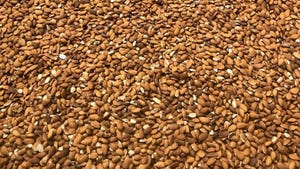
Separating wheat from chaff at the genetic level

What is in this article?:

  • USDA estimates that global farmers grew 681 million tons of wheat in 2011. Only corn and rice had bigger harvests.
  • Biotechnology breakthrough taps key parts of the wheat genome.
  • Essential biotech advance will allow producers to grow more and better wheat.

It may be the greatest thing since sliced bread. Heck, it may be even better than sliced bread.

Several weeks ago, researchers announced that they had tapped into key parts of the wheat genome. With this success, we could be on the path to doubling wheat production and increasing food security for people around the world.

That’s an awful lot of sliced bread.

It also marks one of several important milestones in the history of wheat, a plant that currently accounts for around 20 percent of all calories consumed by humans.

About 8,000 years ago, farmers domesticated this staple crop. This agricultural innovation may have led to human society’s transition from hunting and gathering to settled production and the rise of civilization.

Almost 2,000 years ago, the Gospel of Matthew gave us one of our best-known idioms, about separating the wheat from the chaff.

And today, scientists are exposing the secrets of wheat’s genetic makeup.

The formal announcement came in Nature, the academic journal. Scientists from the United Kingdom led the effort, joined by collaborators in Germany and the United States. One member of the team hails from my home state: Dr. Shahryar F. Kianian, a geneticist at North Dakota State University.

Wheat may look like a simple plant, but its biology is astonishingly complex. Wheat is comprised of three different grasses; it has an enormous genome of about 95,000 genes, which is roughly five times larger than the human genome.

So decoding wheat’s genome is a long and laborious task. In Science, the researchers described their approach, called “shotgun sequencing.” They break the genome into pieces and look for patterns, allowing them to learn more at a faster pace.

It’s like separating wheat and chaff at the genetic level.

Their paper was written for an audience of peers, scientists with advanced degrees. Yet their conclusion points to a practical application: “Analysis of complex polygenic traits such as yield and nutrient use efficiency will also be accelerated, contributing to sustainable increases in wheat crop production.”

In ordinary English, that means we’ll soon grow both more and better wheat.

Discuss this Article 1

jones88
on May 7, 2013

There is so much good coming from the wheat industry in the U.S. So many are benefiting from this big wheat growth. So much to get from the science from it and the benefits of using it. furnished suites Toronto

Post new comment
Sign In or register to use your Western Farm Press ID

(optional)

Continuing Education Courses
This accredited CE course focuses on choosing the correct variety alfalfa based on a number of...
New Course
The 2,000-member Weed Science Society of America’s (WSSA) Herbicide Resistance Action...

The course details six of the primary diseases affecting citrus: Huanglongbing (Citrus...

Newsletter Signup