Raspberry fumigation: less is more?

  • Raspberry growers typically use broadcast fumigation to deal with root lesion nematodes and root rot, but increasing EPA restrictions have inspired alternative methods.

Less fumigant may actually improve raspberry crops, as an ongoing study by Washington State University small fruits horticulturalist Thomas Walters indicates.

Raspberry growers typically use broadcast fumigation to deal with root lesion nematodes and root rot, but increasing Environmental Protection Agency restrictions inspired Walters to research alternative methods.

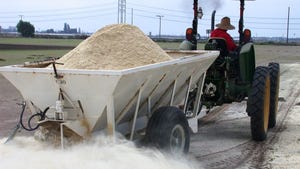
This bed fumigation apparatus, used in WSU research trials, reduced fumigant use and buffer zones, and resulted in fewer nematodes and larger raspberry plants.

Raspberry plants are finicky about soil and climate and optimal land for commercial cultivation is in short supply. While many farmers rotate crops to stay ahead of pests, raspberry growers don’t have enough suitable land to move their crop. When pests and pathogens find a permanent home for their favorite snack, they can reproduce until they become unmanageable. A soil-borne pest, root lesion nematodes, and a fungal pathogen, raspberry root rot, are particularly troublesome to raspberry growers. Every five to eight years, the culprits get so troublesome that the plants are removed, the field is broadcast fumigated, and new raspberries are planted.

Increasing restrictions have growers seeking alternatives to broadcast fumigation. New EPA Environmental Protection Agency regulations require a buffer zone for two days after fumigation. The size of the buffer zone depends on the field size, the fumigant, and associated rate used and other factors, but it can easily be 600 feet or more. With many raspberry fields in close proximity to houses, this approach is no longer practical.

To more selectively apply fumigant, Walters borrowed a concept from California strawberry growers, and adapted a bed fumigation apparatus. This multi-stage tractor-drawn tool uses a shank to cut the soil. Fumigant is injected into the soil through a hose behind the shank. The apparatus then shapes the three-foot wide bed and pulls a fumigant-resistant plastic tarp over it. Raspberry rows are spaced 10 feet apart, with no fumigation in the alleyways.

Because the new process uses only one third as much fumigant as broadcast fumigation, the statutory buffer zone drops to 25 feet, making the process much more neighbor-friendly. However, the expense of the tarp makes the cost about the same as broadcast fumigation. The biggest drawback of bed fumigation is that it requires more planning to be sure the beds are properly placed for irrigation.

Since the study began in fall 2010, results have been promising. Twice a year, Walters and his colleagues from the United States Department of Agriculture measure plant growth and take soil and root samples to evaluate pests. When compared to broadcast fumigation, the raspberries grown with bed fumigation are doing at least as well, if not much better. Soil tests from some sites show 10 times more nematodes in broadcast-fumigated plots than bed-fumigated plots. Also, all raspberry plants in bed-fumigated plots are the same size or larger than plants in the broadcast-fumigated plots. Walters will soon compare raspberry yield from the test plots, as well.

Walters notes that this project was possible thanks to cooperation from the USDA and Trident Agricultural Products, Inc., and support from the grower community.

Discuss this Article 2

Anonymous (not verified)
on Jul 4, 2012

cover cropping (biofumigation) with white mustard has proven to be as effective as fumigation. Many commercial growers prefer it. 3 months growing, disk completely under, highly effective against nematodes

saqib anwer (not verified)
on Sep 7, 2012

PAKISTAN PEST CONTROL

www.ppcfum.com
92-21-32218113
921-21-32639899
Fax: 92-21-32621560
WE PROTECT YOUR INTEREST IN PAKISTAN FOR WOOD/PACKING TREATMENT (INCL. ISPM MARKING) & FUMIGATION OF FOODSTUFF & CARGOES. INSERT OUR NAME IN YOUR CONTRACTS ******* PAKISTAN PEST CONTROL *******
.
REGISTER MEMBER
KARACHI CHAMBER OF COMMERCE & IND.
registered government of Pakistan department of plant protection
● Fumigation
All Fumigants used for Fumigation are highly toxic and hazardous in nature, as such they are classified as restricted use pesticides by the EPA (Environmental Protection Agency).
A basic requirement is that sufficient personnel trained to fumigate are available to carry out all necessary operations.
Our all fumigation operations are carried out by the trained persons (Verified and approved by the Technical Consultant and Plant Protection Department).

Advantage of fumigation –

Fumigants are usually quick acting and as result in total control of pest & insects.
Fumigation can control at all stages of pests (i.e. eggs, larvae, pupae, adults and hidden insects).
Fumigants being Gases, they diffuse through all parts of the structure or commodity and can reach to pests that could not be reached with conventional pest control materials or techniques for certain commodities, Fumigation is the only recommended practical way to control pests.
Fumigation has no adverse effect on Germination quality.
PAKISTAN PEST CONTROL
PAKISTAN PEST CONTROL is authorized to carry out all Quarantine requirements regarding Fumigation and our Certificates are accepted worldwide. We are also specialized in Fumigation / Disinfestations of residential & commercial building / project besides export cargoes Fumigation
PAKISTAN PEST CONTROL:
> Established in 1979.
> Approved by PLANT PROTECTION DEPARTMENT GOVERNMENT OF PAKISTAN.
> Member: Karachi Chamber of Commerce & Industry.
> Approved Fumigator lists of A.Q.I.S Australia.
> Treatment Certificate are acceptable in Australia , New Zealand, USA, Europe, China, Middle East & Other Countries.
> Services are appreciated by many respectable Clubs / Members of LION CLUBS INTERNATIONAL.
FUMIGATION:-

Fumigation is a process of exposing insects or material infested by insects to the fumes of a chemical at a lethal strength in an enclosed space for a given period of time. Fumigant is a chemical, which at a required temperature and pressure can exist in the gaseous state in sufficient concentration to be lethal to a given pest organism. Fumigation is the introduction of the toxic gas in high concentration so that the gas pervades the entire area and kills the insects prevalent and thus preserve the precious cargo of the customer.

Treatment By Fumigation are:
Godowns/ Warehouses/ Silos/ Flour mills/ Empty ship holds Fumigation
Stuffed & Empty containers of Export/Import at Port/Inland Container Depot (ICD)/Container, Freight Stations (CFS) and at House Stuffing Points.
In-transit Fumigation-Commodities Onboard, Barges etc.,
Termite Control Treatment during (Pre & Post Construction) Stage as per PSI standards with Guarantee.
Rodent control & De-ratting of Ships.
Disinfestations Of Warehouses & plants.
General Pest control services.
Fumigation is the process where a highly toxic Fumigant such as Methyl Bromide or Phosphates are used to eradicate pests and insect from products, produce or a location.

The process involves the Fumigation complete covering or sealing of the product or item with canvas, having plastic sheets & taping to make it as airtight as possible. The Fumigant gases is then released into the sealed area or compartment. The duration of exposure varies from 8 hours to 48 hours, depending on the product to be fumigated and the type of fumigant used as per temperature & requirement

Fumigation is a Quarantine requirement for countries such as Australia , New Zealand and China before goods are admitted into the country.

Items we fumigate include:-
Timber
Wooden/Pallets Packing Material
Furniture
Tobacco
Rice & other Food Stuff.
Wooden sports goods.
After treatments we issue Certificates & if require also arrange Govt's Phytosanicary Certificates verifying are our treatments.

FUMIGATION OF RAW MATERIALS:
i) By Methyl Bromide doses require from @ 36 gms per M3 to @ 80 grams per M3
ii) By Phosphine Gas Tablet dose require @ 1.1 Tab per M3
(With Instruction to Exporter for proper cleaning & packing).
CONTAINER FUMIGATION WITH METHYL BROMIDE:

After stuffing some time Container goes to container yards terminal, of KPT/QICT (inside port areas) Customs Department to fulfill their custom formalities and to sealed the container.

(By special method we can also fumigate the container after custom examination with Methyl - Bromide whose exposure done at destination).

All Fumigation Treatment are monitored by the Expert of PPC for Fumigation & after exposure opening Container doors are opened to release gas therein. Site inspections may be carried out by the environment health inspectors to determine all safety aspects are adhered to. All fumigation’s are carried out by our trained experienced fumigators. The concentration of the gas used will kill all alive insects pests present at the time of fumigation. Fumigated cargo should be shipped out as soon as possible on completion of the process.

Fumigation are specially with Methyl Promide carried out in accordance to "AQIS" (Australian Quarantine & Inspection Services) set standards.

ALUMINUM PHOSPHATE FUMIGATION:

Aluminum Phosphate is in the form of tablets and are also use worldwide for fumigation of raw and processed commodities including grains, tobacco, nuts seeds, animal feeds, tea, coffee leaf, wheat flour, processed spices, dried fruits. It can also be used for fumigating storage structures like silos warehouses, flour mills ship holds, railcars etc. The period required 3 - 6 days time keeping in view the conditions & temperature, USA and some other countries requires Phosphine gas Fumigation.
WOOD TREATMENT & WOOD PACKING FUMIGATION:
ISPM 15 fumigation accredited to carry out phytosanitary treatment. This includes the application of Methyl Bromide Fumigation treatment and IPPC marks defined under the International Standards for Phytosanitary measures (i.e. ISPM 15) for solid wood packaging.

ISPM:-
The international ISPM 15 requirements on wood pallets apply to all species of coniferous and non-coniferous packaging materials. The standard does not not apply to wood packaging made wholly of products such as plywood, particle board, oriented strand board, medium density fiber board or products created using glue, heat and pressure or a combination of these.
Most member countries have already partially or fully implemented the standards. The EU, Australia, Canada and South Africa are also implementing bans on coniferous wood packaging and in certain cases non-coniferous hardwood packaging, meaning shipping pallets (skids), crates, and wood used to secure ocean cargo loads.
Under the ISPM15 requirements, exporters would be required to heat treat wood packaging material to a minimum core temperature of 56AºC for a minimum of 30 minutes. Exporters could also use methylbromide to fumigate the wood packing.
The rule requires certification of the packaging with an approved International Plant Protection Convention (IPPC) logo. Unmarked Wooden Packing Materials / Woods.
will be considered untreated and (objectionable) non-compliant.

METHYL BROMIDE FUMIGATION

Methyl Bromide is most widely used fumigant for Quarantine purposes. It is a
preferred fumigant for most of the quarantine authorities around the world, because
of its good penetrating ability, rapid action, high toxicity to a broad spectrum of
insects and pests. It is frequently used for fumigating timber, agricultural products,
empty containers, food stuffs, and other agricultural produce. When fumigation is
carried out with Methyl Bromide fumigant residue problems will not be there as
aeration can be carried out easily. It is very effective in controlling all stages of
insects from egg to the adult stage. Quarantine Authorities around the world have
stipulated that methyl bromide fumigation has to be carried out for all the packing
materials which is made out of Wood, Straw materials.

The aim is to prevent pests, other insects and biological material from being transferred unknowingly from one country to another. Goods packed in wood material that does not comply with the ISPM15 standard will be returned to the Exporter at their expense.
The international ISPM15 requirements on wood pallets apply to all species of coniferous and non-coniferous packaging materials. The standard does not not apply to wood packaging made wholly of products such as plywood, particle board, oriented strand board, medium density fiber board or products created using glue, heat and pressure or a combination of these.
Most member countries have already partially or fully implemented the standards. The EU, Australia, Canada and South Africa are also implementing bans on coniferous wood packaging and in certain cases non-coniferous hardwood packaging, meaning shipping pallets (skids), crates, and wood used to secure ocean cargo loads.
Under the ISPM15 requirements, exporters would be required to heat treat wood packaging material to a minimum core temperature of 56AºC for a minimum of 30 minutes. Exporters could also use Methyl Bromide to fumigate the wood packing.
The following information is a complete extract from AQIS Advice Notice No. 2007/09 regarding ISPM15. ISPM15 requires the use of either heat treatment or fumigation using methyl bromide, as the only two approved methods to enable compliance.

1. Compliant Wood Packaging Material

Wood packaging is only recognised as ISPM 15 compliant when the following conditions have been met:
1. It has been treated by an approved treatment; and
2. It bears an internationally recognised certification mark
2. Approved Treatments

Under the ISPM15 standard there are currently only two approved forms of treatment:
Heat treatment (a core temperature of 56°C must be reached and maintained for a minimum of 30 minutes); and

Fumigation with methyl bromide (as per the table below)
Temperature Dosage (g/m3) Minimum concentration (g/m3) at:
2hrs 4hrs 12hrs 24hrs
21°C or above 48 36 31 28 24
16°C or above 56 42 36 32 28
10°C or above 64 48 42 36 32
The minimum temperature should not be less than 20°C and the minimum exposure time must be 24 hours. (as per conditions).
3. The Internationally Recognized Mark

The mark verifies that the packaging has been subject to an approved treatment and that the material has been produced by
an AQIS approved facility. To be recognised as compliant the mark must include:
the IPPC mark,
XX - the country code (AU for Australia)
YY- the treatment code (HT or MB)
OOO - represents the unique Certification.
Exporters should note that countries that are enforcing the ISPM 15 standard will NOT accept fumigation or heat treatment. Certificates in lieu of the internationally recognized mark, even when the packaging has been treated / fumigated.
Wood packaging material that does not bear the Mark / Stamping is considered to be objectionable non-compliant.
WE PROTECT YOUR INTEREST IN PAKISTAN FOR WOOD/PACKING TREATMENT (INCL. ISPM MARKING) & FUMIGATION OF FOODSTUFF & CARGOES. INSERT OUR NAME IN YOUR CONTRACTS ******* PAKISTAN PEST CONTROL *******

www.ppcfum.com
92-21-32218113
921-21-32639899
Fax: 92-21-32621560

Post new comment
Sign In or register to use your Western Farm Press ID
(optional)

Continuing Education Courses
This accredited CE course focuses on choosing the correct variety alfalfa based on a number of...
New Course
The 2,000-member Weed Science Society of America’s (WSSA) Herbicide Resistance Action...

The course details six of the primary diseases affecting citrus: Huanglongbing (Citrus...

Newsletter Signup