LBAM a major threat to California agriculture

What is in this article?:

  • LBAM a major threat to California agriculture
  • Management
  • Light brown apple moth was recently found in Santa Barbara County for the sixth time.  LBAM is a quarantine pest on the United States mainland and can cause serious damage to various crops, nurseries, fruit trees, landscapes, and native plants.

Light brown apple moth (LBAM), Epiphyas postvittana (Walker) was recently found in Santa Barbara County for the sixth time.  LBAM is a quarantine pest on the United States mainland and can cause serious damage to various crops, nurseries, fruit trees, landscapes, and native plants.

Origin and distribution: It is an invasive pest native of Australia, but has been present in Hawaii for more than a century.  It was first found in Alameda County in 2007.  It is now established in Alameda, Contra Costa, Marin, Monterey, Napa, San Benito, San Francisco, San Mateo, Santa Clara, Santa Cruz, Solano, and Sonoma counties in California.  It is also reported in San Diego, San Luis Obispo, and Santa Barbara.

Host range: LBAM feeds on a variety of host plants, but prefers members of Asteraceae (aster), Fabaceae (legumes), Polygonaceae (knot-weed) and Rosaceae (rose).  It is a pest of apples, apricots, peaches, pear, grapes, strawberries, cane berries, cole crops, ornamental shrubs, trees and many other hosts.  Nurseries near urban areas are especially sensitive to LBAM infestation in California.  If it spreads and establishes as a pest, many agricultural crops can be at risk.

Damage: Damage to foliage and other parts by rolling and webbing, loss of inflorescence, feeding on or boring into the buds, fruit, or stems, fruit drop or damage to the surface, and exposing the damaged areas to plant pathogens typical of LBAM larval feeding.

Biology: LBAM belongs to a large lepidopteran family of Tortricidae.  It is a large family containing many of the common months including important pests such as codling moth (Cydia pomonella), oriental fruit moth (Grapholitha molesta), spurce budworms (Choristoneura spp.), and the western black-headed budworm (Acleris gloverana).  Mexican jumping-bean moth (Cydia deshaisiana) also belongs to this family. There are 1200 species of tortricids in North America.

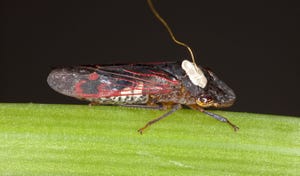
LBAM eggs are laid in groups of 20-50 in overlapping manner and are covered with greenish transparent material.  On average, females lay a total of 120-500 eggs in its lifetime.  Eggs turn dark as they mature and hatch in 1-2 weeks.  Larvae are pale to medium green with a yellowish to tan colored head capsule.  Younger larvae roll the leaves and form webbings of leaves as they mature.  Mature larvae may also bore into fruits.  Mature larvae are about 10-18 mm long.  During winter, larvae can survive for two months without feeding.  Pupae are formed in a silken cocoon among the leaf webbings.  They turn from green to brown as they mature in 1-3 weeks.  Adults mate right after they emerge and females lay eggs within 2-3 days after emergence.  Adults are small, light brown with darker markings and have a wingspan of 16-25 mm.  They hold their wings in a roof-like pattern at rest.  Markings on their wings can be highly variable and identification based on external features can be very difficult.  Positive identification of LBAM adults often requires examination of reproductive organs.  Females are lighter colored and larger than males.  They rest in sheltered parts of the plant canopy during the daytime and fly during the nighttime.  They are not powerful flyers, so stay close to the infested areas within a 100 m (330 feet) range.  Adults survive for 2-3 weeks.  Depending on temperature, there can be two (Central and North Coast areas) or three to four (Central Valley and Southern California) generations per year in California.

LBAM eggs are laid in groups of 20-50 in overlapping manner and are covered with greenish transparent material.  On average, females lay a total of 120-500 eggs in its lifetime.  Eggs turn dark as they mature and hatch in 1-2 weeks.  Larvae are pale to medium green with a yellowish to tan colored head capsule.  Younger larvae roll the leaves and form webbings of leaves as they mature.  Mature larvae may also bore into fruits.  Mature larvae are about 10-18 mm long.  During winter, larvae can survive for two months without feeding.  Pupae are formed in a silken cocoon among the leaf webbings.  They turn from green to brown as they mature in 1-3 weeks.  Adults mate right after they emerge and females lay eggs within 2-3 days after emergence.  Adults are small, light brown with darker markings and have a wingspan of 16-25 mm.  They hold their wings in a roof-like pattern at rest.  Markings on their wings can be highly variable and identification based on external features can be very difficult.  Positive identification of LBAM adults often requires examination of reproductive organs.  Females are lighter colored and larger than males.  They rest in sheltered parts of the plant canopy during the daytime and fly during the nighttime.  They are not powerful flyers, so stay close to the infested areas within a 100 m (330 feet) range.  Adults survive for 2-3 weeks.  Depending on temperature, there can be two (Central and North Coast areas) or three to four (Central Valley and Southern California) generations per year in California.

Discuss this article 2

THE LIGHT BROWN APPLE MOTH (LBAM) IS NO MORE OF A THREAT TO AGRICULTURE THAN THE WIND.

The entomologist who first noticed it, three courts who evaluated it, the state senate committee on agriculture all determined that the moth is a NON-ISSUE to agriculture.

Only the California Department of Agriculture (CDFA), the USDA, and the chemical companies who stand to rob taxpayers of $100 Million per year for unnecessary pesticide contracts are keeping this LBAM propaganda alive.

The quarantines & interference with farming are very real, but they are caused by CDFA, not LBAM.

Professor's press release on CDFA LBAM Program Fraud
http://www.indybay.org/newsitems/2008/10/07/18543314.php

There are millions and millions of LBAM in Santa Cruz and San Francisco counties for six years since they were noticed and about 50 years since they arrived and not a single legitimate incident of crop damage or a single problem - END OF STORY.

By RobertWilliams  on Dec 23, 2011

This again? The LBAM is not a threat. CDFA won't admit it was wrong in 2009, it was wrong to spray Santa Cruz (over 100 people hopsitalized) and that there is no (none) documented damage from this pest. CDFA needs to admit it made wrong decisions based on bad science, but putting a lot of money in pest control budgets. Again, there is no documented damage, and the Light Brown Apple moth has been in CA for at least 30 years according to event CDFA's literature.

By Anonymous (not verified)  on Jan 1, 2012
Post new comment
Sign In or register to use your Western Farm Press ID

(optional)

Continuing Education Courses
New Course
The 2,000-member Weed Science Society of America’s (WSSA) Herbicide Resistance Action...
New Course

The course details six of the primary diseases affecting citrus: Huanglongbing (Citrus...

Get the latest info on almond insect pest management. California: 2 Hours "Other"
Farmer-to-Farmer Used Equipment