Brown marmorated stink bug latest invasive pest threat to U.S. crops

What is in this article?:

  • The dirty dozen have become the stinking 13 with the latest invasive pest alert by USDA-APHIS.
  • BMSB has been found in 29 states. It has become established in northwest Oregon and has been found in Vancouver, Wash.
  • One was picked up five years ago in a storage facility in Vallejo, Calif., where a family from Pennsylvania recently relocated. It was also found two years ago in air freight at a Southern California airport.
  • BMSB attacks wide range of crops from fruit to grapes to soybeans.

The dirty dozen have become the stinking 13 with the latest invasive pest alert by USDA-APHIS and university entomologists across the U.S. for growers to be on the lookout for the brown marmorated stink bug (BMSB).

BMSB joins Asian citrus psyllid, Asian longhorned beetle, citrus greening, emerald ash borer, European grapevine moth, European gypsy moth, false codling moth, light brown apple moth, Mediterranean fruit fly, Mexican fruit fly, Oriental fruit fly, and sudden oak death and dangerous invasive pests.

BMSB has been found in 29 states. It has become established in northwest Oregon and has been found in Vancouver, Wash. One was picked up five years ago in a storage facility in Vallejo, Calif., where a family from Pennsylvania recently relocated. It was also found two years ago in air freight at a Southern California airport.

Eastern Pennsylvania is where it was first collected in the U.S. in September 1998. It was believed to have reached the U.S. on a cargo ship from Asia.

Larry Hull, a Pennsylvania State University entomologist based at the Fruit Research and Extension Center in Biglerville, Penn., said even through it has since been found in parts of New Jersey, Maryland, Virginia and West Virginia, the insect had not caused any significant damage to tree fruit crops until this past season. “Some growers in Maryland and northern Virginia had complained about damage from the insect in 2009,” Hull says. “But, 2010 was the first year when things really got out of hand.”

This past season, he notes, some Pennsylvania peach growers lost as much as 50 percent to 60 percent of their crop to the insect which feeds directly on the fruit. “All the forces (early bloom and very, dry warm weather) came together to create very high BMSB populations and caught everyone off guard,” he says.

Among other crops, it feeds on grapes, citrus, blackberry, sweet corn, field corn and soybeans.

According to entomologist Walt Bentley, University of California IPM specialist based at the UC Kearney Ag Center in Parlier, Calif., BMSB has been found in tree fruit orchards in Oregon.

Growers should take finds of unknown stinkbugs seriously and report them to county agriculture commissioners immediately.

“We missed EGVM for a few years and then it became established,” he says. Unlike EGVM, BMSB poses a bigger threat since it feeds on a host of cultivated, ornamental and wild hosts.

(BMSB) is native to China, Japan, Korea and Taiwan where it is a major economic pest, attacking a variety of high value crops.

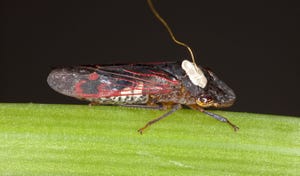
Adult BMSB resemble other stinkbugs. They have a marbled pattern on their backs and specialized mouthparts that enable them to penetrate and feed on plant tissues. Feeding results in deformed fruit (cat‐facing), and internal brown spotting that renders the fruit unsuitable for the fresh market.

The BMSB can emit a foul odor; the presence of BMSBs in wine grape clusters at harvest and crush may contaminate the fruit and impart their foul bitter‐sweet odor to the wine.

The name “marmorated” is from the Latin word for marble, “marmor.” The back of the adult has a marble-like pattern, hence the name.

Discuss this article 1

In any discussion about the Light Brown Apple Moth it must be remembered that there is NO THREAT caused by the LBAM ANYWHERE it is found in the world. The moth has been in the state for decades and has, by CDFA's own admission in their EIR, NOT CAUSED ANY DAMAGE in the state. The moth was misclassified decades ago and the USDA and CDFA refuse to respect modern research and knowledge regarding the real threat of this innocuous insect. In New Zealand, where it has been found for more then 100 years (this is true also for Hawaii, the UK, and everywhere it is native or has been introduced) farmers are required to provide only LBAM-free produce if they intend to export to the US. New Zealand farmers are not subject to quarantines, do not have to have LBAM-free farms, and the government helps these farmers with useful information on control. Our CDFA and USDA are not there to help just prevent farmers from doing their jobs and imposing restrictions. LBAM is easy to control with organic IPM methods.

The ONLY threat of LBAM is the inspections and draconian quarantines imposed on our farmers and the violation of our farms and businesses by the CDFA/USDA. The media and agricultural commissioners have not acted responsibly and need to check the misinformation they promulgate as facts regarding the LBAM and the eradication program.

Be aware that the mating disruption hormones used to reduce the number of LBAM have never had efficacy tests completed in any setting outside of agriculture. The CDFA do not know if these substances will even work. These chemical pheromones have also never been tested for any effects on humans. Please understand that the levels of these artificial substances being used in urban areas are at levels 10's of thousands of times more concentrated than those encountered in nature. What are the effects of these very persistent chemicals on humans? No one knows? Do you want to accept that risk?

Resist the quarantines, ask questions, get educated (Northern California resisted after the CDFA sprayed regions of Santa Cruz and Monterey counties with synthetic chemicals never meant for or tested for exposure to humans and without any efficacy tests on how these treatments might work), urge reclassification of LBAM. Refuse to sign compliance agreements until all of your questions are answered. Stand up and fight with legal challenges. LBAM is not a threat, our Ag agencies are the real threat despite the fact their job is to protect us.

By Stan Roller (not verified)  on Dec 16, 2010
Post new comment
Sign In or register to use your Western Farm Press ID

(optional)

Continuing Education Courses
New Course
The 2,000-member Weed Science Society of America’s (WSSA) Herbicide Resistance Action...
New Course

The course details six of the primary diseases affecting citrus: Huanglongbing (Citrus...

Get the latest info on almond insect pest management.
Farmer-to-Farmer Used Equipment