Smart-Dyson works, achieves elusive grape-foliage balance

Apr 7, 2001 12:00 PM, By Harry Cline Farm Press Editorial Staff
Scott Henry and Smart-Dyson are peculiar names for vineyard trellising systems — as improbable as the technique they embody in managing grapevine canopies.

However, according to longtime Monterey County, Calif., grape grower Bill Petrovic, Smart-Dyson comes the closest he has seen in coastal vineyard canopy management in attaining that elusive balance between foliage growth and maximum premium wine grape production. And, it's cheaper to manage than most other systems now in use.

Smart-Dyson (S-D) came from international viticulturist Richard Smart and John Dyson, a well-known grape grower with vineyards in New York and California. Scott Henry is named for the Oregon grape grower and former aerospace engineer who developed it. Henry's technology is basically a system of two vines in one location, one high, and one low. Smart-Dyson uses the same high-low approach, but with a single, spur-pruned cordon-trained vine.

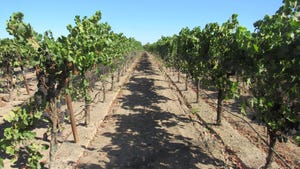
Most modern-day trellising systems, until Henry and S-D came along, are based on raising up the vine and its foliage or spreading it out — or sometimes both. These are basically throwbacks to arbors made less labor intensive and adaptable to modern viticulture. Smart-Dyson is like an arbor tilted on end. It positions a portion of the vine's fruiting canes to fall downward. The rest go up.

When fruiting canes reach 24-inches long, which is about June on California's central coast, canes on the south side of San Bernabe Smart-Dyson-trellised vines are directed down by a trellis wire strung 16-inches below a 48-inch high cordon. Workers unclip this low wire, raise it above the cordon; catch young canes and re-clip the wire once again to grapestakes. Petrovic calls this “raking down” canes. It is just the opposite of Vertical Shoot Positioning (VSP), which involves moving wires up grapestakes to catch foliage before it falls. Smart-Dyson encourages some canes to fall.

‘Picture window’ vine

There is no catch wire on the north side of Smart-Dyson and the canes grow up “naturally” thanks to incessant summer winds. “The wind blows like crazy in the summer on the coast, and the prevailing winds hold up canes on the north side of the vines canes,” he said.

He describes Smart-Dyson as creating a “picture window” grapevine — canes, foliage and grape bunches on a vertical plane.

“Training canes down is foreign to us viticulturally,” said Petrovic, who admitted he had his doubts about Smart-Dyson when he first heard about it. Petrovic began experimenting with the S-D about seven years ago, taking kicker canes and training them into cordons and adding downward shoot positioning wires. This was about the time the new up-down trellising systems were introduced.

His skepticism quickly disappeared. Petrovic, in his third decade of managing Central Coast wine grapes, has become so enamored with the success of implausible training system he would like some day to see 100 percent of the 8,000-acre San Bernabe Vineyards on Smart-Dyson.

“We have not yet found a variety it does not work on — Syrah, Chardonnay, you name it. A lot of people said it would not work on Cabernet Sauvignon. Cabernet is one of the easiest to adapt to Smart-Dyson,” he said. Replacement San Bernabe vineyards are put on Smart-Dyson, and he is retraining some younger blocks to the system.

Smart-Dyson's split canopy is a very efficient system of producing maximum tonnage of premium quality, coastal wine grapes by balancing foliage growth and grape production, said Petrovic.

Grapes are one of the most labor-intensive permanent crops in California, and any change in the way grapes are grown today must not add to labor costs and must increase income. Just as important is that wine grapes must be adaptable to mechanical harvesting in any new system. Smart-Dyson grades “A” in both at San Bernabe.

“Merlot mechanically harvests easily at three miles per hour with much less energy required to get the grapes off than for a quad system,” he said.

Smart-Dyson is also more economical to prune. Petrovic said his hourly workers can prunes S-D vines twice as fast as the traditional single curtain California Sprawl. “Smart-Dyson is three times faster to prune than quadrilateral trellising systems. Workers can prune 45 to 55 Smart-Dyson vines per hour.”

One reason for that is there are fewer tendrils holding wood to wires. “I never really paid that much attention before, but it became obvious that with quad systems or others vertical systems, vines want to grab on to the wire. That is not happening with Smart-Dyson,” said Petrovic. Although he does not yet mechanically pre-prune, Petrovic believes S-D would be ideal for it.

Falls to ground

“The beauty of this trellising is that pruners do not have to grab brush and pull it away — it falls to the ground when it is cut,” he said.

Smart-Dyson replaces kicker canes on vertically trellised vines at San Bernabe. Kicker canes on spur-pruned vines increase tonnage, but they are expensive. “It costs $50 per acre just to tie them, and it adds to pruning cost as well in selecting them,” he said.

Petrovic achieves the same amount of spurs (16-two bud spurs per cordon per side) on Smart-Dyson vines as he does with kicker canes on a traditional trellis. That's about 60 buds per vine.

The vertical plane S-D system lets more ambient light into the canopy than other systems, and air movement is excellent, reducing disease incidence and balancing bud fruitfulness, according to Petrovic.

Historically, coastal vines on traditional vertical trellising do not get enough heat units for ideal bud differentiation. “It is a shading issue, and people did think over time the upper canes on Smart-Dyson would be dominant. However, that has not happened,” he said. “Atypical bud dominance is not there.”

Although Smart-Dyson directs canes up or down, Petrovic said enough canes fall the opposite directions that there is no dominance.

“On the north side, there will be canes that dip down and on the south side there will be canes that go up. It is enough to avoid upper cane dominance,” he said.

The split canopy also reduces the need to pull leaves to improve air movement and reduce shading and disease “This is a big labor savings,” he added. He plans to put new Petite Sirah vineyards on S-D. That varietal is one of the most susceptible to disease, especially bunch rot.

“A lot of people think you have to have low tonnage to have quality. That is not true…you can have poor quality with low tonnage,” he said. “It is all a matter of reaching that balance of foliage to grapes.”

Planted early ‘70s

San Bernabe, purchased by Delicato Winery in Manteca in 1988, is one of the oldest vineyards in Monterey County. Delicato utilizes only a portion of the 30,000 tons produced at San Bernabe each year. The rest goes to the biggest names in the California premium wines.

San Bernabe was planted in the early 1970s in 12-foot rows and trellised in California sprawl with 36-inch high cordons.

That is all gone. Rows are now 9.6 feet wide and gone are the so-called “valley varieties” like Riesling and French Colombard, remnants of the long past white wine boom.

“We underwent a big grafting program in 1989, switching to Merlot, Chardonnay, Cabernet Sauvignon, Syrah and other more desirable varietals,” said Petrovic, who has been there since 1978 and vineyard manager since 1982.

Petrovic and San Bernabe have undergone significant changes over three decades.

For Petrovic, the trellising system with the peculiar name and even more unlikely split canopy training technique, is a milestone in that journey.

“I am a real skeptic when it comes to trying new things,” he said. “I realize it is very important to keep up with the new technology that come alone and we do. However, anything new has got to prove itself convincingly for me to use it. Smart-Dyson has done that.”

E-mail: harry_cline@intertec.com

Get Copyright ClearanceWant to use this article? Click here for options!
© 2008 Penton Media, Inc.


Latest Jobs

resources

events icon events

product info icon tradeshows

tradeshow icon digests

research icon photos

Continuing Education

Accredited by California DPR and California and Arizona Certified Crop Advisers:


(New Course)

Nutrient Management in Key California Crops


This online CEU course offers a detailed look at the nutrient management in key California crops. It is sponsored online by Western Plant Health Association and funded by a grant from the California Department of Food and Agriculture Fertilizer Research and Protection Program (FREP). It is accredited for one (1)-hour of credit by the California Department of Pesticide Regulation for California Pest Control Advisers (PCA), Private Applicators, Qualified Applicators and Aerial Applicators. The course is also accredited for 3 units in Nutrient Management (NM) for California and Arizona Certified Crop Advisers (CCAs).

Accredited in California, Arizona, Idaho, Oregon and Washington and for Certified Crop Advisers:


(New Course)
Organic/Sustainable Agricultural Production in the West

Organic/sustainable agriculture is expanding rapidly in the U.S. with an average annual increase of 20% during the last 15 years. This course covers a wide range of pests and organic control strategies. It is accredited for up to 4 continuing education hours for PCAs and Applicator Licensees in California, Arizona, Idaho, Oregon and Washington. It is also approved for Certified Crop Adviser credit.

ACCREDITED IN OREGON AND WASHINGTON:


(New Course)
Managing Spray Drift to Minimize Problems

This online spray drift management course has been certified by the Oregon Department of Agriculture and the Washington Department of Agriculture for 2 hours of credit for licensed Applicators and Consultants in Oregon and Washington.

ACCREDITED IN CALIFORNIA ONLY:


Almond Pest Management

Get the latest info on almond insect pest management and earn 2 hrs. CE DPR and CCA credit in California.

California Groundwater Protection Regulations

Earn 2 hrs. in California laws and regs CE and learn how to protect California groundwater supplies.


Disease Management in California Almonds

Managing diseases in California almond production is a year-long process. This course provides the latest information on controlling these diseases with management practices and fungicides. The course is approved for 2 CEUs by DPR for PCAs and all applicator categories and California CCAs.

Powdery Mildew Control in California Grapevines

Learn about the No. 1 grape disease in California; earn 2 California CE hours.

ACCREDITED IN CALIFORNIA AND ARIZONA:


The Role of Copper in Disease Control

Copper has long been a key tool in disease control in a many crops. This 2-CEU course accredited California PCAs and all DPR applicator categories and Arizona applicators details how best to use copper to maximize its potential.

Insecticide Resistance Management in Agronomic and Row Crops

A 3-hr. CE approved for California and Arizona licensees and CCAs in both states.

Agronomic Weed Resistance Management in Row Crops, Trees Nuts and Vines

Weeds Resistance Management is approved for 3 hours of CE credit for all California and Arizona licensees and Certified Crop Advisers.

Lepidopterous Pest Management/ Pesticide Safety

This course is approved for 2 hours in Arizona and California (1 hr. of laws/regs; 1 hour Other) and for CCAs.

Managing Spray Drift to Minimize Problems

2-hrs laws and regs for California licensees; 2 hours in Arizona and for CCAs.

Back to Top

Browse Print Issues

Additional Resources

subscribe to Farm Press Daily Southeast Farm Press Southwest Farm Press Delta Farm Press