Secretary Veneman notes: Farm law discussions now taking backseat to terrorist matters

Oct 6, 2001 12:00 PM, By Charles Johnson Farm Press Editorial Staff

It's anyone's guess how much the Sept. 11 terrorist attacks will delay discussion of the new farm bill, says USDA Secretary Ann M. Veneman.

Many in the agriculture community were expecting some action from the U.S. House of Representatives by Sept. 14. Now that could be postponed for a lengthy period of time as members of Congress focus attention on the nation's terrorist crisis.

“Prior to the terrorist attacks, the farm bill was a high priority. But now, with this crisis, it has just not happened. It's important at this point to remember that no matter what may happen in terms of a new farm bill, the current law will not expire for another year, so we do have some flexibility,” Veneman says.

The Bush administration expects international trade to continue on a normal basis, meanwhile, despite the nation's new war against terrorism. “We don't at this point anticipate major disruptions of trade flow. We have not adjusted our trade numbers for the coming year,” Veneman says.

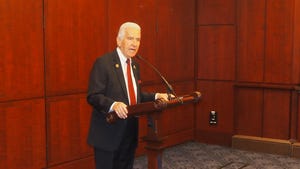
The secretary spoke at a Washington press conference to release the Bush administration's review of the food and agriculture system, Food and Agricultural Policy: Taking Stock for the New Century. The 111-page document is designed to be a broad look at U.S. farm policies and the nation's role in the global agricultural economy.

It contains few specific administration proposals, however.

“It is not a farm bill book. It will give us a means by which we can frame the debate for food and farm policy for the future,” Veneman says.

She says policy makers should examine past programs and, where necessary, define new goals and principles to guide the growth of the industry.

New challenge

“Our challenge today is to address the vital forces of change while at the same time modernizing the foundations of our farm and food system to ensure continued growth and development for the 21st century. Farmers today operate in a global, technologically advanced, rapidly diversifying, highly competitive environment that is driven by increasingly sophisticated consumers. The various policies, programs, and supporting infrastructure that serve our food system will require updating to meet future needs,” Veneman says.

Old policies designed for what she terms, “an isolated economy,” won't work for the new, rapidly expanding food and agriculture system, she says.

One key, she says, is to make certain that farm and trade policies are fully compatible. “We want domestic policy to be consistent with trade policy. It means we have certain commitments under the World Trade Organization's Uruguay Round, based upon a historical level of government farm support. We want to make sure we don't have programs that put us over the limit in terms of our World Trade Organization commitments,” she says.

The report does contain hints of what the Bush administration considers important in farm policy. It says that many federal farm programs implemented since the 1930s did not work, and implies that neither did the Federal Agriculture Improvement and Reform (FAIR) Act of 1996, which was designed to give farmers cropping flexibility and decouple program benefits. The current law inflated land prices, the report says, and directs program benefits to only 40 percent of the nation's farms.

Calling for what it terms, “a market-oriented economic safety net for farmers,” the administration seems to want to extend help to farms beyond those traditionally benefiting from federal programs. Veneman notes that while 150,000 farmers produce 70 percent of nation's food and fiber, an additional 2 million meet the federal criterion of selling at least $1,000 worth of product annually.

“The commercial operations make up only one segment of our farm community. The number of farms has actually increased slightly because people want to take advantage of the opportunity offered by the rural lifestyle. We're also seeing a lot of small acreages producing for niche markets. As biotech increases, we're going to see more growers producing specialty crops. We're going to see more specialty chemicals derived from plants, like soy ink. The change is tremendous,” Veneman says.

“Farm policy must promote sustainable prosperity for farmers and agriculture and rural communities without engendering long-term dependence on direct government support.”

Programs applicable

Some of this support may come through conservation policy designed to protect water quality, wildlife habitat, wetlands, and topsoil. Observing that the 150,000 farmers producing 70 percent of the nation's farm output only own one-third of the land, Veneman says she expects conservation programs to be broadly applicable to all agriculture sectors.

“It doesn't matter how big or small you are, we need programs for all of agriculture,” she says.

Veneman says she does not anticipate additional land retirement programs. “When looking at conservation programs, we traditionally look at taking land out of production. But I don't think we'll do that. The question is, how do we design programs to help farms enhance conservation on existing land?” she says.

e-mail: chjohnson@primediabusiness.com

Get Copyright ClearanceWant to use this article? Click here for options!
© 2008 Penton Media, Inc.


Latest Jobs

resources

events icon events

product info icon tradeshows

tradeshow icon digests

research icon photos

Continuing Education

Accredited by California DPR and California and Arizona Certified Crop Advisers:


(New Course)

Nutrient Management in Key California Crops


This online CEU course offers a detailed look at the nutrient management in key California crops. It is sponsored online by Western Plant Health Association and funded by a grant from the California Department of Food and Agriculture Fertilizer Research and Protection Program (FREP). It is accredited for one (1)-hour of credit by the California Department of Pesticide Regulation for California Pest Control Advisers (PCA), Private Applicators, Qualified Applicators and Aerial Applicators. The course is also accredited for 3 units in Nutrient Management (NM) for California and Arizona Certified Crop Advisers (CCAs).

Accredited in California, Arizona, Idaho, Oregon and Washington and for Certified Crop Advisers:


(New Course)
Organic/Sustainable Agricultural Production in the West

Organic/sustainable agriculture is expanding rapidly in the U.S. with an average annual increase of 20% during the last 15 years. This course covers a wide range of pests and organic control strategies. It is accredited for up to 4 continuing education hours for PCAs and Applicator Licensees in California, Arizona, Idaho, Oregon and Washington. It is also approved for Certified Crop Adviser credit.

ACCREDITED IN OREGON AND WASHINGTON:


(New Course)
Managing Spray Drift to Minimize Problems

This online spray drift management course has been certified by the Oregon Department of Agriculture and the Washington Department of Agriculture for 2 hours of credit for licensed Applicators and Consultants in Oregon and Washington.

ACCREDITED IN CALIFORNIA ONLY:


Almond Pest Management

Get the latest info on almond insect pest management and earn 2 hrs. CE DPR and CCA credit in California.

California Groundwater Protection Regulations

Earn 2 hrs. in California laws and regs CE and learn how to protect California groundwater supplies.


Disease Management in California Almonds

Managing diseases in California almond production is a year-long process. This course provides the latest information on controlling these diseases with management practices and fungicides. The course is approved for 2 CEUs by DPR for PCAs and all applicator categories and California CCAs.

Powdery Mildew Control in California Grapevines

Learn about the No. 1 grape disease in California; earn 2 California CE hours.

ACCREDITED IN CALIFORNIA AND ARIZONA:


The Role of Copper in Disease Control

Copper has long been a key tool in disease control in a many crops. This 2-CEU course accredited California PCAs and all DPR applicator categories and Arizona applicators details how best to use copper to maximize its potential.

Insecticide Resistance Management in Agronomic and Row Crops

A 3-hr. CE approved for California and Arizona licensees and CCAs in both states.

Agronomic Weed Resistance Management in Row Crops, Trees Nuts and Vines

Weeds Resistance Management is approved for 3 hours of CE credit for all California and Arizona licensees and Certified Crop Advisers.

Lepidopterous Pest Management/ Pesticide Safety

This course is approved for 2 hours in Arizona and California (1 hr. of laws/regs; 1 hour Other) and for CCAs.

Managing Spray Drift to Minimize Problems

2-hrs laws and regs for California licensees; 2 hours in Arizona and for CCAs.

Back to Top

Browse Print Issues

Additional Resources

subscribe to Farm Press Daily Southeast Farm Press Southwest Farm Press Delta Farm Press