Salinas Valley trials monitor covers, con-till

Sep 6, 2003 12:00 PM, By Dan Bryant

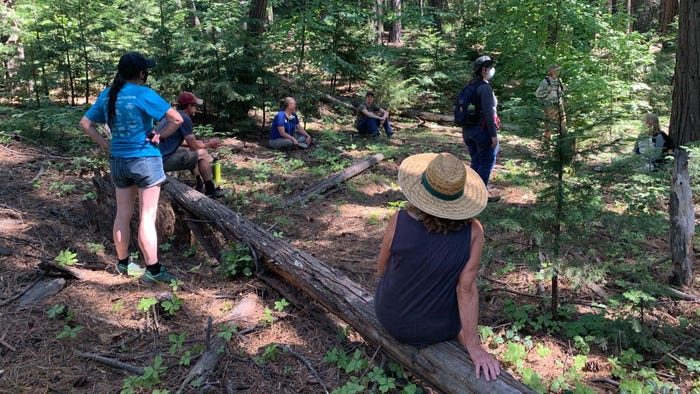
Can cover crops and conservation tillage work in Salinas Valley vegetables? Growers likely have their opinions, but University of California researchers hope to harvest details about the concept from current trials with broccoli at USDA's Spence Research Farm south of Salinas.

“Bed preparation probably isn't done anywhere with more intensity than in the Salinas Valley,” said Richard Smith, Monterey County farm advisor, during a recent field day at the site.

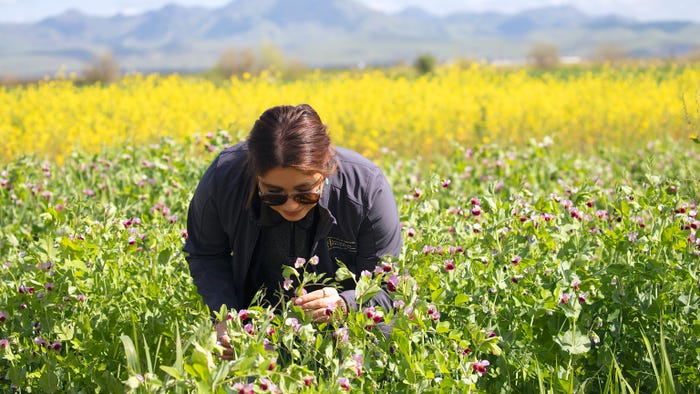
He is evaluating a mustard cover crop, Caliente 119, against conventional practices on listed and shaped beds.

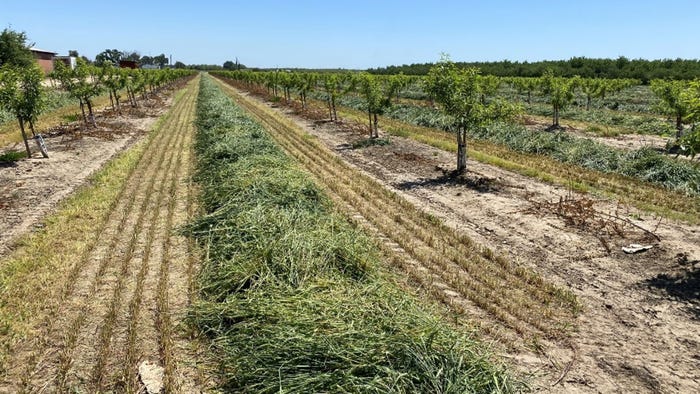
The cover was planted April 11 to plots and 88 pounds of nitrogen as ammonium nitrate was applied to the growing mustard, which was flail chopped June 16.

Four tillage treatments were made the following day to separate plots: no cover crop and conventional tillage with three passes with a Sundance minimum-till system, the cover crop with no tillage, the cover crop with partial tillage of a single Sundance pass, and the cover crop with complete incorporation by three Sundance passes.

Sixty pounds of nitrogen as ammonium nitrate was applied and Goal herbicide was applied to selected portions. Heritage variety broccoli was transplanted in the plots June 18.

Collaborating with Smith on the project is Michael Cahn, irrigation farm advisor for Monterey County. Before coming to Salinas, Cahn worked with conservation tillage in Yuba County as a means of reducing costs, both in tillage itself and fuel.

Support reasons

He gave three reasons in support of conservation tillage:

First, considerable thought is being given by governmental agencies across the U.S. to providing farmers environmental credits for storing carbon in the soil with conservation tillage practices.

Another is to improve water quality by preventing run-off of nutrients and soil erosion, factors of high interest in Monterey County.

A third reason is reduction of dust, a mounting issue for agriculture throughout the state.

Use of a mustard cover crop, Smith said, is also of interest as a way to suppress disease in lettuce. He and others last year began a separate, multi-year investigation of mustard covers that may help to control lettuce head-drop caused by Sclerotinia minor. The project also aims at learning what impact a cover has on weed populations.

“There doesn't appear to be a significant amount of dormancy in the mustard cover crop seeds, and therefore, they do not appear to pose a problem as an aggressive, long-term weed in production fields,” Smith said.

He added, however, that summer plantings (those after June) of mustards set seed in as few as 55 days, while spring and fall plantings can take more than 70 days to produce seed.

That's why, he explained, “summer plantings of mustard cover crops should be incorporated quickly after the onset of flowering to avoid them setting seed.”

Breeding efforts

Steve Fennimore, Monterey County weed science farm advisor, told field day attendees that efforts to develop a sulfonylurea herbicide-tolerant lettuce by conventional breeding means are moving forward.

It is a significant breakthrough, he noted, because of consumer groups' and other others' objections have left little likelihood of acceptance of genetically modified lettuce having tolerance to herbicides.

University of Idaho researchers found a naturally occurring, resistant gene in prickly lettuce, a common weed in wheat fields in the northwest, and crossed it into Bibb-type lettuce.

Fennimore said the University of California obtained the plant material, and Beiquan Mou, lettuce breeder with USDA-ARS in Salinas, is collaborating by crossing the resistant material with lettuce types commercially grown in the Salinas Valley.

Conventional breeding typically takes several years to achieve cultivars having all desired traits.

“The Roundup Ready lettuce idea,” Fennimore said, “would have been an excellent weed control system, but it is biotechnology and it is now at a dead-end. We will be screening the new plant material, which is not genetically modified, with different chemicals in the field and hopefully we will get some useful leads.”

Collaboration

Fennimore also cooperated with Shachar Shem-Tov, a visiting scientist from Israel, in a trial at the Spence site to quantify the advantages of pre-irrigating lettuce fields as a weed control practice.

By stimulating early weed emergence, local growers have found that much of the growth can be destroyed by tillage prior to seeding and the amount of herbicide needed can be reduced. In the trial, Kerb was used at rates of 0.6 and 1.2 pounds per acre.

The two researchers confirmed that weed densities and hand weeding time were reduced by preirrigation vs. no preirrigation. They measured weed densities 21 days after planting and the time required to thin the stand.

“Where a one-week preplant interval was used, sprinkler irrigation was the most effective method to deplete weed emergence, while furrow irrigation resulted in no reduction in weed densities,” Shem-Tov reported.

Where a two-week preplant interval was used, he added, weed densities in the control plots were twice those in the preirrigated plots regardless of irrigation method.

“Thinning times in the furrow- and sprinkler-irrigated plot were reduced by 37 percent to 49 percent compared with the control,” Shem-Tov said.

Differences between the preirrigation treatments and the control were significant, regardless of whether the low or high rate of Kerb was applied.

No meaningful difference was observed between the two rates, suggesting that the low rate could be used.

Get Copyright ClearanceWant to use this article? Click here for options!
© 2008 Penton Media, Inc.


Latest Jobs

resources

events icon events

product info icon tradeshows

tradeshow icon digests

research icon photos

Continuing Education

Accredited by California DPR and California and Arizona Certified Crop Advisers:


(New Course)

Nutrient Management in Key California Crops


This online CEU course offers a detailed look at the nutrient management in key California crops. It is sponsored online by Western Plant Health Association and funded by a grant from the California Department of Food and Agriculture Fertilizer Research and Protection Program (FREP). It is accredited for one (1)-hour of credit by the California Department of Pesticide Regulation for California Pest Control Advisers (PCA), Private Applicators, Qualified Applicators and Aerial Applicators. The course is also accredited for 3 units in Nutrient Management (NM) for California and Arizona Certified Crop Advisers (CCAs).

Accredited in California, Arizona, Idaho, Oregon and Washington and for Certified Crop Advisers:


(New Course)
Organic/Sustainable Agricultural Production in the West

Organic/sustainable agriculture is expanding rapidly in the U.S. with an average annual increase of 20% during the last 15 years. This course covers a wide range of pests and organic control strategies. It is accredited for up to 4 continuing education hours for PCAs and Applicator Licensees in California, Arizona, Idaho, Oregon and Washington. It is also approved for Certified Crop Adviser credit.

ACCREDITED IN OREGON AND WASHINGTON:


(New Course)
Managing Spray Drift to Minimize Problems

This online spray drift management course has been certified by the Oregon Department of Agriculture and the Washington Department of Agriculture for 2 hours of credit for licensed Applicators and Consultants in Oregon and Washington.

ACCREDITED IN CALIFORNIA ONLY:


Almond Pest Management

Get the latest info on almond insect pest management and earn 2 hrs. CE DPR and CCA credit in California.

California Groundwater Protection Regulations

Earn 2 hrs. in California laws and regs CE and learn how to protect California groundwater supplies.


Disease Management in California Almonds

Managing diseases in California almond production is a year-long process. This course provides the latest information on controlling these diseases with management practices and fungicides. The course is approved for 2 CEUs by DPR for PCAs and all applicator categories and California CCAs.

Powdery Mildew Control in California Grapevines

Learn about the No. 1 grape disease in California; earn 2 California CE hours.

ACCREDITED IN CALIFORNIA AND ARIZONA:


The Role of Copper in Disease Control

Copper has long been a key tool in disease control in a many crops. This 2-CEU course accredited California PCAs and all DPR applicator categories and Arizona applicators details how best to use copper to maximize its potential.

Insecticide Resistance Management in Agronomic and Row Crops

A 3-hr. CE approved for California and Arizona licensees and CCAs in both states.

Agronomic Weed Resistance Management in Row Crops, Trees Nuts and Vines

Weeds Resistance Management is approved for 3 hours of CE credit for all California and Arizona licensees and Certified Crop Advisers.

Lepidopterous Pest Management/ Pesticide Safety

This course is approved for 2 hours in Arizona and California (1 hr. of laws/regs; 1 hour Other) and for CCAs.

Managing Spray Drift to Minimize Problems

2-hrs laws and regs for California licensees; 2 hours in Arizona and for CCAs.

Back to Top

Browse Print Issues

Additional Resources

subscribe to Farm Press Daily Southeast Farm Press Southwest Farm Press Delta Farm Press