Run on diesel fuel biggest impact from plane attack so far in farming

Oct 6, 2001 12:00 PM, By Harry Cline, Farm Press Editorial Staff

More diesel fuel was likely bought on Sept. 11, 2001 by California and Arizona farmers than any single day in recent memory.

When the hijacked airlines crashed in to the World Trade Center and Pentagon on that fateful day, fear went through every thread of American life, including harvest on Western farms and ranches.

When reports circulated that Midwest service stations were charging $5 per gallon for gasoline, farmers ripped cell phones from their belts and snatched phones from pickup truck cradles, summoning their diesel jobbers.

Diesel prices were up at least 20 cents per gallon in the San Joaquin Valley from the day before in a matter of minutes after the first plane hit the World Trade Center. Hundreds of truckloads were ordered. It is harvest season, and the last thing a farmer needs is to halt harvest for lack of fuel.

That has been the biggest tangible impact on the business of producing food and fiber in the West since America was attacked on that warm September morning.

For a few days aerial applicators were grounded. Some thought that was because of the Federal Aviation Administration restrictions in the wake of the hijackings. Now reports are circulating that that was because evidence was uncovered that terrorists were plotting to use crop dusters to propagate biological warfare.

Air freight shipments of fresh fruits and vegetables faltered for a few days after that attacks, but quickly returned to normal when air freight carriers returned to the skies.

Like the rest of America, farmers were in shock after the attack. It was eerily quiet in agricultural commerce for two weeks after hijacked airlines shattered American life.

“I got a lot of e-mails and calls from around the world offering condolences about what happened, but there was very little business being conducted,” said Marc Lewkowitz, marketing manager for Queensland Cotton/Anderson Clayton Corp.

Farming not same

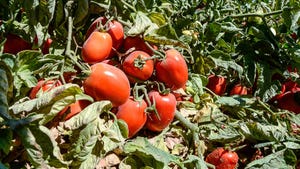
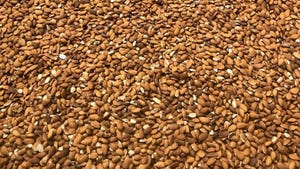
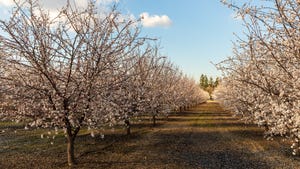
The buying and selling end of farming may have stopped for a few weeks, however, the almonds, processing tomatoes, cotton, lettuce, grapes and most of the other crops of diversified Western agriculture were ripe for harvest, and farmers had to get back to work quickly, However, they know the farming business will never be the same again. How it would change spawned bewildering uncertainty.

“We are all concerned about our country like everyone else. We are concerned about our families and the fallout from a protracted, full scale war,” said Kern County, Calif., producer Larry Starrh. To say how it might affect his business, he can offer only conjecture at this point.

Farming has not been very profitable in recent years, and these terrorist attacks are only adding to the anguish.

Fresno County, Calif., farmer Don Cameron is optimistic the hard times are bottoming out and profitability may soon return. He's talking supply and demand, but now added to the equation are issues California producers could only remotely imagine.

“Irrigated farming in California is dependent on a reliable water supply. Now in this new, terrible age of terrorism we have been thrust into we have to be concerned about someone blowing up Shasta Dam,” said Starrh. That is a major source of not only irrigation water supplies, but for many urban areas as well. Blowing up any major dam in California and Arizona would cripple the West.

That has always been a possibility, but now it is a much more frightening likelihood as heavily armed security on these structures becomes reality. “We have to worry about security for our water supply. Without water, we are out of business,” said Starrh.

Markets critical

California agriculture depends on global markets, noted Starrh. Disruption of markets overseas would have a huge impact. Losing significant export markets could be the nails in the coffin for many producers already struggling to make ends meeting with prices below the Depression era.

“We are harvesting a huge almond crop right now, but sales are also good and we are moving a lot of product,” said Starrh. Disruption of that would be devastating.

“Shipping lanes remain open and I don't expect that to be disrupted in the near future,” said Lewkowitz.

And, of course the federal farm bill now languishes in Congress as well as other legislation deemed vital to agriculture Sept. 10

More than 50 percent of farm net income now is from federal farm payments, a figure reflective of the dire straits of American agriculture.

‘We are stopped where we are as far as planning for next year,” said Starrh. “We cannot make plans for next year until we know what will be there.”

Bill Van Skike, president of California Planting Cotton Seed Distributors, Shafter, Calif., noted that the farm bill debate on the eve of the war on terrorism takes two distinct sides.

Some contend the farm bill and its billions in support of farmers may be lost to the need to increase military funding, noted Van Skike. Others believe politicians and the public will accept the reality that producing food and fiber is essential for America's survival and will fully fund support for agriculture.

“Obviously I think agriculture is strategically important, and I think the public will see that too,” said Cameron. Van Skike agreed.

Farmers are hopeful politicians can draw the obvious parallel of what has happened to American energy supplies in this era of dependence on foreign oil and what could happened if the United States became dependent on other nations for its food and fiber.

America's heightened security blanket is also concerning producer, especially fruit and vegetable producers who depend of foreign workers to gather many crops.

The peak season for most hand-harvested crops has passed, but with reports of sharply reduced drug seizures along the Mexican border because of increased security, producers are concerned about the future supply of migrant workers being cut off by tighter border controls. That concern becomes immediate as fall descends and hand pruning of trees and vines begins.

As much as 50 percent of the agricultural work force in the West has been identified as illegal aliens.

The recession-bound economy also is causing concern.

“The futures market is very important to the cotton industry. It is the speculators who make the market move and there has to be concerns about liquidity in those markets,” Lewkowitz said.

There is some hope that the war effort may bolster the domestic textile industry, particularly if the global attack on terrorism idles some foreign mills.

“Unfortunately, the huge supply of cotton in the world market today is not going away — war or no war,” said Tom Ullman, cotton merchant with Barkley of California, based in Fresno. “Mills are still buying on as-needed basis and there remains talk of 30-cent cotton.”

Just like all other Americans, There is little farmers can do except wait and see what the future may be in a world shocked into the reality of terrorism. So, for now it is business as usual and concerns about prices for their crops and water availability for the next year. That will change. It's the when and how that that are mystifying.

Kings County, Calif., producer Dick Newton is a pilot, like many farmers. They used their planes to check their crops.

“I like to look at my cotton fields to see how well we do with defoliation, but with the FAA ban on visual flights, I cannot do that,” said Newton.

Reality sets in

That's only a minor inconvenience compared to the suffering of so many at the hands the horrible terrorists attacks, noted Newton, a former military jet fighter pilot.

“The reality of today's world came home when I heard about the fellow who (illegally) took off from a local Fresno airport on a visual flight only to look out his window and see an F-16 with its wheels down,” said Newton. “Needless to say, he turned back and landed.”

Newton was one of those farmers who bought diesel on Sept. 11. “I think we bought about 6,500 gallons, but by the end of the day it had dropped 10 cents from the 20 cents it was in the morning,” he said. “Oh well, we at least have the diesel to harvest our cotton.”

Beyond that lies is a frighteningly changed world on the farm.

e-mail: hcline@primediabusiness.com

Get Copyright ClearanceWant to use this article? Click here for options!
© 2008 Penton Media, Inc.


Latest Jobs

resources

events icon events

product info icon tradeshows

tradeshow icon digests

research icon photos

Continuing Education

Accredited by California DPR and California and Arizona Certified Crop Advisers:


(New Course)

Nutrient Management in Key California Crops


This online CEU course offers a detailed look at the nutrient management in key California crops. It is sponsored online by Western Plant Health Association and funded by a grant from the California Department of Food and Agriculture Fertilizer Research and Protection Program (FREP). It is accredited for one (1)-hour of credit by the California Department of Pesticide Regulation for California Pest Control Advisers (PCA), Private Applicators, Qualified Applicators and Aerial Applicators. The course is also accredited for 3 units in Nutrient Management (NM) for California and Arizona Certified Crop Advisers (CCAs).

Accredited in California, Arizona, Idaho, Oregon and Washington and for Certified Crop Advisers:


(New Course)
Organic/Sustainable Agricultural Production in the West

Organic/sustainable agriculture is expanding rapidly in the U.S. with an average annual increase of 20% during the last 15 years. This course covers a wide range of pests and organic control strategies. It is accredited for up to 4 continuing education hours for PCAs and Applicator Licensees in California, Arizona, Idaho, Oregon and Washington. It is also approved for Certified Crop Adviser credit.

ACCREDITED IN OREGON AND WASHINGTON:


(New Course)
Managing Spray Drift to Minimize Problems

This online spray drift management course has been certified by the Oregon Department of Agriculture and the Washington Department of Agriculture for 2 hours of credit for licensed Applicators and Consultants in Oregon and Washington.

ACCREDITED IN CALIFORNIA ONLY:


Almond Pest Management

Get the latest info on almond insect pest management and earn 2 hrs. CE DPR and CCA credit in California.

California Groundwater Protection Regulations

Earn 2 hrs. in California laws and regs CE and learn how to protect California groundwater supplies.


Disease Management in California Almonds

Managing diseases in California almond production is a year-long process. This course provides the latest information on controlling these diseases with management practices and fungicides. The course is approved for 2 CEUs by DPR for PCAs and all applicator categories and California CCAs.

Powdery Mildew Control in California Grapevines

Learn about the No. 1 grape disease in California; earn 2 California CE hours.

ACCREDITED IN CALIFORNIA AND ARIZONA:


The Role of Copper in Disease Control

Copper has long been a key tool in disease control in a many crops. This 2-CEU course accredited California PCAs and all DPR applicator categories and Arizona applicators details how best to use copper to maximize its potential.

Insecticide Resistance Management in Agronomic and Row Crops

A 3-hr. CE approved for California and Arizona licensees and CCAs in both states.

Agronomic Weed Resistance Management in Row Crops, Trees Nuts and Vines

Weeds Resistance Management is approved for 3 hours of CE credit for all California and Arizona licensees and Certified Crop Advisers.

Lepidopterous Pest Management/ Pesticide Safety

This course is approved for 2 hours in Arizona and California (1 hr. of laws/regs; 1 hour Other) and for CCAs.

Managing Spray Drift to Minimize Problems

2-hrs laws and regs for California licensees; 2 hours in Arizona and for CCAs.

Back to Top

Browse Print Issues

Additional Resources

subscribe to Farm Press Daily Southeast Farm Press Southwest Farm Press Delta Farm Press