Payments based on farm size promoted

Jun 2, 2001 12:00 PM, By Hembree Brandon Farm Press Editorial Staff

The man the Bush administration wants to play a key role in development of the new farm bill says farm size may be a more effective determinant of who gets government payments than the present “one-size-fits-all” approach.

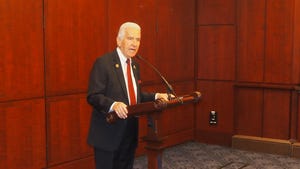
Arkansas native J.B. Penn, nominee for USDA agriculture undersecretary, said at his confirmation hearing before the Senate Agriculture Committee that the department will likely not provide the Bush administration with a “full-blown” proposal for a farm bill, but instead will probably develop a book of principles that the administration can send to Congress to serve as a guide for replacing the so-called Freedom to Farm Act that expires in 2002.

Penn, who served as a staff economist for President Carter's Council of Economic Advisors, was senior vice president at Sparks Cos., a worldwide commodities operation based in Memphis, before being tapped by the president for the No. 3 post at the USDA. The committee is expected to vote on his confirmation in the next several weeks.

In a 48-page “discussion paper” on agriculture policy, Penn suggests that government payments to the nation's farmers might be based on whether a farm is large, medium, or small.

  • There are about 157,000 farms that fall into the largest category, he said, with sales topping $250,000, and producing 72 percent of the nation's agricultural goods. These could best be helped by government through some kind of federal safety net, as well as by improved risk management programs and greater trade opportunities.

  • Medium-sized farms total about 190,000 and produce about 15 percent of the output. A large part of the income for these operations comes from off-farm jobs, and many are struggling, he said. Government assistance to these farms could be through programs to help them to increase their size and reach a higher economic level.

  • Small farms number about 1.6 million, have limited farm sales, and rely almost exclusively on off-farm income. These, Penn noted, could be helped through economic development and/or conservation programs.

Veneman's question

That approach is in keeping with Secretary of Agriculture Ann Veneman's questioning of the one-size-fits-all farm policy that has been used for decades.

In a recent Washington address, she noted that only about 18 percent of U.S. farms report gross sales greater than $100,000 per year. Those 344,000 farms produce more than 87 percent of the nation's total agricultural output.

“The needs of these farms may be very different than those of the 82 percent of farms that earn less than $100,000 and produce less than 13 percent of total production,” she said.

At the Senate hearing on Penn's nomination, Agriculture Committee Chairman Richard Lugar, R-Ind., himself not a fan of the one-size-fits-all approach, characterized Penn's policy discussion paper as “remarkable.”

The committee has indicated it will hold hearings over the next few months to obtain input for farm policy development. The chairman of the House Agriculture Committee, Larry Combest, R-Texas, has already indicated that he would like to have a House version of a preliminary farm bill wrapped up by the summer recess that begins Aug. 3, but that may be wishful thinking, given the numerous disagreements to be resolved. Beyond that, Senate/House drafting and conference sessions could well run into 2002.

“We will need to pick up the pace of things,” Lugar told Penn during the hearing. “We need some idea of where the administration is headed so we aren't surprised, and so you aren't surprised by what Congress does.”

Major funds infusion

Discussions related to a new farm bill come on the heels of three years of major infusions of government money into the farm sector to help producers cope with drought, floods, hurricanes, and other disasters, as well as dismal prices for most crops.

That $25 billion was money above and beyond payments provided for under provisions of the 1996 farm bill. And Congress has just approved new farm appropriations that include another $5.5 billion to go to farmers by Sept. 30 this year to offset a fourth year of in-the-cellar crop prices.

Penn told the Senate hearing that making payments to all farmers “may be causing us misery” by increasing costs to government and reducing U.S. agriculture's competitiveness in world markets.”

Get Copyright ClearanceWant to use this article? Click here for options!
© 2008 Penton Media, Inc.


Latest Jobs

resources

events icon events

product info icon tradeshows

tradeshow icon digests

research icon photos

Continuing Education

Accredited by California DPR and California and Arizona Certified Crop Advisers:


(New Course)

Nutrient Management in Key California Crops


This online CEU course offers a detailed look at the nutrient management in key California crops. It is sponsored online by Western Plant Health Association and funded by a grant from the California Department of Food and Agriculture Fertilizer Research and Protection Program (FREP). It is accredited for one (1)-hour of credit by the California Department of Pesticide Regulation for California Pest Control Advisers (PCA), Private Applicators, Qualified Applicators and Aerial Applicators. The course is also accredited for 3 units in Nutrient Management (NM) for California and Arizona Certified Crop Advisers (CCAs).

Accredited in California, Arizona, Idaho, Oregon and Washington and for Certified Crop Advisers:


(New Course)
Organic/Sustainable Agricultural Production in the West

Organic/sustainable agriculture is expanding rapidly in the U.S. with an average annual increase of 20% during the last 15 years. This course covers a wide range of pests and organic control strategies. It is accredited for up to 4 continuing education hours for PCAs and Applicator Licensees in California, Arizona, Idaho, Oregon and Washington. It is also approved for Certified Crop Adviser credit.

ACCREDITED IN OREGON AND WASHINGTON:


(New Course)
Managing Spray Drift to Minimize Problems

This online spray drift management course has been certified by the Oregon Department of Agriculture and the Washington Department of Agriculture for 2 hours of credit for licensed Applicators and Consultants in Oregon and Washington.

ACCREDITED IN CALIFORNIA ONLY:


Almond Pest Management

Get the latest info on almond insect pest management and earn 2 hrs. CE DPR and CCA credit in California.

California Groundwater Protection Regulations

Earn 2 hrs. in California laws and regs CE and learn how to protect California groundwater supplies.


Disease Management in California Almonds

Managing diseases in California almond production is a year-long process. This course provides the latest information on controlling these diseases with management practices and fungicides. The course is approved for 2 CEUs by DPR for PCAs and all applicator categories and California CCAs.

Powdery Mildew Control in California Grapevines

Learn about the No. 1 grape disease in California; earn 2 California CE hours.

ACCREDITED IN CALIFORNIA AND ARIZONA:


The Role of Copper in Disease Control

Copper has long been a key tool in disease control in a many crops. This 2-CEU course accredited California PCAs and all DPR applicator categories and Arizona applicators details how best to use copper to maximize its potential.

Insecticide Resistance Management in Agronomic and Row Crops

A 3-hr. CE approved for California and Arizona licensees and CCAs in both states.

Agronomic Weed Resistance Management in Row Crops, Trees Nuts and Vines

Weeds Resistance Management is approved for 3 hours of CE credit for all California and Arizona licensees and Certified Crop Advisers.

Lepidopterous Pest Management/ Pesticide Safety

This course is approved for 2 hours in Arizona and California (1 hr. of laws/regs; 1 hour Other) and for CCAs.

Managing Spray Drift to Minimize Problems

2-hrs laws and regs for California licensees; 2 hours in Arizona and for CCAs.

Back to Top

Browse Print Issues

Additional Resources

subscribe to Farm Press Daily Southeast Farm Press Southwest Farm Press Delta Farm Press