Methyl bromide substitutes screened

Oct 6, 2001 12:00 PM, By Dan Bryant Farm Press Editorial Staff

After evaluations of vine growth and nematode counts this winter, “micro-plots” planted with single Cabernet Sauvignon grape vines will show how various compounds — some old, some more recent — measure up to methyl bromide for control of nematodes.

This growing season the trials at the University of California's Kearney Agricultural Center at Parlier have been screening more than a dozen compounds as potential replacements for the widely used fumigant.

Blamed, along with other compounds, for ozone-depletion in the atmosphere, methyl bromide is due to be phased out of commercial agricultural use by Jan. 1, 2005, except for quarantine and other special applications, in the U.S. and other developed countries.

At a recent grape day, UC, Riverside nematologist Mike McKenry said, “During the winter of 2000 only two products exhibited significant activity against root knot nematode. Studies like this require two full years of evaluation before it is appropriate to indicate winners and losers.”

However, he said, some materials in the trial indicated methods worthy of tests in adjacent micro-plots for the 2001-2002 season.

The major thrust of his experiments is to find new methods to deliver alternative, post-plant nematicides to areas of the vineyard where the microscopic worms cause the greatest harm, rather than treating an entire block of vines.

“To do this we have to use nematicidal agents having reduced mammalian toxicity. A number of products are sold as nematicidal but have not been evaluated against standard nematicide comparisons,” he said.

First step

He went on to say the first step in the process is to compare performance of various nematicidal agents against nematodes that parasitize the outside of vine roots as well as others that live inside the roots. The micro-plots, upright sections of PVC drainage pipe about 18-inches in diameter, are best suited for such trials.

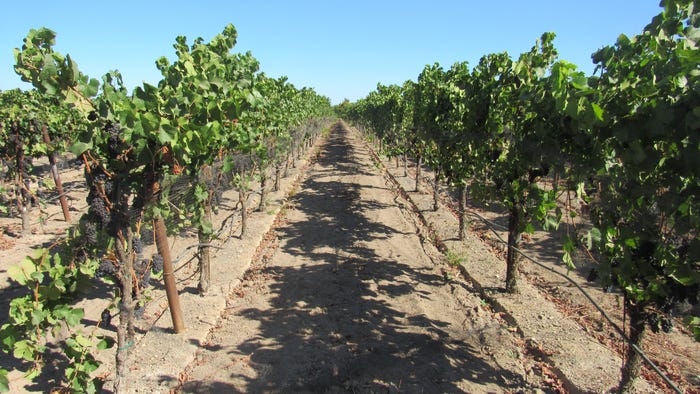
The vines of Cabernet Sauvignon, which is particularly susceptible to root knot nematode, were planted in June of 1999 in sandy and sandy-loam soils infested with that species, as well as citrus, root lesion, and dagger nematodes. The various treatments began the following May.

“These young vines are producing new roots about 10 months out of the year and the soil is warm enough for root knot nematode to penetrate new root tips about seven months of each year,” he explained.

In comments about the alternatives he is applying in the trials, McKenry said, “We are observing products that are nematicidal but move properly in one soil texture but not another. There are products that stimulate vine growth (and presumably root growth) but are not nematicidal. There are also products that are phytotoxic but when the rates are reduced the nematicidal control also may decline.”

Products in the study include: Nemacur, Enzone, DiTera, urea, lignosulfonate, AGI 9100 chitosan, Oxycom, fosthiazate, Cordon, Admire, Agri 50, Agroneem, and humic acid.

Treatments were made to vines in three gallons of water through May 2001 and in four-gallon applications, to take compounds deeper in the soil, in June 2001 and afterward.

e-mail: dbryant@primediabusiness.com

Get Copyright ClearanceWant to use this article? Click here for options!
© 2008 Penton Media, Inc.


Latest Jobs

resources

events icon events

product info icon tradeshows

tradeshow icon digests

research icon photos

Continuing Education

Accredited by California DPR and California and Arizona Certified Crop Advisers:


(New Course)

Nutrient Management in Key California Crops


This online CEU course offers a detailed look at the nutrient management in key California crops. It is sponsored online by Western Plant Health Association and funded by a grant from the California Department of Food and Agriculture Fertilizer Research and Protection Program (FREP). It is accredited for one (1)-hour of credit by the California Department of Pesticide Regulation for California Pest Control Advisers (PCA), Private Applicators, Qualified Applicators and Aerial Applicators. The course is also accredited for 3 units in Nutrient Management (NM) for California and Arizona Certified Crop Advisers (CCAs).

Accredited in California, Arizona, Idaho, Oregon and Washington and for Certified Crop Advisers:


(New Course)
Organic/Sustainable Agricultural Production in the West

Organic/sustainable agriculture is expanding rapidly in the U.S. with an average annual increase of 20% during the last 15 years. This course covers a wide range of pests and organic control strategies. It is accredited for up to 4 continuing education hours for PCAs and Applicator Licensees in California, Arizona, Idaho, Oregon and Washington. It is also approved for Certified Crop Adviser credit.

ACCREDITED IN OREGON AND WASHINGTON:


(New Course)
Managing Spray Drift to Minimize Problems

This online spray drift management course has been certified by the Oregon Department of Agriculture and the Washington Department of Agriculture for 2 hours of credit for licensed Applicators and Consultants in Oregon and Washington.

ACCREDITED IN CALIFORNIA ONLY:


Almond Pest Management

Get the latest info on almond insect pest management and earn 2 hrs. CE DPR and CCA credit in California.

California Groundwater Protection Regulations

Earn 2 hrs. in California laws and regs CE and learn how to protect California groundwater supplies.


Disease Management in California Almonds

Managing diseases in California almond production is a year-long process. This course provides the latest information on controlling these diseases with management practices and fungicides. The course is approved for 2 CEUs by DPR for PCAs and all applicator categories and California CCAs.

Powdery Mildew Control in California Grapevines

Learn about the No. 1 grape disease in California; earn 2 California CE hours.

ACCREDITED IN CALIFORNIA AND ARIZONA:


The Role of Copper in Disease Control

Copper has long been a key tool in disease control in a many crops. This 2-CEU course accredited California PCAs and all DPR applicator categories and Arizona applicators details how best to use copper to maximize its potential.

Insecticide Resistance Management in Agronomic and Row Crops

A 3-hr. CE approved for California and Arizona licensees and CCAs in both states.

Agronomic Weed Resistance Management in Row Crops, Trees Nuts and Vines

Weeds Resistance Management is approved for 3 hours of CE credit for all California and Arizona licensees and Certified Crop Advisers.

Lepidopterous Pest Management/ Pesticide Safety

This course is approved for 2 hours in Arizona and California (1 hr. of laws/regs; 1 hour Other) and for CCAs.

Managing Spray Drift to Minimize Problems

2-hrs laws and regs for California licensees; 2 hours in Arizona and for CCAs.

Back to Top

Browse Print Issues

Additional Resources

subscribe to Farm Press Daily Southeast Farm Press Southwest Farm Press Delta Farm Press