Energy costs to siphon more from 2001 net farm income

Jun 2, 2001 12:00 PM, By Hembree Brandon, Farm Press Editorial Staff
It's the same old story: With energy prices stratospheric, companies everywhere are increasing prices of their goods or tacking on surcharges for their services to try and compensate. But farmers? They pay the higher energy costs, yet have no control over the price of their products.

In case you've wondered, U.S. farmers shelled out an extra $2.9 billion in energy-related costs last year — diesel and other petroleum products, natural/propane gas, electricity, pesticides, and fertilizer (natural gas represents 75 percent to 90 percent of the cost of producing the ammonia that is the main ingredient of nitrogen fertilizer). That $2.9 billion took a pretty good chunk out of already sagging farm income.

Worse news: Even higher energy prices this year will suck an additional $2 billion to $3 billion out of farmers' pockets.

And, says Keith Collins, chief economist for the USDA, in testimony before the House Agriculture Committee's Subcommittee on Conservation, Credit, Rural Development, and Research, “farmers are limited in the efforts they can take to mitigate the effects of rising energy prices.” Fortunately, Congress stepped in last year with a record $22.1 billion in direct government payments to help offset the effects of higher production costs on farmers' net returns.

The USDA is forecasting that net cash farm income this year will decline about 10 percent from 2000.

Some farmers are switching to alternative crops and production inputs in order to try and hold the line, he says, “but most are facing higher costs of production and reduced incomes due to these higher energy prices.”

Although agriculture is a “relatively intense user” of energy — accounting for about 2 percent of the total energy consumed in the U.S. — the sector has become much more efficient over the last 20 years, Collins notes. “The substitution of diesel for gasoline has been perhaps the most significant shift in energy use over that period,” but widespread adoption of conservation tillage practices, a move to larger machinery, and more efficient crop drying and irrigation systems have also helped. “As a result, from 1978 to 1998, farmers reduced their direct energy use by 41 percent, while their productivity grew sharply.”

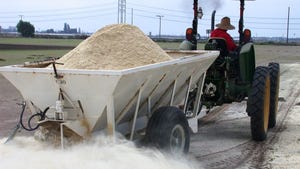
The single largest energy-related component in agriculture continues to be commercial fertilizers, particularly nitrogen, which accounted for about 45 percent of total energy consumption in 1998. The skyrocketing natural gas prices caused the shutdown of many anyhdrous ammonia production facilities last year; at the start of 2001, U.S. capacity was only at about the 50 percent level. By late January, prices for spot ammonia hit $360 per ton, then fell slightly as natural gas prices eased. As a result of all this, nitrogen imports are projected to hit a record this year.

Higher energy prices and this country's dependence on imported oil highlight “the great potential for U.S. agriculture to help solve the nation's energy problems,” Collins told the subcommittee. Crops, crop/forest residues, and energy crops planted on idle or marginal cropland, could be converted to various forms of energy, such as ethanol, biodiesel, biopower, and biochemicals, he noted.

In 2000, more than 1.6 billion gallons of ethanol was produced by 55 plants in 18 states; that's projected to rise to 1.7 billion gallons this year. Another 725 million gallons of capacity is under construction or in planning stages. Since ethanol prices tend to rise in concert with gasoline, the per gallon price of ethanol rose from $1.19 in February, 2000, to $1.63 in February, 2001 (the net per gallon cost of the corn used in producing the ethanol averaged 42 cents in 2000). The U.S. Department of Energy projects that cellulosic ethanol production from grass, wood, and other biomass materials could reach 250 million gallons by 2010.

The Bush Administration has created a cabinet level Energy Policy Development Group to develop recommendations for dealing with the nation's energy supply/demand imbalances; Agriculture Secretary Ann Veneman is a member. The group's recommendations are scheduled to be released later in May.

e-mail: hembree_brandon@intertec.com

Get Copyright ClearanceWant to use this article? Click here for options!
© 2008 Penton Media, Inc.


Latest Jobs

resources

events icon events

product info icon tradeshows

tradeshow icon digests

research icon photos

Continuing Education

Accredited by California DPR and California and Arizona Certified Crop Advisers:


(New Course)

Nutrient Management in Key California Crops


This online CEU course offers a detailed look at the nutrient management in key California crops. It is sponsored online by Western Plant Health Association and funded by a grant from the California Department of Food and Agriculture Fertilizer Research and Protection Program (FREP). It is accredited for one (1)-hour of credit by the California Department of Pesticide Regulation for California Pest Control Advisers (PCA), Private Applicators, Qualified Applicators and Aerial Applicators. The course is also accredited for 3 units in Nutrient Management (NM) for California and Arizona Certified Crop Advisers (CCAs).

Accredited in California, Arizona, Idaho, Oregon and Washington and for Certified Crop Advisers:


(New Course)
Organic/Sustainable Agricultural Production in the West

Organic/sustainable agriculture is expanding rapidly in the U.S. with an average annual increase of 20% during the last 15 years. This course covers a wide range of pests and organic control strategies. It is accredited for up to 4 continuing education hours for PCAs and Applicator Licensees in California, Arizona, Idaho, Oregon and Washington. It is also approved for Certified Crop Adviser credit.

ACCREDITED IN OREGON AND WASHINGTON:


(New Course)
Managing Spray Drift to Minimize Problems

This online spray drift management course has been certified by the Oregon Department of Agriculture and the Washington Department of Agriculture for 2 hours of credit for licensed Applicators and Consultants in Oregon and Washington.

ACCREDITED IN CALIFORNIA ONLY:


Almond Pest Management

Get the latest info on almond insect pest management and earn 2 hrs. CE DPR and CCA credit in California.

California Groundwater Protection Regulations

Earn 2 hrs. in California laws and regs CE and learn how to protect California groundwater supplies.


Disease Management in California Almonds

Managing diseases in California almond production is a year-long process. This course provides the latest information on controlling these diseases with management practices and fungicides. The course is approved for 2 CEUs by DPR for PCAs and all applicator categories and California CCAs.

Powdery Mildew Control in California Grapevines

Learn about the No. 1 grape disease in California; earn 2 California CE hours.

ACCREDITED IN CALIFORNIA AND ARIZONA:


The Role of Copper in Disease Control

Copper has long been a key tool in disease control in a many crops. This 2-CEU course accredited California PCAs and all DPR applicator categories and Arizona applicators details how best to use copper to maximize its potential.

Insecticide Resistance Management in Agronomic and Row Crops

A 3-hr. CE approved for California and Arizona licensees and CCAs in both states.

Agronomic Weed Resistance Management in Row Crops, Trees Nuts and Vines

Weeds Resistance Management is approved for 3 hours of CE credit for all California and Arizona licensees and Certified Crop Advisers.

Lepidopterous Pest Management/ Pesticide Safety

This course is approved for 2 hours in Arizona and California (1 hr. of laws/regs; 1 hour Other) and for CCAs.

Managing Spray Drift to Minimize Problems

2-hrs laws and regs for California licensees; 2 hours in Arizona and for CCAs.

Back to Top

Browse Print Issues

Additional Resources

subscribe to Farm Press Daily Southeast Farm Press Southwest Farm Press Delta Farm Press