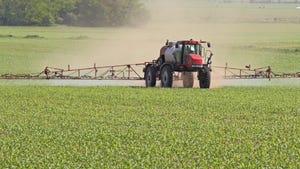
Case shows six-row picker, lists advances

Oct 6, 2001 12:00 PM, By Elton Robinson, Farm Press Editorial Staff

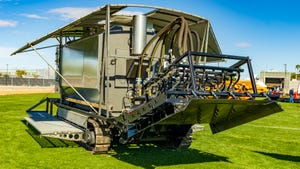
U.S. cotton producers would love to pick more cotton per hour, per day and per harvest season. At a product launch at Agricenter International in Memphis, Case IH brought out a calculator to prove that its first six-row assembly-line cotton picker can do all that and more.

The calculation program, which is available on a CD and on the Internet at www.caseih.com, showed a number of examples where the six-row CPX610 could provide substantial profit increases through an increase in picking savings and capacity savings.

Picking savings in the examples refer to additional incremental dollars earned by harvesting more cotton out of the field. Case says its field testing has shown a 1 percent to 3 percent-harvested cotton yield advantage when picking from both sides of the row versus picking from one side, the latter a reference to a competing company's in-line picking drums.

For example, on a 1,500-acre operation with a two-bale yield, a 1 percent increase in picking efficiency would provide 30 additional bales of cotton which would sell for $7,200 at 50 cents per pound.

Capacity savings refer to the increased basket capacity which allows farmers to complete their harvest in fewer days by spending less time unloading. For example, on the same 1,500-acre operation, harvest would conclude 1.145 days earlier vs. a competing six-row machine, saving $302 in labor and $1,431 in estimated depreciation.

That would provide a total cost savings of $8,933. Maximum cost savings at a 3 percent increase in picking efficiency could provide a total potential savings on the 1,500-acre farm of $23,333, according to Case's calculations.

Design of the six-row picker began in 1994. According to Kevin Richman, with the Case cotton harvesting team, “The first thing we had to do was match the basket capacity with the extra drum. The actual size of the basket was increased from 1,150 to 1,400 cubic feet.”

That change occurred in 1996. But Richman stresses that increasing the basket size alone, “wasn't the answer. It's the way you pack in there. We do a better job with our packer/auger combination. And that's why we can take a machine that has virtually the same cubic footage as our competitor and put another 2,000 pounds in there.”

The packing mechanism is automatic and can tell the operator when the basket has reached capacity, noted Richman. “The operator turns it on and when the compaction level reaches a certain level, it starts packing it down.”

Richman says the CPX610's best feature may be changes in the chassis. “A longer wheelbase makes it really ride nicely.” Another feature is a specially designed bent frame which allows for a tighter turning radius.

A rotary air screen, “eliminates a lot of time spent cleaning engine screens and blowing out radiators,” Richman said. “It's a huge improvement.”

With a basket capacity of 10,500 pounds, fuel tank capacity of 200 gallons and water tank capacity of 365 gallons, the operator can spend more time picking cotton and make fewer stops for unloading, Case says. “So producers can run these 14-hour days. That's what they're asking for,” Richman said.

An auto-lubrication system is an option on all new Case cotton pickers. “That really eliminates a lot of the daily servicing,” Richman said.

The CPX610 offers a 340-hp engine, full-time all-wheel drive and fully synchronized picking up to four miles per hour. An automatic height-sensing system, located at the front of the plant lifter, allows the plant lifters to better follow the ground contour and avoid “plowing” soil with the drums.

The CPX610 will pick 36- to 40-inch row spacings. The model does not include an option for a cotton yield monitor which Case IH and the University of Tennessee helped to develop.

e-mail: erobinson@primediabusiness.com

Get Copyright ClearanceWant to use this article? Click here for options!
© 2008 Penton Media, Inc.


Latest Jobs

resources

events icon events

product info icon tradeshows

tradeshow icon digests

research icon photos

Continuing Education

Accredited by California DPR and California and Arizona Certified Crop Advisers:


(New Course)

Nutrient Management in Key California Crops


This online CEU course offers a detailed look at the nutrient management in key California crops. It is sponsored online by Western Plant Health Association and funded by a grant from the California Department of Food and Agriculture Fertilizer Research and Protection Program (FREP). It is accredited for one (1)-hour of credit by the California Department of Pesticide Regulation for California Pest Control Advisers (PCA), Private Applicators, Qualified Applicators and Aerial Applicators. The course is also accredited for 3 units in Nutrient Management (NM) for California and Arizona Certified Crop Advisers (CCAs).

Accredited in California, Arizona, Idaho, Oregon and Washington and for Certified Crop Advisers:


(New Course)
Organic/Sustainable Agricultural Production in the West

Organic/sustainable agriculture is expanding rapidly in the U.S. with an average annual increase of 20% during the last 15 years. This course covers a wide range of pests and organic control strategies. It is accredited for up to 4 continuing education hours for PCAs and Applicator Licensees in California, Arizona, Idaho, Oregon and Washington. It is also approved for Certified Crop Adviser credit.

ACCREDITED IN OREGON AND WASHINGTON:


(New Course)
Managing Spray Drift to Minimize Problems

This online spray drift management course has been certified by the Oregon Department of Agriculture and the Washington Department of Agriculture for 2 hours of credit for licensed Applicators and Consultants in Oregon and Washington.

ACCREDITED IN CALIFORNIA ONLY:


Almond Pest Management

Get the latest info on almond insect pest management and earn 2 hrs. CE DPR and CCA credit in California.

California Groundwater Protection Regulations

Earn 2 hrs. in California laws and regs CE and learn how to protect California groundwater supplies.


Disease Management in California Almonds

Managing diseases in California almond production is a year-long process. This course provides the latest information on controlling these diseases with management practices and fungicides. The course is approved for 2 CEUs by DPR for PCAs and all applicator categories and California CCAs.

Powdery Mildew Control in California Grapevines

Learn about the No. 1 grape disease in California; earn 2 California CE hours.

ACCREDITED IN CALIFORNIA AND ARIZONA:


The Role of Copper in Disease Control

Copper has long been a key tool in disease control in a many crops. This 2-CEU course accredited California PCAs and all DPR applicator categories and Arizona applicators details how best to use copper to maximize its potential.

Insecticide Resistance Management in Agronomic and Row Crops

A 3-hr. CE approved for California and Arizona licensees and CCAs in both states.

Agronomic Weed Resistance Management in Row Crops, Trees Nuts and Vines

Weeds Resistance Management is approved for 3 hours of CE credit for all California and Arizona licensees and Certified Crop Advisers.

Lepidopterous Pest Management/ Pesticide Safety

This course is approved for 2 hours in Arizona and California (1 hr. of laws/regs; 1 hour Other) and for CCAs.

Managing Spray Drift to Minimize Problems

2-hrs laws and regs for California licensees; 2 hours in Arizona and for CCAs.

Back to Top

Browse Print Issues

Additional Resources

subscribe to Farm Press Daily Southeast Farm Press Southwest Farm Press Delta Farm Press