Almond crazy top and hull rot more in evidence this season

Jun 2, 2001 12:00 PM, By Harry Cline Farm Press Editorial Staff
California is rocketing ever closer to that one-billion-pound almond crop. This year the California Agricultural Statistics Service's subjective crop estimate is 875 million pounds.

If realized, it will be the largest crop ever produced in the state.

The 2001 crop estimate represents a 25.5 percent increase over last season's 698 million pounds. If realized, the 875 million pounds from 525,000 bearing acres will exceed the 1999-2000 crop by 45 million pounds.

CASS is conducting an objective measurement survey now where sample almond counts are made. The results will be released June 28 and there is a chance the crop will go down in size following the traditional June drop. Also, high winds up to 60 miles per hour in April caused considerable tree loss in some areas of the state.

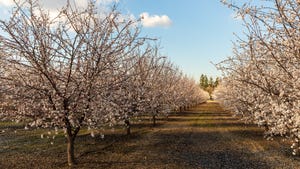
Although this year's bloom was one of the strongest ever, the size of the crop is more reflective of new bearing acreage coming into production than the bloom.

“The weather was not that great for pollination,” said Fresno County UCCE farm advisor Mark Freeman. Overall, he calls the crop in his county “good, but not great.”

Wind losses, Freeman reports, were significant for some growers. “Both young and older trees were blown over with some tree losses representing losses as high as 120 pounds of nuts per acre,” he said.

The big crop will follow an excellent marketing year for last year's crop. California almond shipments for April were a record 47.3 million pounds, obliterating the previous record of 41.8 million pounds shipped a year ago. May shipments may be as large or larger than the actual April shipments, according to the Almond Board of California.

Total shipments through the end of April totaled almost 579 million pounds, 11.6 million pounds of ahead of the previous record of last season. Domestic shipments (165 million pounds) were about 3 million pounds head of last year and exports (417 million pounds) were running about four percent ahead of last year.

Industry inventories (265 million pounds) are down 54 million pounds from last season and the almond board is predicting a carryout inventory of less than 120 million pounds on July 31.

Even with the brisk sales, however, new crop prices are very low with the big crop forecast.

The talk in the coffee shop among almond producers may be the potential record-breaking size of the 2001 crop, but the concern in the orchards has been higher-than-normal incidents of two unrelated maladies, almond bud failure and hull rot.

Almond bud failure, often called “crazy top” is much worse this year, according to Merced County farm advisor Lonnie Hendricks.

One reason for the genetically linked problem is that it affects the two most widely planted varieties, Carmel and Nonpareil, according to Mark Freeman, Hendricks counterpart in Fresno County.

Other varieties where the problem has been severe are Jordanolo, Merced and Harvey, according to Hendricks.

“Nonpareil bud failure has been less common in recent years than it was in the 1960s and ‘70s,” said Hendricks. “But we are again seeing more in Nonpareil.”

Peerless, Price, Thompson and Mission seldom show bud failure. Butte Padre, Sonora, NePlus, Ultra, Fritz and Monterey have shown no BF signs. However, Hendricks said there is no assurance that it will never appear in these varieties.

Although the problem was reported as severe this year, the impact on a tree's ability to set and mature nuts will likely come next year when there is reduced leaf surface and less tree vigor as result of bud failure this season.

While the root of the bud failure is genetic, it is brought on by hot temperatures.

Problem hidden

Last June there were a few days of temperatures of more than 100 degrees in the valley and that probably caused bud failure growers are seeing this year.

“The problem is latent or hidden until environmental conditions are right for it to manifest itself,” said Freeman, who said growers “must assume Carmel trees tend to have bud failure” and should not be planted in hot areas.

Hendricks added that research and field experience suggests water stress may increase BF the following year. “This may be due to higher bud temperatures on stressed and partially defoliated trees,” he said.

The only solution to crazy top is tree replacement and Freeman said many Carmel producers are seriously looking at variety replacement as well.

“Nonpareil bud failure has been less common in recent years than it was in the 1960s and ‘70s. But we are again seeing more in Nonpareil.”

If trees show bud failure within the first five or six years, Hendricks recommends replacing them. After that, trees should be allowed to continue producing until yields fall below economic returns. Budding or grafting BF trees with good wood is possible, but may not be economically successful or practical, Hendricks said.

Both Freeman and Hendricks said growers must be inquisitive with nurseries about budwood sources and if there are performance records, especially budwood from hotter areas.

“However, past good budwood performance is only an indication, not a guarantee of good future performance,” said Hendricks.

Hull Rot

Like bud failure, hull rot can be a nettlesome, long-term problem. Unlike crazy top, hull rot has a cultural solution, according to Brent Holtz, Madera County UC farm advisor.

Holtz said many growers this spring noticed their Nonpareil and Sonoma almond varieties lacked bloom in their lower portions while other varieties, like Carmel, displayed normal bloom.

Growers believe this is a result of shading. However, it is often caused by hull rot.

Hull rot problems start about mid hull split. It is then that dry leaf clusters begin to appear scattered in the tree canopy.

“Individual spurs, small shoots or entire small branches may collapse. The loss of fruiting wood, especially in the lower parts of the tree, can negatively affect yield for years afterward,” said Holtz.

Hull rot is caused by one of two fungi. Monilina fructicola is the one of the brown rot fungi and rhizopus stolonifer is called bread mold fungus.

Lesions or dryish rotted areas develop on the hull. Dense masses of Rhizopus spores produce a powdery dark gray to black growth between the hull and the shell. Monilinia spores are buff-colored, said Holtz, and are evident on inner and outer hull surfaces.

These do not damage the nutmeat, but move from the hull to nearby leaves and shoots, killing these tissues and reducing bloom and yield in later crops.

“Once hull split starts, trees are at risk of becoming infected,” the farm advisor said.

Hull rot often occurs in vigorous, heavily cropped, well-water and fertilized orchards. Holtz calls hull rot the “good growers disease” since it is often worse in well-maintained orchards.

“The reasons for this are not clear. The association with heavy crops might be simply a matter of numbers: more infected fruit means more toxin produced resulting in more leaf and shoot death,” he said.

University of California researchers found that the disease was dramatically reduced with mild water stress during early hull split.

Halving water

“Cutting water by 50 percent during this early hull split puts the tree into moderate stress…not enough to drop the crop… but enough to decrease hull rot infection by half or more,” said Freeman.

The researchers found that the best irrigation regime to reduce hull rot was to irrigate normally until just before and during hull when irrigations were reduced to 50 percent of the evapotranspiration rate.

Holtz noted that this work was done in Kern County and soils can vary throughout the state. “Irrigation management may be difficult in some orchards,” he noted, adding that UC is currently testing several approaches to use water stress under different irrigation strategies and soil types.

“In another trial we are experimenting with midday stem water potential readings to monitor deficit irrigation to reduce hull rot without severely stressing trees,” added Holtz.

In trials in Stanislaus County, hull rot increased with increasing nitrogen amounts.

“Nitrogen should not be applied in excess of that needed for tree health and productivity,” Holtz said, adding that the nitrogen content of irrigation water should be calculated into any fertilizer program.

e-mail: harry_cline@intertec.com

Get Copyright ClearanceWant to use this article? Click here for options!
© 2008 Penton Media, Inc.


Latest Jobs

resources

events icon events

product info icon tradeshows

tradeshow icon digests

research icon photos

Continuing Education

Accredited by California DPR and California and Arizona Certified Crop Advisers:


(New Course)

Nutrient Management in Key California Crops


This online CEU course offers a detailed look at the nutrient management in key California crops. It is sponsored online by Western Plant Health Association and funded by a grant from the California Department of Food and Agriculture Fertilizer Research and Protection Program (FREP). It is accredited for one (1)-hour of credit by the California Department of Pesticide Regulation for California Pest Control Advisers (PCA), Private Applicators, Qualified Applicators and Aerial Applicators. The course is also accredited for 3 units in Nutrient Management (NM) for California and Arizona Certified Crop Advisers (CCAs).

Accredited in California, Arizona, Idaho, Oregon and Washington and for Certified Crop Advisers:


(New Course)
Organic/Sustainable Agricultural Production in the West

Organic/sustainable agriculture is expanding rapidly in the U.S. with an average annual increase of 20% during the last 15 years. This course covers a wide range of pests and organic control strategies. It is accredited for up to 4 continuing education hours for PCAs and Applicator Licensees in California, Arizona, Idaho, Oregon and Washington. It is also approved for Certified Crop Adviser credit.

ACCREDITED IN OREGON AND WASHINGTON:


(New Course)
Managing Spray Drift to Minimize Problems

This online spray drift management course has been certified by the Oregon Department of Agriculture and the Washington Department of Agriculture for 2 hours of credit for licensed Applicators and Consultants in Oregon and Washington.

ACCREDITED IN CALIFORNIA ONLY:


Almond Pest Management

Get the latest info on almond insect pest management and earn 2 hrs. CE DPR and CCA credit in California.

California Groundwater Protection Regulations

Earn 2 hrs. in California laws and regs CE and learn how to protect California groundwater supplies.


Disease Management in California Almonds

Managing diseases in California almond production is a year-long process. This course provides the latest information on controlling these diseases with management practices and fungicides. The course is approved for 2 CEUs by DPR for PCAs and all applicator categories and California CCAs.

Powdery Mildew Control in California Grapevines

Learn about the No. 1 grape disease in California; earn 2 California CE hours.

ACCREDITED IN CALIFORNIA AND ARIZONA:


The Role of Copper in Disease Control

Copper has long been a key tool in disease control in a many crops. This 2-CEU course accredited California PCAs and all DPR applicator categories and Arizona applicators details how best to use copper to maximize its potential.

Insecticide Resistance Management in Agronomic and Row Crops

A 3-hr. CE approved for California and Arizona licensees and CCAs in both states.

Agronomic Weed Resistance Management in Row Crops, Trees Nuts and Vines

Weeds Resistance Management is approved for 3 hours of CE credit for all California and Arizona licensees and Certified Crop Advisers.

Lepidopterous Pest Management/ Pesticide Safety

This course is approved for 2 hours in Arizona and California (1 hr. of laws/regs; 1 hour Other) and for CCAs.

Managing Spray Drift to Minimize Problems

2-hrs laws and regs for California licensees; 2 hours in Arizona and for CCAs.

Back to Top

Browse Print Issues

Additional Resources

subscribe to Farm Press Daily Southeast Farm Press Southwest Farm Press Delta Farm Press