Water issues, struggling dairies cloud California agriculture

  • The Western dairy industry is headed into another down year in what has become a series of three-year cycles of economic pinnacles and troughs.
  • The availability and cost of water to irrigate crops and the economic health of the dairy industry have direct impacts across California agriculture.
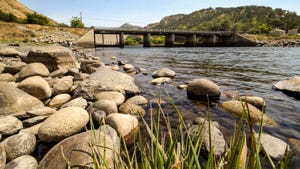
  • Without adequate storage to capture excess moisture in years like 2011, water deliveries have fallen dramatically this year compared to last.

More About:

Nitrate action coming

Sawyers says “expect a lot of action over this nitrate problem that could be potentially very significant for agriculture.”

The state has also begun monitoring groundwater levels for the first time in the state’s history. “The only reason to monitor is to regulate. Expect a lot of attention (from regulators and politicians) to groundwater levels in the next few years,” Sawyers predicts.

(For more, see: Fertilizer industry working to reduce groundwater pollution)

The new groundwater monitoring came from a water package passed by the California legislature in 2009. In that parcel, there was a mandate to create water management and pricing plans for anyone who supplies more than 10,000 acre feet annually.  This covers most irrigation districts.

These water issues will be on the table for decades to come.

A more immediate concern is the dairy industry and its impact on what has been an economically sound period for agriculture through the past few seasons.

Cycles are part of agriculture, and CPA Paul Anema of Modesto, Calif., says the Western dairy industry is headed into another down year in what has become a series of three-year cycles of economic pinnacles and troughs.

The Western dairy industry experienced its worse year ever in 2009 as milk prices plummeted and costs soared. Dairymen lost an average $682 per cow in 2009. Before that, the worse year was 2006 when the loss was $155 per cow. “We thought 2006 was as bad as it could get,” he says.

The industry has rebounded since then and “2011, comparatively, was a very good year for dairy,” says Anema.

However, milk prices have dropped sharply in recent weeks and “2012 looks to be good average year. If we break even for the first six months, it will be good.”

However, “there is a lot of nervousness” as milk futures prices hover around what are considered breakeven prices.

The tenseness is because if the third down year in the cycle gets too deep, many smaller dairies may not recover as they did after 2009.

Those who survived that collapse used profits from 2010 and 2011 to repay debt. Some still have lingering debt from that bad year. There is little equity in many dairies.

Anema says banks and suppliers are not inclined to carry struggling dairymen this time around, as they did in 2009.

“Feed companies have gotten dairies back to 30 days,” and they are not cutting any slack.

There is an old dairy joke that when things get bad, dairymen buy more cows to increase production and hopefully increase income. This time around, Anema says “a lot of his clients” are asking what will happen if they sell the cows and go into tree nut farming.

“The tree nut industry has done well and will continue to do well,” Anema predicts.

Discuss this Article 2

John Parker (not verified)
on Apr 19, 2012

After mentioning that California is important for produciton of 400 commodities, providing data for some of them would be interesting.

stuart
on May 8, 2013

Many thanks for this brilliant post! Many points have extremely useful. Hopefully you'll continue sharing your knowledge around.
latex mattress reviews

Post new comment
Sign In or register to use your Western Farm Press ID
(optional)

Continuing Education Courses
This accredited CE course focuses on choosing the correct variety alfalfa based on a number of...
New Course
The 2,000-member Weed Science Society of America’s (WSSA) Herbicide Resistance Action...

The course details six of the primary diseases affecting citrus: Huanglongbing (Citrus...

Newsletter Signup