Agriculture contests veracity of nitrate study, urges review

  • California's agriculture community called for peer review of a UC Davis study on nitrates in groundwater, emphasizing it did not use existing data from authoritative sources and contains material deficiencies that should be examined before the State Water Resources Control Board uses the report as a basis for policy decisions.

At a State Water Resources Control Board hearing, the agriculture community called for peer review of a recently released University of California, Davis study on nitrates in groundwater, emphasizing it did not use existing data from authoritative sources and contains material deficiencies that should be examined before the State Water Resources Control Board uses the report as a basis for policy decisions.

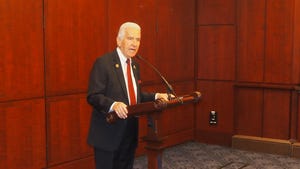
“The State Water Board must have the benefit of a scientifically defensible study that meets the legislative mandate and has been peer reviewed,” said Dave Puglia, Sr. Vice President of Western Growers Association. Puglia presented testimony on behalf of a coalition of agriculture organizations that also includes: California Seed Association, California Pear Growers, California Grain and Feed, Pacific Egg and Poultry, and the California Farm Bureau Federation, among others.

(For more, see: Groundwater nitrate issue dumped in agriculture’s lap)

Among the research not cited in the U.C. Davis report were nitrates studies conducted by the U.S. Geological Survey (USGS), Lawrence Livermore National Laboratory, and the University of California, Santa Cruz. Further, agricultural interests say the report actually contains errors and omissions. In Monterey County, for example, more than 5,100 samples were repeat tests of 4,700 wells, meaning that a substantial number of wells were double or triple counted. The report also skews the data by counting wells that are now in compliance with the nitrate standard – including wells that did not exist in 2000 and wells that no longer exist today – as exceedence wells. Finally, the report fails to generate a truly geographically representative sample as required by USGS.

Allen Ishida, a Tulare County citrus grower and county supervisor, also called on the Water Board to consider how technologies that could determine the source of nitrates, as well as the age of the water supply, would be helpful in generating a more accurate picture of how and when nitrates are entering groundwater.

State Water Board Chair Charles Hoppin committed to a robust stakeholder process going forward, which was welcomed by the agriculture community.

“Agriculture is committed to continuing to work toward a long-term solution that will ensure clean drinking water for affected communities,” said Puglia. “Nitrate management has been a priority of agriculture for years and much progress has been made. But a long-term solution must be based on reliable and scientifically defensible data, which the State Water Board currently doesn’t have.”

For more information, please read Western Growers’ presentation materials or contact Bill Romanelli at (916) 554-3400 or cell 916-212-1446.

Discuss this Article 7

Anonymous (not verified)
on May 24, 2012

The report cites dozens of studies conducted by the USGS, and uses thousands of data points from USGS data collection efforts.

The report does not use data from the Lawrence Livermore datasets because that data was not collected within the study area boundaries of the report. THAT would be scientifically indefensible.

No doubt there are nitrate studies that have been conducted that were not cited in the report. However, to suggest that this somehow reduces the validity of the report is just silly. the report cites hundreds of studies conducted by dozens of agencies and universities.

Repeated tests of individual wells are the only way to understand the change in nitrate concentration over time. Furthermore, a single test at any point in time is always less reliable than multiple tests. The suggestion that only one test result from each well should have been used is either a despicable attempt to deceive the public, or indicative of your Western Growers' author's stupidity.

Lets be very clear here. The SBX21 report was mandated o describe the changes in NO3 concentrations and distribution over time and space. If only one sample were allowed for each well, it would be impossible to examine the time rate of change. That should be incredibly obvious to any person who is not wholly invested in blindness and a guiding principle.

This notion that wells that were not in exceedance were counted as such is just drivel. There is no basis for it, and it is meaningless. The report makes it very clear that wells that were discontinued due to exceedance of the MCL are NOT considered, since there is no data collected on wells that are shut down. In fact, this actually results in an UNDER-estimate of the rate of increase in nitrate concentration in wells, since sample collection is discontinued on wells that exceed the MCL. Again, this should be very clear to all but the dimmest bulbs.

Spatial disaggregation techniques, specifically referenced from USGS methodologies, were used to obtain representative estimates of trends. Did your reporter just go through the report, find things that were done, and then write an article that says those things were not done? This is the most nonsensical piece of pseudo-journalism ever created.

If only 50% of the nitrate going to groundwater was from agriculture, then stable isotope analysis for determination of sources would be warranted. That was not the case. The total load of nitrogen to groundwater is about 96% from irrigated agricultural fields. It is such an overwhelming fraction of the load that piddling around with isotopic analysis is just not warranted at the regional scale. Ishida is just looking for a way to delay the process and spend some more tax-payer dollars on un-needed science rather than on getting with the business of providing clean water to people who need it. It is disgusting and self-serving. Furthermore, the report specifically identifies areas of the study area where ag was not the problem - albiet they are few and far between! Yes, there is nitrate coming from other sources. Yes, those are a problem in very small areas of the region. The report makes this abundantly clear, unless you read it with blinders on.

Puglia doesn't know what the phrase "scientifically defensible" means, apparently. It does not mean "agrees with what I wanted to hear". Tough luck. Have some cheese with your whine.

West Side Farmer (not verified)
on May 26, 2012

You are obviously one of those far left global warming, go green, enviro wacko types. Probably pasty white because your afraid you will contract skin cancer if exposed to the sun. Also a in favor of anything to destroy agriculture in this country in favor of the importing All of our food ! Yeah, that's a great idea! After all that importing all of our oil thing is working out so well. Or better yet why don't we just stop eating all together. Think of all the water we could conserve, along with doing away with all fertilizer and pesticides all together. We could save fuel, no equipment in fields or trucks, trains, ships transporting food around the world. Wow! RomHow much air and enviro pollution would that save?
The problem with you enviro wackos is that you are all idealists. Most of whom have never owned, managed, or run a real business of any kind. Hiding under your desk from your government provided job where their is no accountability for your actions. If you think you have realistic solutions why don't you come down and land on "planet reality" and present them based on scientific evidence from a non bios source rather than the bevy of sources tainted by enviro extremists used and employed by our government.
Yes, I am a farmer and proud of it! It's a hard thankless way of life, and the public had better wake up soon to protect its viability rather than every cause that seeks to extinguish its existence in the USA.

Anonymous (not verified)
on May 24, 2012

nice to know you rabbits are just as biased as i imagined. by not posting my earlier comment, you identify yourselves as hacks.

Anonymous (not verified)
on May 24, 2012

the amazing thing is that you are willing to allow this kind of tripe to be published on your website. you should be embarrassed. not everyone who reads this is an idiot. you are going to look amazingly stupid for publishing this.

Stuart Pettygrove (not verified)
on May 25, 2012

I am one of the co-authors of the UC nitrate report. "Anonymous" (the initial lengthy comment) makes a number of valid points in response to the criticisms of the report. However, I am dismayed that this person had to take it into the realm of personal insults. This is very common on blogs now and is really tiresome. You are anonymous, so why not just vent!! A guess is that the individuals who engage in this sort of thing don't realize how it kind of wrecks their credibility.

Jerry Halford (not verified)
on May 26, 2012

First, why are people posting these offensive comments without the stones to identify themselves?
Secondly, I am a farmer so you know my bias.
Thirdly, Have you taken into consideration that most nitrates in the groundwater are the result of the decay of naturally occuring organic matter in the soil? Also, since those areas with the most naturally occuring organic matter in the soil are also the most fertile, those are the areas in which farmers settled over the past 100 years. Admittedly, farmers have used nitrogen fertilizer for years to enhance the productivity of their crops, but modern science allows us to identify precisely the amount of nitrogen needed to produce a crop and it certainly is not in our best interests to over apply any fertilizer. Feritlizer is very expensive for us and we do not wish to contaminate the ground water with anything, nitrogen or any other chemical/element. We mostly live on the property we farm, we raise our children and grand children here, we drink the water from our wells, and we certainly do not want to poison ourselves or our loved ones. Farmers are not "bumpkins" and we have no desire to damage the environment, water or air, and I take personal offense to comments from urban people who have no direct knowledge of what goes into farming. Just my humble opinion. Thank you.

Dave Hamel (not verified)
on May 26, 2012

It is truly shocking to see the vitriolic response of the first post. It is not surprising to also note the writer is "anonymous". The agenda-driven bully has no place at the forum to discuss and analyze the data.

Apparently, the poster-child for residential water pollution is a high-density, rural apartment complex built in a FEMA flood plain using a water well and a community septic system. Besides gravity, there is the negative pressure of an operating water well in proximity to the sewer ponds. Looks like a pretty short loop between in the incoming and the outgoing water. What is the history of operation water, septic, and waste disposal on the property? This is an civil engineering problem that has its roots in days of Camp McCallum which is now known as San Jerardo Cooperative Inc. at 24500 Calle El Rosario, Salinas. If the property has a health and safety issue, then the county has existing authority to red-tag and close the site for residential use.

Post new comment
Sign In or register to use your Western Farm Press ID

(optional)

Continuing Education Courses
This accredited CE course focuses on choosing the correct variety alfalfa based on a number of...
New Course
The 2,000-member Weed Science Society of America’s (WSSA) Herbicide Resistance Action...

The course details six of the primary diseases affecting citrus: Huanglongbing (Citrus...

Newsletter Signup