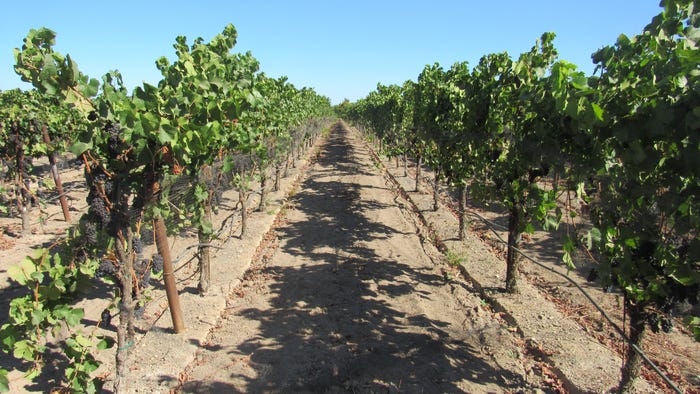
Rules for nitrogen in vineyards have changed dramatically

Nitrogen management all encompassing today

What is in this article?:

  • Much of California's water supply is polluted with nitrates. One of the sources of this pollution is farming.
  • Nitrogen not utilized by  plant eventually reaches water table.
  • California is in the throes of creating a massive regulatory system that will mandate each farm adopt a fertilizer management plan.


Much of California's water supply is polluted with nitrates. One of the sources of this pollution is farming. California is in the throes of creating a massive regulatory system that will mandate each farm adopt a fertilizer management plan.

The rules for nitrogen management have changed dramatically in California.

Old school N management for decades was basically making sure a crop did not stress for N. If you thought it would run short, you’d call the fertilizer salesman to bring more out.

Growers have long soil or tissue-sampled for N, but even with that all they wanted for years was a number from the lab that told them how much they needed to make sure they did not run out.

With growing nitrate monitoring in subsurface and surface water as part of water quality regulations, the line between too much and too little has become much more finite. Labs are asking for far more information these days to make sure the recommendations they issue fit, as closely as possible, the need and timing of the crop without any going to waste or harming the environment.

Don’t expect that recommendation to be one-number-fits-all advice, according to Keith Backman, consultant/manager for Dellavalle Laboratory, Fresno, Calif.

Might as well ask him how much gas it would take to drive from Paso Robles, Calif., to Los Angeles. That would depend on whether you are riding a motorcycle or driving an 18-wheeler and a lot more information.

A sample is only a start in getting a recommendation from Backman or his peers. The more information, the better, according to Backman. There are some general guidelines to point a farmer or consultant into a general direction of a plant’s nitrogen needs, Backman told about 250 people last fall at the Sustainable Ag Expo in Paso Robles, Calif., sponsored by the Central Coast Vineyard Team.

Backman, a Certified Horticulturist/Pomologist and Certified Crop Advisor, says it is a sure bet that vineyards struggling to make late season sugar at the end of last fall are likely to be short on nitrogen at bud break this season.

He commented in his presentation on nitrogen management that red grapes likely went into dormancy last fall short on N for next spring because they were held on the vine in an attempt to reach desirable sugar levels for wineries. Earlier harvested white wine grapes, he added, likely will be better off this spring.

While he offered those guidelines for grape growers, he did not make a specific recommendation and he won’t unless he has a lot more information about where the nitrogen is going; what form of fertilzer is used and how it will be supplied. That’s for starters.

Backman was on the program largely because of the growing problems of nitrates in surface and groundwater.

Discuss this article 2

Nutrient uptake is a key factor in plant health and nitrate management.
It has been widely proven in all agricultural crops, if your plants have mycorrhizae, beneficial bacteria and the related associates the plants will use 30% less fertilizers, simply because they can access them through proper soil biloogy. Inoculating grapes is very simple, but you must follow certain guidelines in order for successful inoculations.
Natural mycorrhizae in 90% of vineyards falls well below levels for results, both petiole and soil reporting as well as plant health and wine quality.
Fertilizer savings more than pay for inoculations through existing drip irrigation systems.

By Bruce Coulthard (not verified)  on Jan 10, 2012

Harry- Please do not take this as a personal attack, I generally admire and respect your reporting work.
1. What do you mean by the line"much of Calif water supply" . What data set backs up this assertion.
2. If this statement is true(which i am waiting to judge), how are grapes a major problem or part of the solution. Grapes fertilization's generally apply one tenth of the amount per acre of N that row and vegetable crops do. Also they are much more likely to be grown in areas with out perched or shallow water tables which are the most likely to be problematic relative to N contamination.

Nice technical reporting of the sampling process
Mike

By Anonymous (not verified)  on Jan 10, 2012
Post new comment
Sign In or register to use your Western Farm Press ID

(optional)

Continuing Education Courses
New Course
The 2,000-member Weed Science Society of America’s (WSSA) Herbicide Resistance Action...
New Course

The course details six of the primary diseases affecting citrus: Huanglongbing (Citrus...

Get the latest info on almond insect pest management.
Farmer-to-Farmer Used Equipment