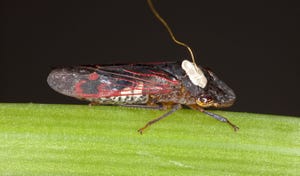
Grape growers warned over glassy-winged sharpshooter threat

What is in this article?:

  • The combination of Pierce's disease and the glassy-winged sharpshooter (GWSS) could be devastating to the California grape industry.
  • GWSS has taken a back seat in recent years as other invasive pests, including the European grapevine moth, captured headlines.

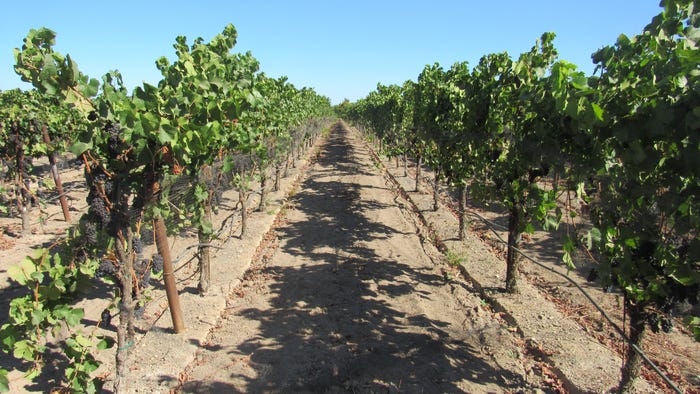
Because of recent finds in insect traps in California, speakers at a grape symposium warned grape growers to keep their guard up against an insect pest that can quickly spread deadly Pierce’s disease in vineyards.

The insect was found recently in commercial vineyards in west Fresno County and near the San Joaquin River and is gradually spreading into rural areas, said Stephen Vasquez, University of California viticulture advisor for Fresno County, and Fred Rinder, the county’s deputy agriculture commissioner.

Both Rinder and Vasquez said the combination of that disease, which has destroyed tens of thousands of acres of grapes in California dating back more than a century, and the glassy-winged sharpshooter (GWSS), a relative newcomer to the state, could be “devastating.”

Fresno County is the state’s top grape producer with a value for the county’s crop at just under $1 billion.

Vasquez described symptoms for Pierce’s and urged testing of any suspect vines, and Rinder talked of the county’s GWSS program for trapping, surveying, treatment and biological control.

Rinder said the county treats only residential areas, but growers are urged to do their own treatments for GWSS if the insect is found in their vineyards.

“Don’t rely on big brother to do the spraying,” he said.

Rinder recommended they make sure restricted materials permits are accurate because they are used by the county to notify growers of a find.

The insect was found in the Fresno-Clovis area in the late 1990s, and more recent finds – coupled with treatment -- were made in the Kerman area and in southeast Fresno County. Some 4,000 properties in the county have been treated for GWSS. Treatments resume in March and trapping with yellow sticky panels will start in May.

The insect has a wide range of host plants, including ornamentals.

Traps will be placed in nurseries, commercial citrus orchards and towns throughout Fresno County along with the perimeter of the Fresno-Clovis area. Bio control efforts will continue through the release of a tiny wasp that parasitizes the eggs of the GWSS.

The insect overwinters in citrus groves and comes out of the groves and into vineyards in April or May. Rinder said that if a citrus grove is within a half mile of a GWSS find, its grower may be able to get funding through the U.S. Department of Agriculture to pay for voluntary spraying of the grove for the insect, which does not harm citrus. He said about 12,000 acres of citrus in Fresno County has been treated for GWSS.

Discuss this Article 1

stuart
on May 8, 2013

I was very pleased to find this site.I wanted to thank you for this great read!! I definitely enjoying every little bit of it and I have you bookmarked to check out new stuff you post.
http://www.mattressjournal.com/has-tempurpedic-lost-touch-with-what-customers-want/

Post new comment
Sign In or register to use your Western Farm Press ID

(optional)

Continuing Education Courses
This accredited CE course focuses on choosing the correct variety alfalfa based on a number of...
New Course
The 2,000-member Weed Science Society of America’s (WSSA) Herbicide Resistance Action...

The course details six of the primary diseases affecting citrus: Huanglongbing (Citrus...

Newsletter Signup