SJV phenoxy drift cotton damage widespread

What is in this article?:

  • At least 15,000 acres of San Joaquin Valley cotton and one young pomegranate orchard have been damaged by phenoxy herbicide drift from a legal, but questionable Merced County, Calif., 2,4-D application to pasture land.
  • It was an application that would have been illegal in Fresno, Tulare, Kings, Kern and Madera counties.

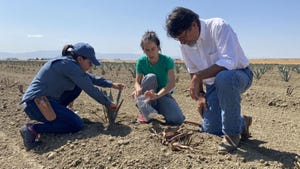
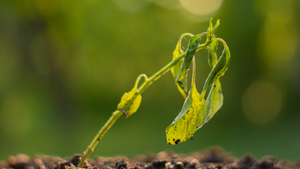
The plant in the middle of this photo has been damaged by 2,4-D drift.

At least 15,000 acres of San Joaquin Valley cotton and one young pomegranate orchard has been damaged by phenoxy herbicide drift from a legal but questionable Merced County, Calif. 2,4-D application to pasture land.

According to Cannon Michael, vice president of Bowles Farming in Los Banos, Calif., the Merced County agricultural commissioner granted a variance for a 1,000-acre 2,4-D application. It was an application that would have been illegal in Fresno, Tulare, Kings, Kern and Madera counties where no 2, 4-D may be applied after March 16 because of the risk of injury to newly planted cotton and leafing out trees and vines.

Officials are continuing to assess the damage of the early June application of the herbicide, but so far injury has been verified as far south as Kern County, according to Fresno County deputy agricultural commissioner Les Wright.

Wright verified the Kern County damage 100 miles away from the suspect Merced County application site at a San Joaquin Sustainable Farming Project cotton field day near Firebaugh, Calif., adjacent to a field that had been hit by the drift.

It was Mike Vandenberg’s farm where the field day was held and he said the damage is spotty in the field, but evident. He is concerned about the long-term effect of the phenoxy herbicide drift on this year’s yield.

Dan Munk, University of California cotton farm advisor, demonstrated the crinkled leaf symptoms of phenoxy damage. However, Munk said in a tour of damaged fields prior to the field day, he saw no square damage.

“Cotton is extremely sensitive to phenoxy herbicides,” he said.

Paul Goodman, a Dos Palos, Calif., cotton producer, can vouch for that. Several years ago, 50 acres of seedling cotton he was farming was scorched by 2,4-5 residue in an aerial applicator’s tanks. “It virtually defoliated the field. I was ready to disk it under and start over. The insurance company said to leave the field in and I would be compensated for any yield loss,” he said.

Goodman said, “The field actually yielded more than undamaged fields. When the season was over a bunch of my fellow growers teased me and asked if I would treat their cotton with this growth regulator next season.”

Munk acknowledged that 2,4-D is actually a growth regulator that can effect different varieties differently.

Goodman said the swelling controversy is much ado about nothing. His comments were heartening to those at the field day who are seeing damage, but the issue is far from resolved.

Wright said the amount of damage lessens the farther south you go from the application site in Merced County. “It may be one in three plants the closer you are to the (suspect) application area. In the Firebaugh area and south it may be only one in 10 plants.” However, he cautioned that county and state officials are continuing to evaluate the situation. He said there may have been more than just one incident on one day. Wright acknowledged that the application was “somewhat” legal. However, growers and others are questioning the wisdom in approving the permit.

Discuss this Article 4

Anonymous (not verified)
on Jun 14, 2012

It is episodes like this that make Dow's 2,4-D-resistant corn and soybean systems entirely unacceptable. 2,4-D will be applied at higher rates, more frequently, on many more acres, and later in the season than it is today. Overall we can expect at least four or five times more 2,4-D in US agriculture, and applied post-emergence when nearby crops will be very susceptible to damage. See http://saveourcrops.org/people-2/ for specialty crop and tree growers who are opposing 2,4-D and dicamba-resistant crops because of the enormous crop damage they would bring.

Not to mention 2,4-D-resistant weeds, which willl come very quickly with Dow's "Enlist Weed Control System," just as glyphosate-resistant weeds did with Roundup Ready crops.

Doctor Dirt (not verified)
on Jun 15, 2012

I am a crop consultant in Arizona and New Mexico and I have been seeing phenoxy style damage to cotton and other crops that appears to from off-brand glyphosates. If the spray tank was left with material in it in the hot sun, then the first 100 ft or so of row shows herbicide damage that is an exact duplicate of the phenoxy herbicides. I have one client who tells me he has NEVER even bought 2,4,D, yet showed damage that I would have sworn was 2,4,D.

This damage has occurred in both of the last 2 years and the only thing I can find in common was the use of Honcho or other off-brands of glyphosate and storage for several hours in the sun in the sprayer.

Has anyone else seen this kind of damage?

Anonymous (not verified)
on Jun 17, 2012

The problem I see is poor judgment on the part of both the issuer of the exemption and the applicator. 1000 acres (if it was that amount) should have raised a large red flag to the county. But the bigger problem is the very poor, unexplainable, illogical decision of the applicator to go ahead with the application when winds were averaging near 20 mph with gusts over 30 along with high ttemperatures. It is impossible to find a logical reasoning for this action since its origin and foundation is illogical.

Anonymous (not verified)
on Jul 13, 2012

Most of damage south of 152 Is from idiots spraying phenoxys on corn. The funniest thing is that one of the applicators that did the spraying, argued the fact that banvel or clarity was a phenoxy. This is a classic example of the wrong material in a ignorant applicators possession .

Post new comment
Sign In or register to use your Western Farm Press ID
(optional)

Continuing Education Courses
This accredited CE course focuses on choosing the correct variety alfalfa based on a number of...
New Course
The 2,000-member Weed Science Society of America’s (WSSA) Herbicide Resistance Action...

The course details six of the primary diseases affecting citrus: Huanglongbing (Citrus...

Newsletter Signup