Embattled tree fruit industry facing hard decision for 2009

Dec 31, 2008 8:06 AM, By Harry Cline
Farm Press Editorial Staff
The embattled California tree fruit industry went into 2008 with high hopes, only to see its optimism nosedive mid-season like an overripe peach plummeting to the orchard floor.

And those hopes rotted away like that peach until the season mercifully ended.

“While the season started out well, it turned into a year the industry couldn’t wait to finish,” according to Gary Van Sickle, director of research and regulatory compliance, and Gordon Smith, manager of international programs for the California Tree Fruit Agreement, Reedley, Calif.

In a report for the 27th Annual Agribusiness Management Conference, Van Sickle and Smith said for the third dismal year in a row, surviving California tree fruit growers and packers are left to ponder their fate.

The one realization is that volume still needs to drop by 10 percent to 15 percent annually to ensure industry marketplace stability. The tight financial restraints growers faced going into this season remain. Many could not get bank loans after two bad years and turned to financing from larger packers.

Consolidation continued by growers and packers with more vertical integration of growing, packing and marketing sectors.

After 2008, this picture is not likely to change, as reports circulated in the offseason that packers have closed and orchards have been sold.

According to Van Sickle and Smith, the general consensus is that orchard removal of poor varieties needs to be stepped up to reduce volume.

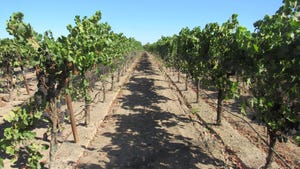
The orchards taken out should not be planted back to fruit, but to other commodities. Growers have been doing that for several years, opting for almonds, citrus and grapes rather than tree fruit. That is likely to be stepped up in the wake of 2008.

The maximum potential tree fruit crop is most likely in the 57-58 million box range compared to the more than 60 million boxes in the 1990s. The 2008 crop was approximately 57 million packages.

The negative factors facing the industry include sharply higher input costs, ongoing financial and regulatory constraints and a variety of what Van Sickle and Smith call “societal-economic” pressures.

Costs like the following also killed the 2008 crop:

– Minimum wage increased from $7.50 to $8, adding up to $1 to the cost of each package.

– As an example of across the board production cost increases, one crop care company raised its prices for agricultural chemicals by 25 percent June 1. They went up another 20 percent on July 1.

– The increased cost of diesel ran the rate for trucking a load of fruit to the East Coast to as high as $10,000 to $11,000 per load last summer. That is roughly double what it was just a few years ago.

Overall, the cost of growing and packing fruit went up $3 per package in 2008.

Nevertheless, the year started out well with moderate prices and good quality. However, in late June when the industry was preparing to provide ample fruit for the July 4 holiday, many retailers did not take the supply the industry had available; inventory soared in cold storage and the FOB market dropped below the cost of production for the remainder of the season.

Part of the problem was the regional effect where retailers pushed locally grown products over California fruit.

The “buy local” movement is hurting the California tree fruit industry.

“Consumers have grown accustomed to paying premium prices for fresh produce at the local markets, provided their expectations for quality are met,” the pair notes.

The downturn in the economy only added to the problem, since produce items are often perceived by consumers as luxury items.

“The reality faced today is that tree fruit can and will be replaced, if quality and price does not work for the retailers’ analysts,” according to Van Sickle and Smith.

“It is not difficult for a retailer to source good fruit, but it is difficult for a retailer to meet profit expectations of their corporate offices” with a product that is now considered a “mature category” by retailers and not what it once was for retailers.

“What this means for the tree fruit industry as suppliers is it must provide high quality fruit consistently and develop marketing tools that can drive sales at the retail level.

“For those in the tree fruit industry that can meet these challenges, there’s light at the end of the tunnel.”

email: hcline@farmpress.com

Get Copyright ClearanceWant to use this article? Click here for options!
© 2009 Penton Media, Inc.


Latest Jobs

resources

events icon events

product info icon tradeshows

tradeshow icon digests

research icon photos

Continuing Education

Accredited for California, Arizona and CCA hours:


(New Course)
Biopesticides -- Effective Use in Pest Management Programs

Biopesticides are increasingly being recommended as components of Integrated Pest Management (IPM) programs in the production of non-organic high-value specialty crops such as fruit, nut, vegetable, vine, ornamental and turf. This online, accredited course, sponsored by Marrone Bio Innovations, details some of the 245 registered biopesticide active ingredients used in a wide array pest management products.

Accredited in California and Arizona:


(New Course)
Agronomic Principles and Efficient Chemigation and Fertigation Using Center Pivot/Linear Sprinkler Systems

This online CE course details sound mechanical irrigation design and management practices to allow efficient chemigation and fertigation. It is accredited for Certified Crop Adviser CE units and is approved for credit hours in California and Arizona.


(New Course)
Pome, Stone Fruit Pest Management Using New Mode of Action Chemistry

New chemistry Rynaxypyr has proven effective against a wide range of economically important Lepidoptera species. Marketed under the trade name Altacor for use in grapes, pome and stone fruit, details on how to use this new chemistry are in this online Continuing Education course that is accredited in California, Pennsylvania, and New Jersey with CE applications pending in Oregon and Washington.


(New Course)
Vegetable Pest Management Using New Mode of Action

Integration of a new mode of action compound like Coragen into IPM and IRM programs to control Lepidoptera in leafy greens, fruiting vegetables, peppers and brassica or cole crops is always welcome. This online CE accredited details how best to use this new mode of action in intensive vegetable production. It is accredited in California, Arizona, Texas, Georgia, New Jersey and Pennsylvania. Application for credit is pending in Florida and Washington.

Accredited by Accredited in California and Washington:


(New Course)
Utilizing Calcium as Nutrient That Protects Against Disease Organisms

This online accredited course focus on Calcium, an important plant nutrient in fertilizer management for maximum, healthy plant development as well as disease and pest prevention. It is accredited in California, Georgia,: Pennsylvania and New Jersey. Credit pending in Florida, South Carolina, Tennessee, Virginia, West Virginia and Washington.


Accredited by California DPR and California and Arizona Certified Crop Advisers:


(New Course)

Nutrient Management in Key California Crops


This online CEU course offers a detailed look at the nutrient management in key California crops. It is sponsored online by Western Plant Health Association and funded by a grant from the California Department of Food and Agriculture Fertilizer Research and Education Program (FREP). It is accredited for one (1)-hour of credit by the California Department of Pesticide Regulation for California Pest Control Advisers (PCA), Private Applicators, Qualified Applicators and Aerial Applicators. The course is also accredited for 3 units in Nutrient Management (NM) for California and Arizona Certified Crop Advisers (CCAs).

Accredited in California, Arizona, Idaho, Oregon and Washington and for Certified Crop Advisers:


(New Course)
Organic/Sustainable Agricultural Production in the West

Organic/sustainable agriculture is expanding rapidly in the U.S. with an average annual increase of 20% during the last 15 years. This course covers a wide range of pests and organic control strategies. It is accredited for up to 4 continuing education hours for PCAs and Applicator Licensees in California, Arizona, Idaho, Oregon and Washington. It is also approved for Certified Crop Adviser credit.


ACCREDITED IN CALIFORNIA ONLY:


Almond Pest Management

Get the latest info on almond insect pest management and earn 2 hrs. CE DPR and CCA credit in California.

California Groundwater Protection Regulations

Earn 2 hrs. in California laws and regs CE and learn how to protect California groundwater supplies.


Disease Management in California Almonds

Managing diseases in California almond production is a year-long process. This course provides the latest information on controlling these diseases with management practices and fungicides. The course is approved for 2 CEUs by DPR for PCAs and all applicator categories and California CCAs.

Powdery Mildew Control in California Grapevines

Learn about the No. 1 grape disease in California; earn 2 California CE hours.

ACCREDITED IN CALIFORNIA AND ARIZONA:


The Role of Copper in Disease Control

Copper has long been a key tool in disease control in a many crops. This 2-CEU course accredited California PCAs and all DPR applicator categories and Arizona applicators details how best to use copper to maximize its potential.

Insecticide Resistance Management in Agronomic and Row Crops

A 3-hr. CE approved for California and Arizona licensees and CCAs in both states.

Agronomic Weed Resistance Management in Row Crops, Trees Nuts and Vines

Weeds Resistance Management is approved for 3 hours of CE credit for all California and Arizona licensees and Certified Crop Advisers.

Lepidopterous Pest Management/ Pesticide Safety

This course is approved for 2 hours in Arizona and California (1 hr. of laws/regs; 1 hour Other) and for CCAs.

ACCREDITED IN CALIFORNIA, ARIZONA, OREGON, AND WASHINGTON:

Managing Spray Drift to Minimize Problems

This online CEU on managing spray drift to minimize problems is accredited for 2-hours in California (Laws and Regs); Arizona, Oregon and Washington.

Back to Top

Browse Print Issues

Additional Resources

subscribe to Farm Press Daily Southeast Farm Press Southwest Farm Press Delta Farm Press