Central San Joaquin Valley almond growers on track for another bumper crop

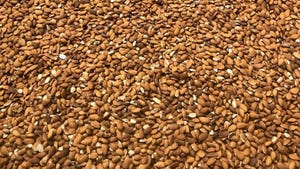
“It’s truly a big crop,” says Mike Kelley of the endless stream of trucks delivering as many 8 million to 12 million pounds of Nonpareil almonds a day to the Central California Almond Growers Association’s plants at Kerman and Sanger, Calif.

Kelley is president and CEO of the cooperative, the largest almond huller and sheller in the world.

This year’s harvest for association members started a little over a month ago, about two weeks later than normal, due to cool weather in the spring. By the time growers had nearly completed delivering Nonpareils and had moved on to their next-maturing varieties four weeks later, 180 million pounds of field run product had been delivered to the two hulling and shelling facilities.

At one point, daily shipments hit 240 truck loads — 36 loads higher than the previous one-day record. When this year’s harvest is done, he expects to have received another 180 to 190 million pounds of almonds.

He expects this year’s harvest to wrap up by the end of October.

“The weather should be very cool when those last varieties come in,” says Kelley, “and that causes me some concern.”

Until grower members began shaking their trees, Kelley doubted California’s 2011 harvest would reach the 1.95 billion meat pounds predicted by USDA/NASS in its 2011 objective measurement report in early July. That projected tonnage represented 19 percent more than last year’s record statewide production of 1.64 million meat pounds.

He thought the final total would actually be about 10 percent less than that prediction. Now, he’s much less sure.

“We’ve brought in about half our crop so far, and shipments in our theater of operation are in line with the objective measurement report,” Kelley says.

Farther south in the San Joaquin Valley, however, this year’s almond crop may not be quite as big as projected in July. Kelley has heard reports that production in Kern County may total no more than about 12 percent larger than 2010.

And, to the north, where Sacramento Valley growers began harvesting almonds several weeks later than in his area, Kelley is even less sure about crop size.

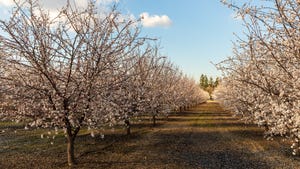
“With all the problems they had with pollination because of inclement weather, it will be interesting to see if those growers reach the levels of this year’s objective measurement report,” he says.

Although nut size is more variable than last year, when most of the nuts were large, Kelley is pleased with the quality of the almonds he’s seeing this season.

“It’s very good,” he says. “The smaller sizes are shelling out very nicely. We’re also seeing very light insect damage and some occasionally fairly large sizes, which surprises me in view of the heavier production.”

He attributes the low insect pressure and sometimes bigger nuts to this year’s favorable growing conditions.

He has received reports of growers currently getting about $2 per pound for Nonpareil, depending on size, this season. That compares to last August when new-crop Nonpareils were selling for about $2.20 per pound.

His big concern now is the increasing threat of rain as the harvest continues. “I think about that every day,” Kelley says. “There are only so many trucks to bring product into our plants.

“Conditions for shelling have been just perfect. If growers can bring in their almonds dry, it will make a huge difference in the final size of this year’s crop.”

Continuing Education Courses
This accredited CE course focuses on choosing the correct variety alfalfa based on a number of...
New Course
The 2,000-member Weed Science Society of America’s (WSSA) Herbicide Resistance Action...

The course details six of the primary diseases affecting citrus: Huanglongbing (Citrus...

Newsletter Signup