Field trials grade herbicides on weed control in alfalfa, wheat in low desert

May 23, 2008 8:18 AM, By Cary Blake
Farm Press Editorial Staff

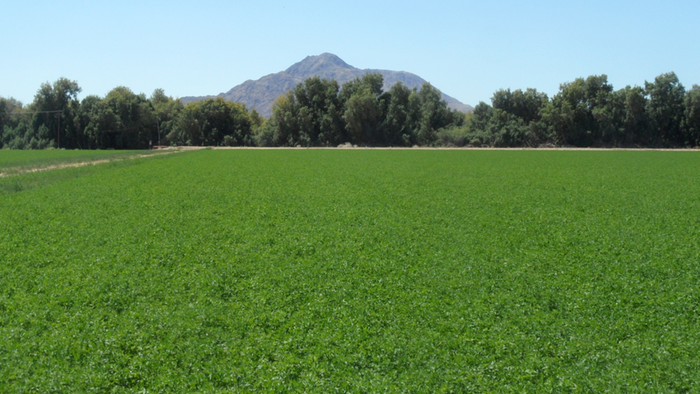
An impressive arsenal loaded with effective weapons is key to winning a war, and that’s exactly the artillery power that low desert alfalfa and wheat growers in California and Arizona have through a wide array of effective herbicides in the war against weeds.

“Growers have herbicides that will control almost any weed out there, annual or perennial,” said Barry Tickes, University of Arizona Cooperative Extension area agent in Yuma, La Paz, and Mohave counties in Arizona. “In most areas of the low desert, 20 herbicides are registered for use in alfalfa for weed control, and 15 herbicides for weeds in wheat.”

Tickes has conducted research on herbicide effectiveness on weeds for almost 30 years. Most recently he’s conducted 15 to 20 trials annually in California’s Imperial Valley and Riverside County, and Arizona’s Yuma and La Paz counties.

Tickes shared his latest findings at the Imperial County Alfalfa-Small Grains Field Day held in April at the Desert Research and Extension Center, El Centro, Calif.

Herbicides in alfalfa

Herbicide registration for weeds in alfalfa began following World War II with the first registered selective herbicide 2,4-DB. Herbicide registrations increased through the 1980s. Many newer products on the market contain older active ingredients that work fine in low desert alfalfa fields.

“We have so many herbicide tools for low desert-grown alfalfa and each has a place,” Tickes said. “The best weed management program is a diverse program with different modes of action and different chemistries.”

The following is comprised of “Tickes’ take” from his field trials:

•Roundup (glyphosate) – a good product that controls a broad spectrum of weeds. Roundup works only with Roundup Ready (RR) alfalfa that was registered in the low desert in 2005. Of the 80,000 acres of RR alfalfa already planted in California, little is grown in the Imperial Valley. An embargo currently exists nationwide prohibiting new RR alfalfa plantings.

“Growers like the opportunity to spray over the top of the crop and kill broad spectrum weeds,” Tickes said. “Roundup offers an easy way to control weeds. It takes a lot of the timing and guesswork out of weed control.”

Roundup doesn’t effectively control all weeds, Tickes said, including malva (cheeseweed) and annual bluegrass in low desert fields.

•Prowl H20 – an updated version of the original Prowl, is a water-based formulation which can be water run (dripped into irrigation water) which provides effective soil deposition and weed control.

“The concern over the H2O formulation is it’s difficult to water run the formulation,” Tickes said. “The product requires dilution and continuous agitation. Even so, Prowl H20 is a good herbicide.” Prowl was first used in alfalfa for seed in the low desert. A generic is available for Prowl, but not for Prowl H20.

•Velpar – field tested in a trial six years ago in Poston, Ariz., to test its effectiveness against groundsel. Excellent control was recorded with little damage to the alfalfa. The trial was followed by additional trials that yielded more positive findings which led to a Velpar registration in 2007 for low desert application.

“Velpar is an excellent herbicide for pre- and post-emergence and offers broad spectrum coverage,” Tickes said. “The herbicide should only be used during the winter months and on established alfalfa. The use of Velpar on seedling alfalfa or during the summer can kill the alfalfa.”

•AlfaMax Gold – a premix of Velpar and Diuron containing two active ingredients, diuron and hexazinone. The premix is registered in Arizona, but not California. Tickes tried Velpar and then Velpar with Diuron (AlfaMax Gold) in separate treatments. The Velpar alone worked well, but the premix (with the diuron) worked slightly better.

“AlfaMax can only be used on completely established alfalfa when the temperature is under 85 degrees F. Never use AlfaMax Gold on seedling alfalfa,” Tickes said.

•Sandea – offers excellent control of yellow and purple nutsedge and other broadleaf weeds. Note that the use of Sandea will cause injury for one and possibly two cuttings after application, Tickes said.

“Where I think Sandea has the best fit is nutsedge control in the late summer during the ‘summer slump’; alfalfa growth has slowed while nutsedge is rapidly growing,” Tickes said. “You’ll lose the least amount of forage and you’ll get the best control then.”

•Chateau – contains the new active ingredient flumioxazin and is strictly for pre-emergent control of tough broadleaf weeds like malva.

Chateau is a good product that definitely fits in the low desert. In 2006 an emergency exemption Sec. 18 registration was granted to control groundsel in alfalfa in Arizona’s La Paz County. Not much has been used commercially yet.

Other herbicide products evaluated by Tickes for weed control in alfalfa:

•Butoxone – use of adjuvant enhances activity but increases injury.

•Eptam – multiple applications are necessary due to losses with water. Doesn’t control established weeds from previous season.

•Balan – crop injury common when crop is stressed. Weeds can emerge through soil cracks.

•Karmex – use only on established crop during winter months.

•Gramoxone – contact activity only. Controls small weeds with good coverage.

•Sencor – use only on established crop during winter months after grazing or cutting.

•Kerb – will leach below germinating weed seed with water leaving sensitive weeds uncontrolled.

•Buctril – do not apply if temperature exceeds 70 degrees F. Contact activity will only control small weeds.

•Treflan TR10 – do not use for pre-plant. Breaks down where water stands. Tied up with organic matter.

•Poast – crop oil concentrate (COC) necessary except with Select Max where it is okay to use with non-ionic surfactant (NIS).

•Select/Prism – COC necessary except with Select max where it’s OK to use NIS.

•Pursuit – long soil activity to some crops. Use Raptor where soil residual needs to be minimized.

•Zorial/Solicam – long soil residual to some crops. Multiple applications needed to control perennial weeds.

•Raptor – better on lambsquarters and grasses than Pursuit. Reduced soil activity.

Herbicides in wheat

On the wheat side with weeds, more herbicides have been registered in the last decade than in the previous 50 years, Tickes said. The product 2,4-D, was registered after World War II for its original use as a plant growth regulator.

•MCPA and Banvel – Tickes linked these two herbicides together as broad spectrum, effective herbicides generally safe to the crop, yet have difficulty in low desert applications due to volatility. “Even on a calm day when it’s over 90 degrees, these products can lift off the plant and move to another field,” Tickes said. “Their utility has decreased over the last 10 to 15 years.”

•Buctril – registered as a contact herbicide for use on small weeds with good coverage. There’s probably more Buctril used in the low desert to control broadleaf weeds than any other broadleaf herbicide, he said.

•Aim/Shark – effective contact herbicide for small weeds with good coverage.

•Unity/Harmony – registered in Arizona in 2008, but hasn’t received a registration in California. “For the first time growers have a broad spectrum, systemic herbicide that doesn’t have volatility problems.”

•Achieve, Puma, Osprey – excellent herbicides for selectively killing winter and summer grasses in wheat. In years with late-planted wheat, the products effectively kill canarygrass and barnyard grass. No generic.

Other herbicide products evaluated by Tickes in wheat:

•2,4-D – drift hazard. Apply after tillering and before boot.

•Avenge – do not use on durum. Weak on canarygrass.

•Hoelon – narrow application window on some grasses. COC will improve control.

•Stinger – a growth regulator with soil residual activity. Follow plant-back restrictions for use.

•Starane – plant growth regulator. Avoid drift to sensitive crops.

•Discover – Wide application window. Registration expected in California and Arizona in 2009.

•Axial – Don’t use on durum. California only.

Tickes reiterated that the best herbicide management program across agriculture includes a variety of pre- and post-emergence products, not a single herbicide. “I encourage farmers to be diversified in their weed control program utilizing different chemistries and modes of action.”

email: cblake@farmpress.com

Get Copyright ClearanceWant to use this article? Click here for options!
© 2009 Penton Media, Inc.


Latest Jobs

resources

events icon events

product info icon tradeshows

tradeshow icon digests

research icon photos

Continuing Education

Accredited for California, Arizona and CCA hours:


(New Course)
Biopesticides -- Effective Use in Pest Management Programs

Biopesticides are increasingly being recommended as components of Integrated Pest Management (IPM) programs in the production of non-organic high-value specialty crops such as fruit, nut, vegetable, vine, ornamental and turf. This online, accredited course, sponsored by Marrone Bio Innovations, details some of the 245 registered biopesticide active ingredients used in a wide array pest management products.

Accredited in California and Arizona:


(New Course)
Agronomic Principles and Efficient Chemigation and Fertigation Using Center Pivot/Linear Sprinkler Systems

This online CE course details sound mechanical irrigation design and management practices to allow efficient chemigation and fertigation. It is accredited for Certified Crop Adviser CE units and is approved for credit hours in California and Arizona.


(New Course)
Pome, Stone Fruit Pest Management Using New Mode of Action Chemistry

New chemistry Rynaxypyr has proven effective against a wide range of economically important Lepidoptera species. Marketed under the trade name Altacor for use in grapes, pome and stone fruit, details on how to use this new chemistry are in this online Continuing Education course that is accredited in California, Pennsylvania, and New Jersey with CE applications pending in Oregon and Washington.


(New Course)
Vegetable Pest Management Using New Mode of Action

Integration of a new mode of action compound like Coragen into IPM and IRM programs to control Lepidoptera in leafy greens, fruiting vegetables, peppers and brassica or cole crops is always welcome. This online CE accredited details how best to use this new mode of action in intensive vegetable production. It is accredited in California, Arizona, Texas, Georgia, New Jersey and Pennsylvania. Application for credit is pending in Florida and Washington.

Accredited by Accredited in California and Washington:


(New Course)
Utilizing Calcium as Nutrient That Protects Against Disease Organisms

This online accredited course focus on Calcium, an important plant nutrient in fertilizer management for maximum, healthy plant development as well as disease and pest prevention. It is accredited in California, Georgia,: Pennsylvania and New Jersey. Credit pending in Florida, South Carolina, Tennessee, Virginia, West Virginia and Washington.


Accredited by California DPR and California and Arizona Certified Crop Advisers:


(New Course)

Nutrient Management in Key California Crops


This online CEU course offers a detailed look at the nutrient management in key California crops. It is sponsored online by Western Plant Health Association and funded by a grant from the California Department of Food and Agriculture Fertilizer Research and Education Program (FREP). It is accredited for one (1)-hour of credit by the California Department of Pesticide Regulation for California Pest Control Advisers (PCA), Private Applicators, Qualified Applicators and Aerial Applicators. The course is also accredited for 3 units in Nutrient Management (NM) for California and Arizona Certified Crop Advisers (CCAs).

Accredited in California, Arizona, Idaho, Oregon and Washington and for Certified Crop Advisers:


(New Course)
Organic/Sustainable Agricultural Production in the West

Organic/sustainable agriculture is expanding rapidly in the U.S. with an average annual increase of 20% during the last 15 years. This course covers a wide range of pests and organic control strategies. It is accredited for up to 4 continuing education hours for PCAs and Applicator Licensees in California, Arizona, Idaho, Oregon and Washington. It is also approved for Certified Crop Adviser credit.


ACCREDITED IN CALIFORNIA ONLY:


Almond Pest Management

Get the latest info on almond insect pest management and earn 2 hrs. CE DPR and CCA credit in California.

California Groundwater Protection Regulations

Earn 2 hrs. in California laws and regs CE and learn how to protect California groundwater supplies.


Disease Management in California Almonds

Managing diseases in California almond production is a year-long process. This course provides the latest information on controlling these diseases with management practices and fungicides. The course is approved for 2 CEUs by DPR for PCAs and all applicator categories and California CCAs.

Powdery Mildew Control in California Grapevines

Learn about the No. 1 grape disease in California; earn 2 California CE hours.

ACCREDITED IN CALIFORNIA AND ARIZONA:


The Role of Copper in Disease Control

Copper has long been a key tool in disease control in a many crops. This 2-CEU course accredited California PCAs and all DPR applicator categories and Arizona applicators details how best to use copper to maximize its potential.

Insecticide Resistance Management in Agronomic and Row Crops

A 3-hr. CE approved for California and Arizona licensees and CCAs in both states.

Agronomic Weed Resistance Management in Row Crops, Trees Nuts and Vines

Weeds Resistance Management is approved for 3 hours of CE credit for all California and Arizona licensees and Certified Crop Advisers.

Lepidopterous Pest Management/ Pesticide Safety

This course is approved for 2 hours in Arizona and California (1 hr. of laws/regs; 1 hour Other) and for CCAs.

ACCREDITED IN CALIFORNIA, ARIZONA, OREGON, AND WASHINGTON:

Managing Spray Drift to Minimize Problems

This online CEU on managing spray drift to minimize problems is accredited for 2-hours in California (Laws and Regs); Arizona, Oregon and Washington.

Back to Top

Browse Print Issues

Additional Resources

subscribe to Farm Press Daily Southeast Farm Press Southwest Farm Press Delta Farm Press