Time to stand up for water rights and the right to farm

Oct 10, 2008 10:13 AM, By Aaron Kiess
Executive Director, California Alfalfa and Forage Association

If you’ve never written or called your state legislators, it’s time to let them know you oppose the Pacific Institute’s “More With Less” report. CAFA and other organizations have been on the offensive since the report was released on Sept. 9. “More With Less” stands for more regulations, an erosion of water rights, less water, and less freedom to make crop selections. The report claims growers can grow more with less water and should shift to “high value” tree and vegetable crops.

The Institute wants courts and regulators to “apply California’s water-rights laws more rationally to ensure water is being used reasonably and beneficially.” Another recommendation: “Redesigning misguided federal and state subsidies that encourage wasteful use of water.”

The report (available at www.pacinst.org) is a blueprint for the Sacramento/San Joaquin Delta, but it should concern all regions in California. If implemented, it would set a dangerous precedent. CAFA’s letter below, sent to the California Department of Food & Agriculture, provides key points to use when writing or e-mailing state legislators.

The California Alfalfa & Forage Association, a statewide organization, is in agreement with the California Farm Bureau and other groups that oppose the Pacific Institute’s “More With Less” report released on Sept. 9. Alfalfa was falsely singled out by the Institute in May, and its report again demonstrates that it understands neither agriculture nor market dynamics. If implemented, their recommendations would disrupt markets, cause severe hardships and have a negative impact on the environment.

The report is flawed and overly simplistic. All field crops are lumped together and their value per acre is compared to tree crops and vegetables. The comparisons are meaningless since researchers didn’t evaluate each commodity separately, calculate return on investment, and assess market dynamics and environmental factors.

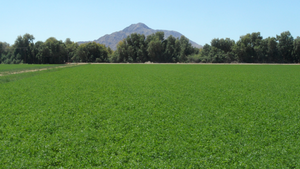
Furthermore, the report only looks at farm gate values. For instance, alfalfa’s farm gate value of more than $1 billion is only part of the picture. Alfalfa is an essential component of California’s dairy and beef cow industry, with combined farm gate values of more than $7 billion. There’s added value due to factors such as a canopy that prevents soil erosion, improved soil tilth, wildlife habitat, and the ability to manufacture nitrogen. Alfalfa is also a vital rotation crop for low-input sustainable agriculture.

The report’s “crop shift” recommendation is troublesome since soil types, drainage, equipment requirements, and other factors dictate crop selection. Alfalfa is mistakenly referred to as a water-wasting crop, yet a scientific analysis based on UC data demonstrates that water use efficiency rivals other commonly grown crops. A shift to other crops would create more hardship for California’s $4.2 billion dairy industry and for livestock producers. Though alfalfa is California’s largest acreage crop, demand far outstrips supply. Record high prices are impacting profitability for dairymen who rely on alfalfa for milk production and herd health.

California hay buyers are searching for alfalfa as far away as Montana and Wyoming. Transporting over long distances adds to higher fuel consumption and impacts the environment. The Institute’s report overlooked many other environmental factors such as: which crops have lower pesticide loads, prevent soil erosion, are less labor intensive, and are wildlife friendly.

– Any attempt to constrain crop selections and erode water rights and availability is a blow to the free market and to consumers. The Institute’s claim that growers are not using water efficiently is debunked by the statistic that food and fiber production has increased by 89 percent from 1967 to 2000, but applied water has increased by only 2 percent.

Get Copyright ClearanceWant to use this article? Click here for options!
© 2008 Penton Media, Inc.


Latest Jobs

resources

events icon events

product info icon tradeshows

tradeshow icon digests

research icon photos

Continuing Education

Accredited by California DPR and California and Arizona Certified Crop Advisers:


(New Course)

Nutrient Management in Key California Crops


This online CEU course offers a detailed look at the nutrient management in key California crops. It is sponsored online by Western Plant Health Association and funded by a grant from the California Department of Food and Agriculture Fertilizer Research and Protection Program (FREP). It is accredited for one (1)-hour of credit by the California Department of Pesticide Regulation for California Pest Control Advisers (PCA), Private Applicators, Qualified Applicators and Aerial Applicators. The course is also accredited for 3 units in Nutrient Management (NM) for California and Arizona Certified Crop Advisers (CCAs).

Accredited in California, Arizona, Idaho, Oregon and Washington and for Certified Crop Advisers:


(New Course)
Organic/Sustainable Agricultural Production in the West

Organic/sustainable agriculture is expanding rapidly in the U.S. with an average annual increase of 20% during the last 15 years. This course covers a wide range of pests and organic control strategies. It is accredited for up to 4 continuing education hours for PCAs and Applicator Licensees in California, Arizona, Idaho, Oregon and Washington. It is also approved for Certified Crop Adviser credit.

ACCREDITED IN OREGON AND WASHINGTON:


(New Course)
Managing Spray Drift to Minimize Problems

This online spray drift management course has been certified by the Oregon Department of Agriculture and the Washington Department of Agriculture for 2 hours of credit for licensed Applicators and Consultants in Oregon and Washington.

ACCREDITED IN CALIFORNIA ONLY:


Almond Pest Management

Get the latest info on almond insect pest management and earn 2 hrs. CE DPR and CCA credit in California.

California Groundwater Protection Regulations

Earn 2 hrs. in California laws and regs CE and learn how to protect California groundwater supplies.


Disease Management in California Almonds

Managing diseases in California almond production is a year-long process. This course provides the latest information on controlling these diseases with management practices and fungicides. The course is approved for 2 CEUs by DPR for PCAs and all applicator categories and California CCAs.

Powdery Mildew Control in California Grapevines

Learn about the No. 1 grape disease in California; earn 2 California CE hours.

ACCREDITED IN CALIFORNIA AND ARIZONA:


The Role of Copper in Disease Control

Copper has long been a key tool in disease control in a many crops. This 2-CEU course accredited California PCAs and all DPR applicator categories and Arizona applicators details how best to use copper to maximize its potential.

Insecticide Resistance Management in Agronomic and Row Crops

A 3-hr. CE approved for California and Arizona licensees and CCAs in both states.

Agronomic Weed Resistance Management in Row Crops, Trees Nuts and Vines

Weeds Resistance Management is approved for 3 hours of CE credit for all California and Arizona licensees and Certified Crop Advisers.

Lepidopterous Pest Management/ Pesticide Safety

This course is approved for 2 hours in Arizona and California (1 hr. of laws/regs; 1 hour Other) and for CCAs.

Managing Spray Drift to Minimize Problems

2-hrs laws and regs for California licensees; 2 hours in Arizona and for CCAs.

Back to Top

Browse Print Issues

Additional Resources

subscribe to Farm Press Daily Southeast Farm Press Southwest Farm Press Delta Farm Press