Roundup Ready alfalfa may go back on the market with regulatory nightmares

What is in this article?:

  • Roundup Ready alfalfa planting seed could be back on the U.S. market by the end of January.
  • USDA may attach more regulatory strings that would severly impact the West.
  • Alfalfa issue could have far-reaching precedent-setting implications for corn, soybeans, cotton and other biotech crops in the U.S. if USDA opts to put geographic restrictions on RR alfalfa.
  • U.S. farmers account for 48 percent of the world’s biotech crop plantings with 158 million acres.


More About:

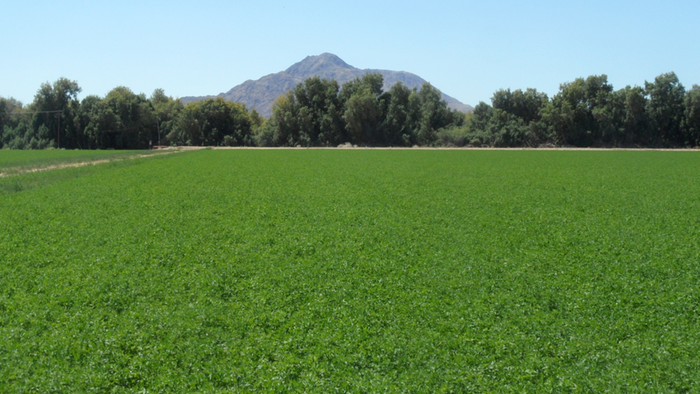
Roundup Ready alfalfa planting seed could be back on the U.S. market by the end of January as expected and in time for spring planting.

However, USDA may attach more regulatory strings to it than there is baling twine on three-wire bales stacked 10-feet high on a set of doubles.

Many were expecting USDA to deregulate planting of RR alfalfa when it announced the final and long-awaited Environmental Impact Statement ordered by the courts. However, Secretary of Agriculture Tom Vilsack put a knot in that notion when he said USDA may place draconian restrictions on where RR alfalfa seed and forage can be grown.

Those recommended restrictions would have a major impact on California, Arizona and other major Western forage and seed producing states (Idaho, Montana, Nevada, Oregon, Utah, Washington, and Wyoming).

For example, if USDA decides to go with a deregulated — yet regulated — scenario, RR alfalfa forage could not be grown in counties where RR alfalfa seed is produced.

Another part of the “deregulation with geographic restrictions and isolation distances” requires 5 miles between GT alfalfa seed production fields and conventional alfalfa. This is incalculably more than is now required for certified seed production.

The California Crop Improvement Association requires only 900 feet of isolation for foundation seed production and just 165 feet for certified seed fields and another variety of alfalfa.

California produces 9 percent of the nation’s alfalfa, harvesting more than 7 million tons annually. Imperial, Kern, Tulare, Merced, and Fresno are the leading alfalfa producing counties in the state.

85 percent of the 80 million pounds of alfalfa seed produced in U.S. each year comes from California, Idaho, Oregon, Washington and Nevada.

A look at the most recent statistics for Fresno and Imperial counties show just how dramatic those regulations would be. Both are among the largest alfalfa seed producing counties in the state. Together they produce about 30,000 acres of alfalfa seed annually. Collectively they also produce alfalfa hay from almost 200,000 acres of alfalfa forage annually.

Under the USDA geographic restrictions scenario, RR alfalfa seed production would be banned from those counties, representing a significant loss of income for farmers since RR alfalfa is expected to be in great demand when it goes back on the market. When RR alfalfa goes back on the market, demand for non-biotech alfalfa is expected to drop and that could also cost farmers in Fresno and Imperial counties millions in lost revenue.

Discuss this article 2

ONION HEADLINE: USDOA SAYS “KEEP BLACK AND WHITE COWS SEPARATE”

USDOA Secretary Tim Vilesack says you can't raise black cows in counties with registered Charolais (white cow breed) herds because even barbed wire is no match for a love-sick black bull. In recent public statements, Vilesack has said he does not want to have the fabric of rural America torn up over this and neighbors need to keep gene pools pure as well as coexist.

After issuing a 23,000 page report on how cows make love and the consequences of such activity, USDOA's Vilesack said one of the preferred options for allowing the peaceful coexistence of black and white cows is segregation. Vilesack is expected to say that black and white cows are equal in importance to US agriculture, but they must be kept separate and we need to do that voluntarily rather than having court-ordered segregation to protect the genetic purity of white cows, which make up less than two percent of the US herd.

Vilesack has called for a meeting of both black and white cow farmers to have a dialogue on the best way to resolve this by combining the best ideas from a diverse set of viewpoints.

In other USDOA News, the USDOA-ARSE has completed a study on how USDOA can use "humanure" made by composting the feces of its employees to fertilize the People's Organic Garden at the department of agriculture.

By Alana (not verified)  on Dec 18, 2010

This is exactly the opposite of what Obama said his administration was about. They promised science-based regulation and this is pure politics.

Vilsack is a failure. Kathleen Merrigan is calling the shots.

By Alana (not verified)  on Dec 19, 2010
Post new comment
Sign In or register to use your Western Farm Press ID
(optional)

Continuing Education Courses
New Course
The 2,000-member Weed Science Society of America’s (WSSA) Herbicide Resistance Action...
New Course

The course details six of the primary diseases affecting citrus: Huanglongbing (Citrus...

Get the latest info on almond insect pest management.
Farmer-to-Farmer Used Equipment