RR alfalfa gains quick acceptance

Mar 7, 2007 10:51 AM, By Harry Cline
Farm Press Editorial Staff

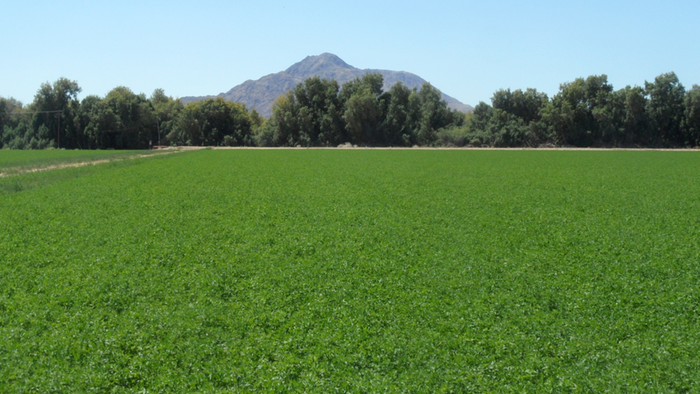
An estimated 20 percent of California’s 1.1 million acres of alfalfa is Roundup Ready varieties just 18 months after the first herbicide-resistant alfalfas were introduced.

Within four years, Bill Cox, Monsanto seed systems manager, expects it to be 90 percent.

For Tulare County, Calif., dairyman/farmer Tom Barcellos, the quicker he gets to 100 percent Roundup-resistant alfalfa the better.

No transgenic crop has experienced quicker acceptance than Roundup Ready alfalfa.

And the reason is simple; it is producing more high quality alfalfa with less production cost per acre and the promise of longer stand life.

Cox of Visalia, Calif., has been a seed salesman for 33 years and he has never seen farmers adopt anything quicker.

“Growers are telling me they are saving $40 to $50 per acre in herbicide costs over conventional varieties. The quality is better because it is weed free,” said Cox.

It’s also producing more because growers are not using harsh herbicides to control weeds. In a side by side comparison, Cox said a local grower produced a half ton more baled hay per acre off Roundup Ready alfalfa in his first four dairy-quality hay cuttings and received $10 more per ton for high TDN and protein.

Sounds almost too good to be true. However, for third-generation farmer-dairyman Tom Barcellos of Tipton, Calif., it is no hype.

“Six years of growing Roundup Ready corn and three years of Roundup Ready cotton convinced me the technology works,” said Barcellos, who operates an 800-cow dairy and a custom harvesting and hauling business as well as farms.

“Roundup Ready alfalfa yields more consistently and is a better crop than conventional alfalfa for basically one reason; we don’t have to knock the pants off of it with herbicides.

“We have been battling weeds in alfalfa in California for years because we really have not had the chemicals to take out things like bermudagrass and johnsongrass in alfalfa without hurting the alfalfa,” said Barcellos, who farms 1,800 acres and already has 25 percent of his alfalfa in herbicide-resistant varieties. Nutsedge is another major weed in alfalfa. Roundup will not kill it, but Barcellos said glyphosate will suppress it without damaging plants.

That is easily worth the $6 per pound he paid for Roundup Ready alfalfa seed vs. $2.50 for conventional seed.

People will tell you it is the traffic in harvesting an alfalfa field eight times a year in the central valley that is a major factor in reducing stand life. “What really takes alfalfa stands out in California after three years is chemical damage and weed pressure,” emphasized Barcellos.

Interseeding crops

Barcellos now puts in extra effort to leave a conventional alfalfa stand in for longer than the “normal” three years. He does it now with interseeding other crops.

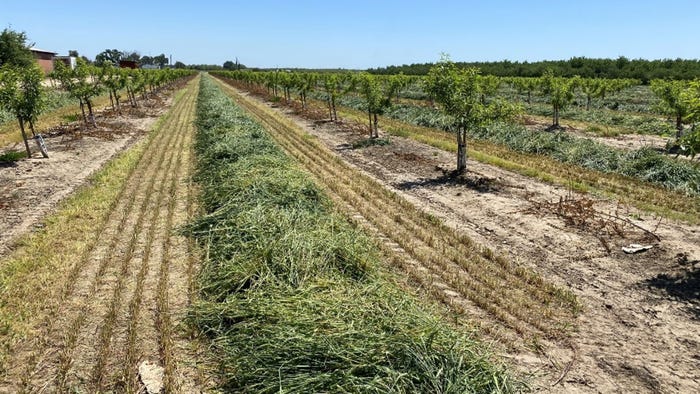
“What we do now is plant 25 pounds of oats per acre in a weakening third or fourth year conventional alfalfa stand. Just enough not to smother the alfalfa. The oats seem to rejuvenate the alfalfa. I can remember my grandfather doing this by chiseling the ground and planting oats. We do it no-till,” he said.

The oat/alfalfa mix is baled. “The oats are a huge factor in the dairy. When you feed dry cows oats as they are ready to freshen, you have less milk fever. Dairymen buy oats for that reason, but by mixing the oats with the alfalfa we don’t have to buy oats,” he said.

That fourth year stand of alfalfa is then swathed and baled for the remainder of the year. In the spring, the fifth year alfalfa stand is taken out, but not before Barcellos interplants Roundup Ready no-till corn.

“Of course I take the conventional alfalfa out with Roundup, but with Roundup Ready alfalfa I can no longer do that. However, I don’t see a problem. I’ll just use Shark to take out the alfalfa,” he explained.

With glyphosate-resistant alfalfa, he expects to alter his rotation. He expects the Roundup Ready alfalfa stand to be economically productive for at least four or five years.

“A lot of guys say they need to take alfalfa out after three years for rotation, even if it is a good stand. Why spend money to remove something that has productive life in it?” said Barcellos, who points out that alfalfa stands in the intermountain region of the West have been in for 15 years.

‘Leave alfalfa alone’

“Sure, they are cut only three times per year and do not have the compaction issues we do with eight cuttings, but still rotation is no reason to take a stand out. Just put wheat and corn in another field and leave the alfalfa alone.”

One of the big issues with glyphosate-resistant crops is herbicide resistance.

Barcellos and Cox do not believe that will be a major issue with this new biotech crop.

Both point out that alfalfa is cut on a 28-30-day schedule and that precludes weeds from going to seed. When it is bagged like Barcellos does with his first and last alfalfa cuttings, any resistant weeds are out of the field before they go to seed.

“There are weeds Roundup will not control. Six are because of resistance. There also are tough weeds to control, not weeds resistant to glyphosate. Monsanto has sold Roundup for 27 years and it has never controlled stinging nettle. It will not now. Put some Pursuit herbicide in the tank if you have stinging nettle,” said Cox.

As much as 44 ounces of Roundup per acre can be used at one time. The crop is labeled for 132 ounces of Roundup in a season. “If you find something is tough to control, increase the Roundup or use another herbicide in a tank mix,” he added.

Although Barcellos has been recognized for his no-till/minimum-till farming, he says all his fields eventually are tilled whether it is to knock down borders for another crop or just laser leveling. Tillage is another way to ward off resistance.

“If we have to chop when it is too wet and there is a compaction issue from the trucks, we will go in and chisel the ground.

“We also have enough variation in our rotation and use of herbicides on crops other than alfalfa that I don’t think we will have resistance problems as they do in the Midwest were they have only a few crops and no-till to conserve moisture and save fertilizer,” Barcellos said.

‘Can triple crop’

“Our land is too valuable to single crop. We can triple crop in a season here. For example, we can plant wheat in the fall and green chop it in the spring and get 18 tons off it. Follow that with no-till corn and get 30 to 34 tons of forage and finish up with no-till sorghum/Sudan and get 11 tons off the first chop and 7 off the second.

“You are talking about a potential of 60 tons to 75 tons of feed per acre per season,” he said.

Intense farming like that is one reason Barcellos sold his cotton picker at the post World Ag Expo farm equipment auction this year.

“Cotton no longer makes economic sense when you can produce that much feed for the dairy industry, whether it is for my own dairy or for sale. I just sold ’06 dry cow hay for $160 per ton. Dairy quality hay is selling for $215 per ton,” he said.

“Economics is also the reason I got out of the grape business and expanded the forages. I spent $1,200 per acre to produce a wine grape crop on 67 acres. When the crop was ready to harvest, it would have cost me more to harvest and haul the grapes than the winery would pay me. I pushed the vineyard out with the grapes still on the vines,” said Barcellos.

The Tulare County dairy industry is driving farming in the county. Barcellos says the same thing is happening with new dairies in Kern County and on the West side of Fresno County.

The insatiable demand for forages is the driving force behind Barcellos farming, and Roundup Ready alfalfa is helping him reduce costs and increase income in meeting that demand.

email: hcline@farmpress.com

Get Copyright ClearanceWant to use this article? Click here for options!
© 2008 Penton Media, Inc.


Latest Jobs

resources

events icon events

product info icon tradeshows

tradeshow icon digests

research icon photos

Continuing Education

Accredited by California DPR and California and Arizona Certified Crop Advisers:


(New Course)

Nutrient Management in Key California Crops


This online CEU course offers a detailed look at the nutrient management in key California crops. It is sponsored online by Western Plant Health Association and funded by a grant from the California Department of Food and Agriculture Fertilizer Research and Protection Program (FREP). It is accredited for one (1)-hour of credit by the California Department of Pesticide Regulation for California Pest Control Advisers (PCA), Private Applicators, Qualified Applicators and Aerial Applicators. The course is also accredited for 3 units in Nutrient Management (NM) for California and Arizona Certified Crop Advisers (CCAs).

Accredited in California, Arizona, Idaho, Oregon and Washington and for Certified Crop Advisers:


(New Course)
Organic/Sustainable Agricultural Production in the West

Organic/sustainable agriculture is expanding rapidly in the U.S. with an average annual increase of 20% during the last 15 years. This course covers a wide range of pests and organic control strategies. It is accredited for up to 4 continuing education hours for PCAs and Applicator Licensees in California, Arizona, Idaho, Oregon and Washington. It is also approved for Certified Crop Adviser credit.

ACCREDITED IN OREGON AND WASHINGTON:


(New Course)
Managing Spray Drift to Minimize Problems

This online spray drift management course has been certified by the Oregon Department of Agriculture and the Washington Department of Agriculture for 2 hours of credit for licensed Applicators and Consultants in Oregon and Washington.

ACCREDITED IN CALIFORNIA ONLY:


Almond Pest Management

Get the latest info on almond insect pest management and earn 2 hrs. CE DPR and CCA credit in California.

California Groundwater Protection Regulations

Earn 2 hrs. in California laws and regs CE and learn how to protect California groundwater supplies.


Disease Management in California Almonds

Managing diseases in California almond production is a year-long process. This course provides the latest information on controlling these diseases with management practices and fungicides. The course is approved for 2 CEUs by DPR for PCAs and all applicator categories and California CCAs.

Powdery Mildew Control in California Grapevines

Learn about the No. 1 grape disease in California; earn 2 California CE hours.

ACCREDITED IN CALIFORNIA AND ARIZONA:


The Role of Copper in Disease Control

Copper has long been a key tool in disease control in a many crops. This 2-CEU course accredited California PCAs and all DPR applicator categories and Arizona applicators details how best to use copper to maximize its potential.

Insecticide Resistance Management in Agronomic and Row Crops

A 3-hr. CE approved for California and Arizona licensees and CCAs in both states.

Agronomic Weed Resistance Management in Row Crops, Trees Nuts and Vines

Weeds Resistance Management is approved for 3 hours of CE credit for all California and Arizona licensees and Certified Crop Advisers.

Lepidopterous Pest Management/ Pesticide Safety

This course is approved for 2 hours in Arizona and California (1 hr. of laws/regs; 1 hour Other) and for CCAs.

Managing Spray Drift to Minimize Problems

2-hrs laws and regs for California licensees; 2 hours in Arizona and for CCAs.

Back to Top

Browse Print Issues

Additional Resources

subscribe to Farm Press Daily Southeast Farm Press Southwest Farm Press Delta Farm Press